I sometimes tease my former Foreign Service colleagues by saying my two best tours as an officer were the times I spent in the Pentagon. In truth, for a career diplomat, it was a bit like serving in a foreign culture. One of the things I learned early on during my time at the “five-sided puzzle palace” was that the job of the secretary of defense is well-nigh impossible. In fact, one of the very best studies of this understudied Cabinet position (at least in comparison to secretaries of state) by Charles Stevenson is titled SecDef: The Nearly Impossible Job of Secretary of Defense. Historians at the Office of the Secretary of Defense agree with Stevenson, noting that “the job of secretary of defense can be nearly impossible. Modern secretaries of defense preside over the nation’s largest bureaucracy; propose, defend, and manage budgets that exceed those of many mid-size countries; interact with Cabinet colleagues on policy matters that are often contentious; and answer to presidents with their own distinctive personalities and leadership styles.” It is clearly a daunting task.
The first SecDef for whom I worked, Dick Cheney, once told me: “Eric, there are 22,000 people in this building and at any given time at least 1 percent of them are] doing something really stupid that I will be blamed for tomorrow on the front page of the Washington Post.” Two decades later, while lunching with my former boss Secretary Robert Gates, he told me that he had (successfully) pushed for then-CIA chief Leon Panetta to be his successor in the Obama administration. “Leon,” he said, “has been a member of Congress, director of OMB, chief of staff in the White House in addition to being CIA director and is the best-prepared candidate for this job.” Then he caught himself. “Well, actually there is absolutely nothing that really prepares you for this,” he added.
Why is the role of secretary of defense so hard? Why have so many of its occupants seemingly failed or faded into obscurity? Who has performed well at the many tasks the job entails? And perhaps most importantly, what makes for a successful secretary? Given the incumbent’s manifest unfitness for the office, answering these questions seems particularly pertinent in our current moment.
There is no job description that comes with the role. According to Title 10 of the U.S. Code, the secretary is a civilian appointed by the president with the advice and consent of the Senate and is the principal assistant to the president for aiding in all matters relating to the Defense Department.
As noted above, the department is the largest bureaucracy in the United States government. When the position of secretary was established as part of the unification of the armed services under the National Security Act of 1947 in the wake of World War II, the role was not well defined, nor did the secretary have a large staff with which to deal with the already established bureaucracies of the military services. The first two secretaries, James Forrestal and Louis Johnson, struggled mightily with the enormous but inchoate responsibilities. Forrestal clashed repeatedly with President Harry Truman over cutting the defense budget; he may have met with Truman’s opponent in the 1948 election, New York Gov. Thomas Dewey, to stay on as secretary; and eventually he was forced out by Truman. Forrestal went into a deep depression and died after falling from a 16th-story window at Bethesda Medical Center in Maryland.
The early missteps of the initial group of defense secretaries underline the broad range of duties a defense secretary must balance.
Louis Johnson, unlike Forrestal, was an enthusiastic budget cutter, but his zeal for frugality led him to clash repeatedly with the military and when the Soviets tested a nuclear weapon and the Korean War broke out he fell afoul of the President’s political need to rearm the nation. Against a backdrop of rapidly increasing defense spending and criticism over Johnson’s management of readiness, Truman asked for his resignation. Johnson was also a difficult personality; Truman would later note that Johnson had managed to offend “every member of the cabinet.” He was replaced by Gen. George Marshall, whose health issues made his tenure perhaps the least distinguished part of his career in public service.
The early failures of the first several secretaries of defense highlight the multiplicity of roles that a defense secretary must fulfill. First, the secretary assists the president by imposing the latter’s agenda on the gargantuan national security bureaucracy, no small task. If one reads the excellent accounts of secretaries’ tenures prepared by the Historical Office in the Office of the Secretary of Defense (OSD), a theme that runs through the early volumes is the struggle of successive secretaries and their aides to build a staff that could contend with the pre-existing large military bureaucracies that were jealously protecting their own prerogatives. The span of responsibility and control is almost unimaginable, as a quick glance at the OSD organizational chart suggests. In addition, the SecDef presents to the president the views of military services and civilian subject matter experts during the administration’s internal national security decision-making processes on a broad range of issues. This policy responsibility is only one of the many tasks that requires deft management of civil-military relations.
The secretary, with the aid of the deputy secretary and comptroller, also manages an enormous defense budget (which may nonetheless still be insufficient to the scale of the challenge offered by Russia, China, North Korea and Iran’s tightening military collaboration).The budget now has crested at more than $1 trillion, and the spending is so vast that it has repeatedly failed efforts at an audit despite massive efforts to improve financial reporting. The budget, in turn, requires the secretary and his aides to allocate scarce resources among a variety of programs. It is composed of personnel costs as well as the procurement of weapons systems and ongoing costs of operations and maintenance.
The secretary is also a military diplomat, directing the management of a vast array of alliance and security assistance relationships with the military establishments of nations across the globe, including our NATO allies, our allies in the Indo-Pacific region, and an array of nations in the Middle East, the Western Hemisphere, and Africa. These responsibilities entail frequent travel to NATO ministerial meetings and summits in Europe as well as other international trips in the service of what is sometimes called “defense diplomacy”—an effort to understand the outlooks and perspectives of allied and other militaries.
Perhaps the gravest responsibility of the secretary is to advise the president on the potential use of military force around the globe to defend American interests when challenged by armed aggression or hostile actions. This requires the preparation of contingency plans by the combatant commanders—European Command, Pacific Command, Cyber Command, etc. This process is what scholar Eliot Cohen has so appropriately called “the unequal dialogue” between civilians and military commanders, in which civilians should subject the assumptions on which war plans are routinely built to relentless and careful scrutiny.
Finally, the position requires a range of presentational skills. The secretary must argue for enormous spending, explain inevitable mishaps, defend the use of force in various instances and, hopefully, articulate a vision of how and why the nation must prepare itself for potential future conflicts. And he must do all of this before Congress, which authorizes defense funding; to news media; and to American citizens.
If that job description seems like a lot and, perhaps, impossible for any single individual to fulfill, it might make sense that very few secretaries of defense have been regarded as successful, and that their average tenure is only about two years.
So what makes a secretary successful? Ingredients for success, despite Secretary Gates’ conclusion that there is no clear path of preparation for the post, seem to be a mix of relevant government experience, leadership style, and most of all the emotional intelligence to be able to develop productive relationships with White House and Cabinet peers, as well as uniformed military and key Congressional leaders.
Despite unquestioned intelligence, Robert McNamara and James Schlesinger ultimately failed at the job. McNamara’s failure, attributable to a complex set of factors, ultimately resulted from his background in business, which inclined him toward quantifiable measures of success rather than the more qualitative criteria that tend to rule in political life—hence, his serious misunderstanding and underestimation of our adversaries in the Vietnam War. Schlesinger, who may have been the best-prepared secretary of defense in history, was ultimately unable to establish a workable relationship with President Gerald Ford—who found him maddeningly condescending—or with his State Department counterpart, Henry Kissinger.
Dick Cheney came to the office arguably by accident—he reached the post only after support for Sen. John Tower’s nomination collapsed amid reports of excessive drinking and skirt chasing. Cheney’s tenure was marked by a vigorous, and necessary, assertion of civilian control of the military, such as when he chastised Air Force Chief of Staff Larry Welch for discussing arms control negotiations with a member of Congress and subsequently fired Welch’s successor, Gen. Michael Dugan, for discussing forthcoming military operations in the first Gulf War with members of the press. Cheney’s tenure was marked by the successful military operations in Panama that removed drug lord Manuel Noriega from office and the liberation of Kuwait from Saddam Hussein. Cheney developed a collaborative relationship with Chairman of the Joint Chiefs of Staff Colin Powell (in contrast to their subsequent relationship in the George W. Bush administration) that enabled him to interrogate and help shape what ultimately became the successful war plan to liberate Kuwait. But the failure of the Bush administration to secure reelection left Cheney unable to put a deep imprint on the Pentagon.
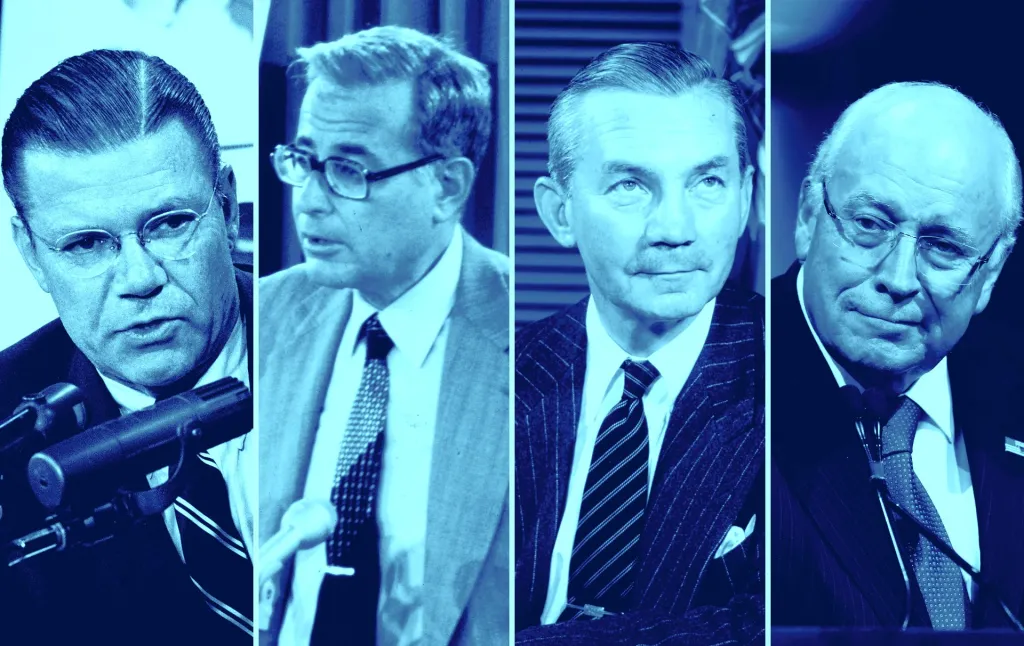
Mel Laird in Nixon’s first term, Harold Brown in the Carter administration, and Bob Gates in the George W. Bush and Obama administrations appear to have been relatively successful in meeting the exacting demands of the SecDef job. Laird resolutely focused on extracting the U.S. military from the war in Vietnam. Brown zeroed in on offsetting Soviet conventional force advantages and overhauling U.S. nuclear strategy. Gates held senior officers to account, repaired alliance relationships, and implemented the surge in Iraq in the aftermath of the tumultuous tenure of his predecessor Donald Rumsfeld, whose clashes with military officers resulted in a so-called “revolt of the Generals” in 2006. What all of these successful SecDefs had in common was exceptional intellect combined with serious previous experience in government and in other executive positions: Laird as a longtime member of Congress and senior member of the House Armed Services Committee; Brown as a nuclear physicist and secretary of the Air Force as well as president of the California Institute of Technology; and Gates as a Ph.D. in Russian History, CIA director, deputy national security adviser, and president of Texas A&M University. Gates and Laird were bureaucratic black belts (Henry Kissinger, for example, expressed his “high regard for Laird” as a bureaucratic rival), but both, along with Brown, developed extremely good collaborative relationships with their uniformed colleagues and were respected in the White House.
Pete Hegseth, for his part, has failed on virtually every dimension of the secretary’s job.
The most recent Secretaries of Defense, Lloyd Austin and Pete Hegseth, are a study in contrasts. The former was chosen by Joe Biden largely because the president believed he was unlikely to push back against his preferred policies, including the ill-starred withdrawal from Afghanistan. That largely turned out to be the case, leading to a catastrophic and chaotic end to the war. Still, to his credit, Austin resisted pressures to adopt a “no first use” policy for nuclear weapons (which would have undermined the basis of U.S. extended deterrence for its European and Asian treaty allies), empowered the civilian policy staff in OSD (despite fears that his recent retirement from military service would lead him to lean, excessively, on his uniformed colleagues). He also rallied European allies to provide defense support for Ukraine after the Russian invasion albeit slowly and grudgingly with regard to the transfer of some weapons systems.
Pete Hegseth, for his part, has failed on virtually every dimension of the secretary’s job. He has fired, without cause or explanation, a broad swath of senior military officers. He has blocked promotions for others (disproportionately women and people of color). His stewardship of the current war in Iran suggests that he failed to sufficiently question the assumptions underpinning warplanning and/or to make the president aware of the risks he was running by launching military operations. The campaign that he launched against alleged drug runners in the Caribbean and eastern Pacific has raised questions about whether or not he has issued orders that violate the law of armed conflict. His relations with Congress have been terrible and imperiled the administration’s efforts at securing funding, including funds to compensate the Pentagon for the unbudgeted costs of the war with Iran now running close to $50 billion. His juvenile posturing and macho preening are the stuff of internet memes.
It is not at all clear how long the tenure of the current incumbent in the secretary’s office will be. But given the history of the office, it seems likely that he will be replaced sometime in the next two years, either by the current administration or its successor. As the relevant officeholders consider potential replacements, they would do well to consider the vast range of responsibilities, the difficult relationships that must be mastered, and the public presentation requirements of the position. If they want to set up the next secretary for success, they will want someone, a man or woman, with the requisite mix of experience, the emotional intelligence, and temperament to succeed in Washington’s “virtually impossible job.”