
Decades ago, choosing to live abroad as an expatriate carried a certain unease. Abandoning one’s roots and extended family of origin willingly was not simple, nor was it a path many people chose. Figures such as Henry James (to England), James Baldwin, Josephine Baker, Ernest Hemingway, Gertrude Stein (all to Paris), Tina Turner (to Switzerland), and John Huston (to Ireland) did not undertake the move casually.
Although the motives behind their departures varied—escaping homophobia, racism, or taxes, and/or being drawn to adventure or old-world glamour—their relocations required severing ties with the familiar, in terms of both time and space. If you’d relocated to Paris before the advent of inexpensive, reliable international phone service, you had to accept corresponding communication by letter, and until the 1950s, a return trip “home” meant a transatlantic voyage lasting five to seven days by ship. And despite its sophistication, Paris would have been an unfamiliar world, not only linguistically and culturally, but in everyday routines as well; what you were accustomed to eating or drinking in Chicago or Boston would seldom be available in Paris.
But a new pattern is emerging. There is substantial evidence of a wave of expatriatism that suggests living abroad may be far easier today than it once was. Leaving one’s homeland no longer entails a total severing of connections; you can be in Torino, Italy at 4 p.m. local time and join a Zoom meeting with colleagues in New York at 10 a.m. their time. The notions of “home” and personal identity are becoming portable.
In March 2026, The Economist noted that “Westerners are fleeing their countries in record numbers.” The Wall Street Journal reported that 2025 set a new high for Americans relocating abroad. Moreover, many more are contemplating such a move. A 2025 Harris poll found that 42 percent of Americans are considering or planning to live overseas.
Additionally, regular pieces in mainstream media about “what it’s like to live in …” feed the curiosity of those weighing the option. For practical guidance, there are countless online resources offering advice on expatriate life and/or rankings of countries where this is more or less feasible.
Law firms have sprung up to assist aspiring expats with obtaining residency abroad and navigating intricate tax questions. According to CNN, there is now a “global rush for second passports.” Crucially, it isn’t solely the elites, the wealthy, or the cosmopolitan that are driving the movement. In November, the Wall Street Journal highlighted an investment firm fielding calls from teachers, engineers, small-business owners, and others who believe their money goes further overseas. These new expatriates will swell the estimated 5.5 million Americans already living abroad (a figure likely an undercount, as expatriatism now takes many forms, including so‑called partial expats—e.g., eight months abroad, four months in the U.S.—and numerous individuals who relocate abroad without easy traceability). Where are Americans relocating to now? In addition to traditional destinations like Mexico, Canada, and the United Kingdom, there is movement toward New Zealand and a few European locales that would have seemed unlikely not long ago, such as Slovenia and Albania.
If this represents a substantial shift from a fringe phenomenon toward something more common—perhaps even approaching a mass movement—there are reasons that make sense. Today, advancements in communication technology, global commerce, and modern transportation have minimized many of the unsettling aspects of expatriatism. In former times, leaving your country of origin meant uprooting yourself in a very literal sense: you’d need a new job and, often, to learn another language. Now, you can uproot while remaining anchored to your original home through the internet, allowing you to retain your job and stay connected with the places you know. The globalization of consumer goods has made the unfamiliar feel almost disturbingly familiar (you can find M&M’s everywhere, and peanut butter is available in rural France).
Perhaps the most notable difference between today’s expats and those of the past is that the current wave largely consists of ordinary people. The earlier expatriates tended to be exceptional—a cohort with the courage to uproot themselves and a penchant for adventure. Today’s expats still carry some of those traits, but for many, moving abroad—whether permanently or for a few years—is more a matter of imagination than of character. Americans have always been a mobile people, and the post-World War II rise of the middle class increased this mobility (last year alone, roughly 15 million Americans relocated within the United States).
There are many motivations behind today’s expatriation. For a sizable group, the rising cost of living in the United States is a deciding factor. Others are prompted by triggers such as alarming gun violence in their neighborhoods or political shifts like the second term of Donald Trump. Yet for others, the impetus is simply knowing someone who has done it, or perhaps a news story.
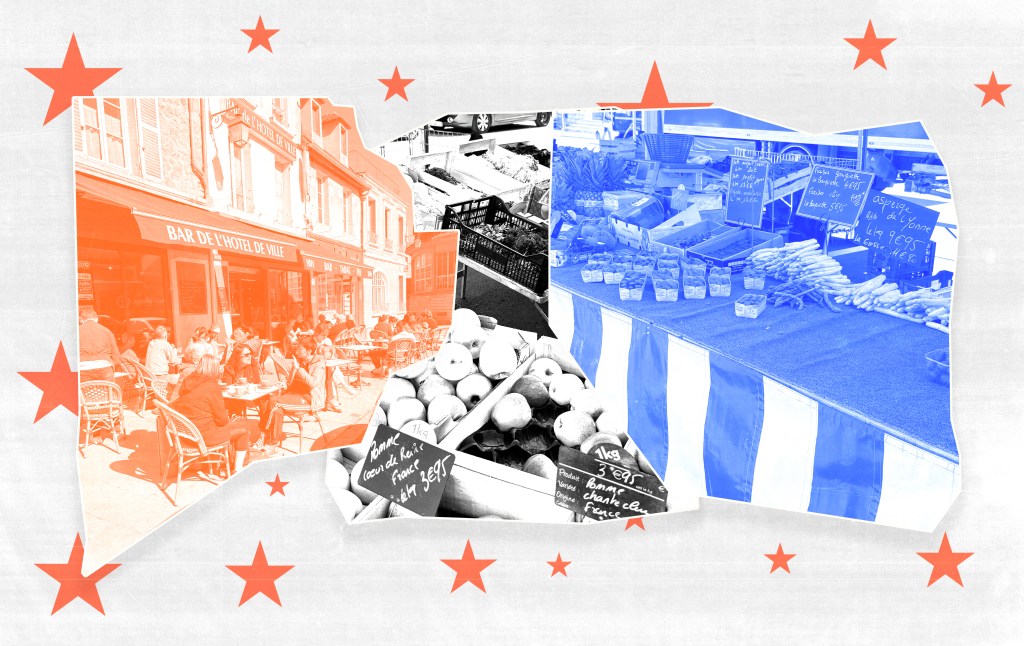
The tiny town in rural France where I spend six months of the year serves as a microcosm of contemporary expatriatism. A decade ago, the area housed few foreign residents. Likely due to the COVID era that normalized remote work, and perhaps due to a cascading spread of information, a subtle invasion has unfolded over the last six or seven years. Now, every Thursday morning between 8:30 and noon, anyone wanting to speak English can drop by the main café in the town center, home to 6,500 people in northern Burgundy. The group ranges from five to twenty-five participants, gathered at a long table (outdoors in good weather, indoors when it’s chilly). In addition to a handful of French regulars—retired physics teachers, veterinarians, farmers, local shopkeepers, and a Chicago-born bartender who wants to keep her English—the core membership comprises newly arrived expats: a Russian political refugee, a Dutch octogenarian who spends part of the year in the area, a dozen Britons, around six Americans, a New Zealander, and an Australian.
The Brits remain basically British; the Americans, American; the Aussie is still an Aussie; all with a sprinkling of France thrown in.
Our stories vary considerably. A farming couple from northern England found their surroundings crowded and costly, so they moved. A semi-retired British scientist married an artist from New Zealand and bought a home with a garden in town five years ago, seeking a place that wasn’t overwhelmed by expats or tourists. The Australian, a former foreign service officer, has long cherished living abroad, and he and his partner moved here partly due to housing costs (they purchased a grand mansion with an enclosed garden in the town’s center for about a fifth of what a comparable property would cost in Australia). For a divorced American woman from Idaho who spoke no French upon arrival, it signified a fresh start and adventure; she rents a town apartment for around $450 per month. A couple in their late fifties maintain homes in Arizona and this town, splitting their year between the two places while working remotely. Two retired doctors from the U.K. do the same. A Wyoming woman and a French pilot share their time between New Zealand and France. Finally, there’s a Scotsman who left Edinburgh 35 years ago, moved to Alexandria, Egypt to work as a translator, and later met an American woman living in France; they now split their year roughly two-thirds in France and the rest in Egypt.
None of these individuals is wealthy by any standard. In this part of France, rents are modest, with a 250-year-old stone house ranging from about $100,000 to $250,000. Property taxes are low, healthcare costs and prescription drugs are affordable, and high-speed fiber internet costs roughly $40 a month. A meal at one of the town’s fifteen restaurants runs about $35 to $55 per person, including tax and tip.
What topics dominate Thursday mornings? The weather, family matters, the annoyances of getting a plumber to show up, and so forth. Language is a frequent topic, too. We are all at various proficiency levels—some French attendees speak fluent English, some Anglophones speak fluent French—so we discuss the many ways to express things and speculate about the cultural nuances behind them.
So, what do we share? Part of our common identity lies in language and the fact that we are expatriates. Beyond that, we carry a portable identity: the Brits remain essentially British; the Americans, American; the Aussie, an Aussie; all with a dash of France sprinkled in. Absent the fact of living abroad, we are, in essence, unremarkable.
In short, we have discovered that our identities can be created, and as such they can also be portable.
What’s new compared with past expatriatism is the effortless portability of identity, along with the capacity to fashion a fresh sense of familiarity. The principal enabler of this newly fluid state is, unsurprisingly, modern technology. Crossing the Atlantic in six to eight hours, coupled with ubiquitous high-speed internet, enables an expat to stay connected with family and friends. You can even peruse your hometown newspaper online each morning. Even as you have physically moved, you can mentally remain where you started, whenever you choose. The growing adoption of VPNs vividly illustrates this technological marvel—press a button and the internet believes you’re in France; press it again and you’re back in the United States. Portability, in effect.
Yet perhaps equally significant is a shift in how we conceive home and our awareness of identity.
In The Homeless Mind, sociologists Peter Berger, Brigitte Berger, and Hansfried Kellner suggest that a world dominated by technology and urbanization has fostered a “componential” self, such that our sense of self is something we construct—we inhabit a “plurality” of worlds:
In earlier societies … the individual was always in the same “world.” Unless he physically left his own society, he rarely, if ever, would have the feeling that a particular social situation took him out of this common life-world. The typical situation of individuals in a modern society is very different. Different sectors of their everyday life relate them to vastly different and often severely discrepant worlds of meaning and experience. Modern life is typically segmented to a very high degree, and it is important to understand that this segmentation…has important manifestations on the level of consciousness.
Put differently, because many of us no longer enjoy a solid, shared life-world—that once came from living one’s entire existence within a relatively closed, clan-like setting—we have learned to build one anew in order to lead a meaningful life. We have discovered that our identities can be constructed, and thus can be portable. When relocating, we create fresh circles of familiarity, forge new friendships, establish routines, settle into the home we’ve moved into, and soon have a rebuilt “life-world.”
Being an expat today isn’t for everyone, but it’s vastly more feasible than ever before and, in many respects, easier than it even appears. What does this imply for the future? In the near term, not a great deal, since it seems we are currently in a temporary retreat from globalism, and most Americans still prefer to remain in the country they call home. Yet the growing cohort who choose to leave their homeland cannot be dismissed as mere discontent or a thirst for adventure. Especially since their identity now travels with them in a portable fashion, they become, often without realizing it, informal ambassadors. Just as the small expat circle in my French town debates the nuances of English and French, and our different cultures, this blending of language and culture will inevitably render American expatriates a touch less American and our French interlocutors a touch less French; a reflective mirror of our own history as a melting pot. Consequently, expatriatism may prove to be just another arrow in the broader, long-term, worldwide multicultural trend.