
Not long ago I joined a podcast to discuss contemporary parenting with a group of American moms. During the discussion, I remarked on how liberating it feels as a parent to grant your children more freedom. I explained that, from a very young age, I have allowed my children to run errands or grab small treats for themselves from the corner shop near our home in the United Kingdom—a practice that not only fosters their confidence but also lightens my workload.
In response, one of the hosts mentioned that she has begun letting her 10-year-old do the same. Then she added a detail that took me by surprise: to reach the store in question, her son must cross an intersection where people not only blow through the stop sign, but frequently perform donuts.
I am someone who lives out my stance against a culture of safetyism. The degree of freedom I grant my 7- and 8-year-olds—to go not only to the corner shop, but to the park or essentially anywhere else in our urban neighborhood—pushes right up against what is socially acceptable in our area. My husband or I accompany them to school every day, and if we were still in the United Kingdom, we would let them make the trip on their own as soon as the school allowed it. Yet we aren’t staying here. This summer, after nearly seven years abroad, we’ll be returning to the United States. And the podcast host’s remarks reinforced my growing instinct that the free-range parenting style I’ve embraced here will likely not survive the move—not because I’ll lose nerve across the Atlantic, but because the American environment simply won’t accommodate it.
There is a substantial discourse about the overly protective mode of parenting that has come to dominate in America. Often, it’s assumed that helicopter parenting reflects irrational fears—a cultural paranoia driven by media exaggerations about stranger danger and with little basis in real risk. I think there is some evidence supporting this viewpoint. Various surveys have found, for instance, that a disturbingly large share of American parents believe a child should not be left home alone until well into their teens. It’s hard for me to imagine a home environment so dangerous that a 10-year-old couldn’t handle a couple of hours on their own.
But what about the public environment? Surely we can agree that the degree of freedom granted to children should reflect the terrain they are expected to navigate—it’s more prudent, for example, to hold a 3-year-old’s hand on a crowded subway platform than on a beach or in an open field. And the terrain—social and physical—in large swaths of American society differs markedly from the United Kingdom, in ways that inevitably pushes the timeline of children’s independence back.
The corner shop question—what age is appropriate for a child to go there alone?—offers a concrete way of illustrating my point. For my second child, whose urge for independence appeared quite early, the answer was five and a half. It wasn’t my idea. On a summer day, after failing to persuade her older sister to accompany her, she asked if she could head to the store by herself to buy some Skittles. I felt a twinge of conflict, but ultimately allowed it. I handed her some pocket change and waited outside until she returned about ten minutes later, bursting with joy at having accomplished her feat.
Before we moved to England, I lived in a Madison, Wisconsin suburb, a midsized city that, by American standards, is comparatively walkable and safe. Had I still resided there when my 5-year-old daughter asked to run her errand, I would have certainly said no. In fact, I doubt she would have asked.
The English status quo seems, on the whole, easier for kids to navigate.
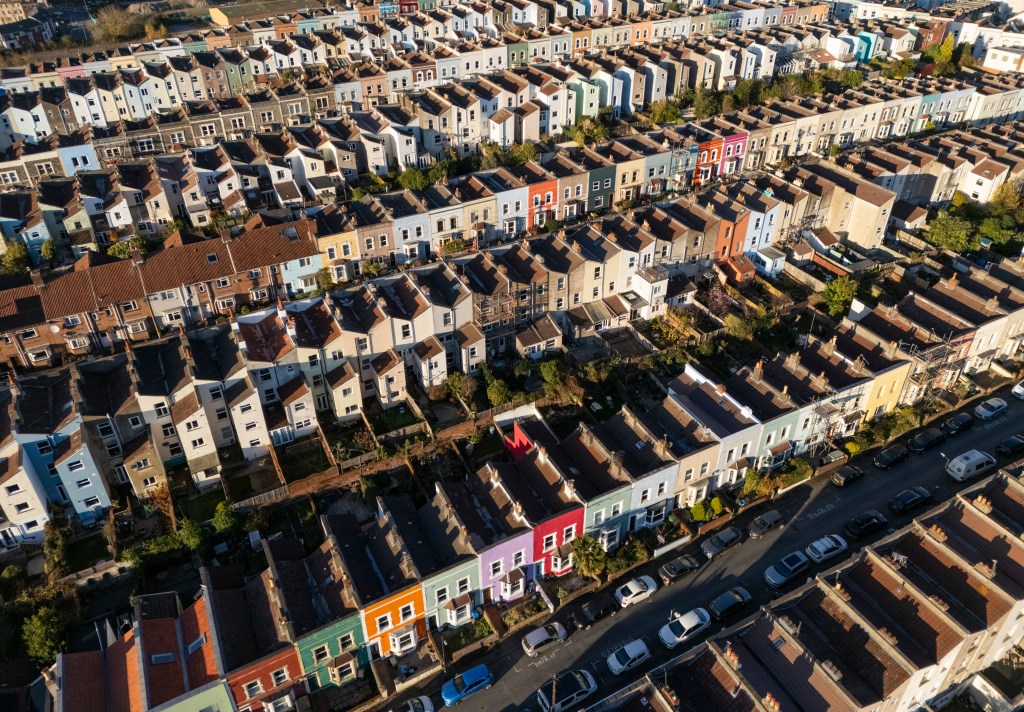
Here, the corner store is nearby—a six-minute round-trip walk by Google Maps. Getting there doesn’t require my daughter to cross any streets beyond the one in front of our house. The streets she must traverse are narrow, two-way avenues where exceeding 20 mph is difficult because drivers constantly yield to oncoming traffic. In Madison, by contrast, the closest “corner store” was a gas station that demanded a 26-minute round-trip across a much wider road where drivers frequently sped past the 30 mph limit and finished in a parking lot larger than the store itself. These are fundamentally different journeys, demanding different levels of maturity.
My point might seem selectively chosen and overly particular, but the differing patterns of urban design they reveal have broader implications. It is a fact that, on average, the physical distance between a child’s home and the places they might visit is greater in America than in England or other European nations. The mixed-use development necessary for a corner shop to exist is illegal in many American neighborhoods. The row houses that enable density in English cities often are, too. Minimum lot sizes and parking requirements have the effect of spreading everything out. This is not to say English housing policy is flawless. Far from it: that nation, too, grapples with a housing crisis. Yet, on the whole, the English status quo appears easier for kids to navigate.
This observation becomes even clearer when you compare how English and American children get to school. People often point to the collapse in the share of American children walking or biking to school—from over 40 percent in 1969 to under 11 percent today—as evidence of waning independence. But while the United Kingdom is certainly no free-range utopia, nearly half (46 percent) of children in England get to school on foot or by bike, a figure that has remained relatively steady over the past few decades. It is probably no coincidence that, on average, English children live much closer to school than American children do (2.5 miles vs. 4.4 miles, respectively). To put a finer point on it, more than four in five American kids live 3 miles or more from their school—a distance that vanishingly few British kids walk. We can debate the appropriate age for traversing such distances, but suggesting that distance should be ignored would be imprudent. All else equal, the farther a shop or school or park lies from a child’s home, the older that child generally must be to make the trip alone.
And of course, all is not equal. Consider the chilling example of Mary Fong Lau, the 78-year-old woman who killed a family after crashing into a San Francisco bus shelter at 70 mph. The case rightly provoked outrage over the ease with which she avoided jail after causing such harm—Lau faced no prison time. But for me, the more striking fact was that such speed could be attained in an urban environment in the first place. This underscores a pervasive problem in America: streets enable recklessness. Don’t misunderstand me: there is ample room for improvement in making English streets safer for non-motorists. But, generally speaking, I don’t have to worry about elderly drivers hitting highway speeds in residential areas, nor about teenage boys doing donuts on streets near my current home. Not merely because such behavior is illegal (though that’s true), but because the physical design makes it extremely difficult to accomplish. A British mom acquaintance recently told me, “The U.S. makes driving very pleasant and the U.K. makes it highly unpleasant and stressful.” That’s precisely the idea: the built environment here makes driving a more anxiety-filled experience—but ultimately safer for everyone.
Reckless driving is just one facet of a broader trend that hinders children’s independence: public disorder. This is a broad and fuzzy category of behaviors ranging from relatively minor acts—littering, or leaving dog waste on the sidewalk—to more serious problems like public urination, open drug use, or brawling. Such social disarray exists to varying degrees in every country in the world, and the United Kingdom is certainly no exception. But as others have noted, America’s public disorder problem appears more widespread and acute than in our peer countries. Dispatch contributing writer Charles Fain Lehman has argued that disorder has risen in America since the pandemic, but I would argue that it was elevated even before COVID began to spread. While living in Madison, I grew accustomed, as many Americans do, to sharing buses with people who were intoxicated or simply not fully tethered to reality. The tendency for welcoming public spaces to become hotbeds for vandalism, substance abuse, and violence made such spaces a liability to the city.
Now that I’ve resided in Bristol, a city of half a million people, for almost seven years, I still recognize its flaws. But the buses here generally do not serve as roaming shelters. There are certainly pockets where you encounter unstable individuals, but they are rarer and more concentrated. If my intuition—or Britain’s markedly lower rate of drug-overdose deaths—can be trusted, the troubled people you encounter are far less likely to be using serious drugs near me.
Pinning down a single cause for this discrepancy is difficult. Homelessness is higher in the United Kingdom than in the United States, yet street sleeping is lower there. Broadly speaking, British law also allows authorities to take a more proactive stance on public disorder, granting them broader civil powers to, for example, ban someone from a specific area. And the threshold for involuntary commitment is somewhat lower in the United Kingdom than in the United States; it considers not only the threat of imminent danger to oneself or others but also the individual’s health. But I suspect that what separates the U.S. from many other nations is not merely a slower removal of disorderly individuals, but that there are more disorderly people to begin with. Just as street design fosters recklessness, a combination of lax laws, individualistic ideals, and easy access to drugs or weapons might be cultivating a more disorderly populace.
Children can move freely only when adults commit to upholding the social contract. Public disorder is a visible indication of widespread refusal to do so.
The risk of being harmed by an unstable person is small. Still, safety isn’t the sole consideration. Being approached by a disoriented stranger is a disconcerting experience. Even in my twenties, I didn’t always know how to respond. Do I look away or might that irritate them? Should I get off at my usual stop or wait for one where there’s more likely to be a crowd? One reason it feels easier to envision letting my children use public transportation on their own here is that, for the most part, these are questions they won’t have to face.
The deeper issue, though, is that children’s independence has never truly been independent. It has always depended on the willingness of adults nearby to look out for the children and tailor their conduct accordingly. That might mean watching their step or their language, offering guidance or even a firm word when needed. It is this social infrastructure that enables children in places like Japan to roam. In other words, children can move freely only when adults uphold the social contract. Public disorder is a visible sign of widespread refusal to do so. As Chris Arnade writes in his recent essay on America’s public disorder problem, “there is a fine line between vibrant streets and squalid ones, and that line is public trust.” And, as he adds: “The U.S. is on the wrong side of it.”
I cannot definitively pinpoint the root cause of America’s public disorder. But any disorder makes the public realm more challenging for children to navigate. I have no plans to abandon my commitment to granting my children age-appropriate independence when we return to the United States later this year. Yet I have come to accept that “age-appropriate independence” will look quite different there than it does here.