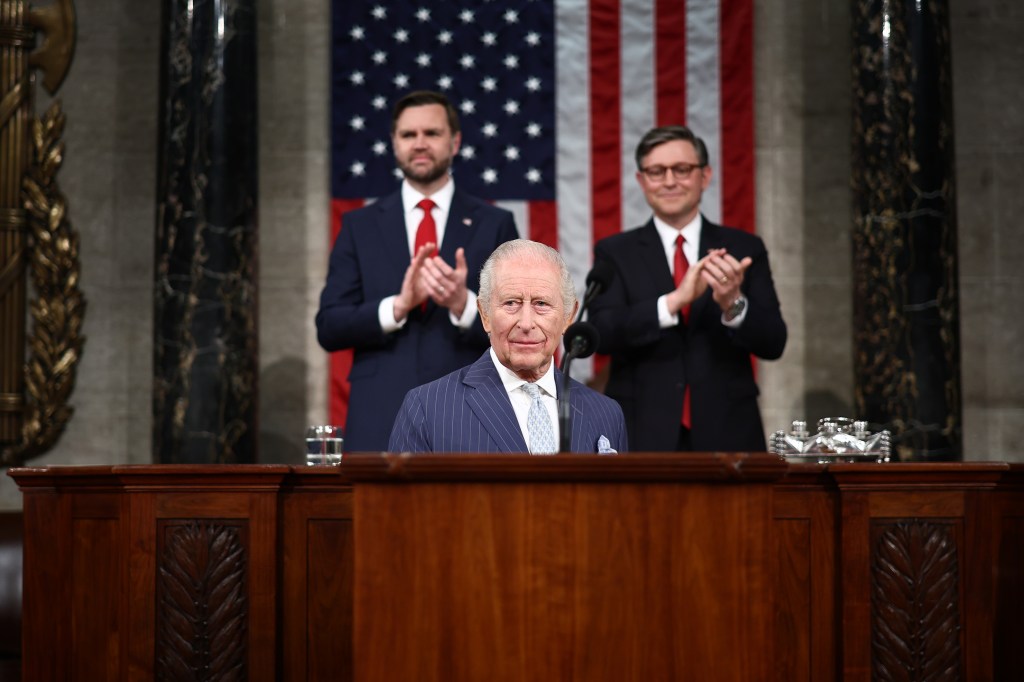
When King Charles III addressed a joint session of Congress on Tuesday, he reassured lawmakers from both parties that he was not arriving as part of some cunning rearguard maneuver to restore his former colonies to the British crown.
Although undoing the effects of the American Revolution 250 years ago wasn’t his aim, mending the frayed ties between the United States and Great Britain plainly was.
President Donald Trump has repeatedly strained the partnership between the two nations, ranging from new tariffs on Britain to faulting Prime Minister Keir Starmer for what he sees as insufficient backing in the war against Iran and allegedly urging him to increase defense spending. With those rifts as the backdrop, the king urged Congress not to abandon the alliance that has endured for centuries.
“The story of the United Kingdom and the United States is at its heart a story of reconciliation, renewal, and remarkable partnership,” Charles said. “From the bitter divisions of 250 years ago, we forged a friendship that has grown into one of the most consequential alliances in human history. I pray with all my heart that our alliance will continue to defend our shared values with our partners in Europe and the Commonwealth and across the world—and that we ignore the clarion calls to become ever more inward-looking.”
The king received multiple standing ovations during his address. One of the largest was after his reference to the Magna Carta, the “Great Charter” of 1215 that saw English nobles assert their influence to rein in the power of King John, which Charles said has been cited by the U.S. Supreme Court as “the foundation of the principle that executive power is subject to checks and balances.”
Although the president clearly enjoys his interactions with the British royals, Trump’s bombastic style of politics is a major reason why the alliance—not just with the U.K. but with NATO more broadly—is frayed today. Still, diplomats from the two countries also need to contend with two conflicting views of Britain inherent in American culture. They must balance the legacy of the disagreements the countries have had throughout their history with the fact that many of America’s core institutions have British roots.
This is far from the first time that relations between the two countries have been awkward. After all, American colonists did fight, bleed, and die for independence from Charles’ great-great-great-great-great-grandfather 250 years ago. Thomas Paine at the time captured the attitude of many colonists towards imperial rule in his 1776 essay “Common Sense,” castigating not just King George III, but the very idea of monarchy.
Government by kings was first introduced into the world by the Heathens, from whom the children of Israel copied the custom. It was the most prosperous invention the Devil ever set on foot for the promotion of idolatry. The Heathens paid divine honours to their deceased kings, and the Christian World hath improved on the plan by doing the same to their living ones. How impious is the title of sacred Majesty applied to a worm, who in the midst of his splendor is crumbling into dust!
Our country today inherits such anti-monarchical views. Many Americans take the spirit of 1776 to mean holding little to no reverence for royalty, and they have representation in Congress. Republican Rep. Tim Burchett, who serves a district in Eastern Tennessee, often walks around the Capitol grounds in the winter wearing a Carhartt jacket over his suit. He is a car guy, and he told The Dispatch that if he had the opportunity to talk to King Charles, he would discuss the monarch’s Aston Martin convertible rather than political issues. “I don’t really care [about] his thoughts on anything. Like, I don’t like the fact that you can’t shake his hand,” Burchett said. (Though it is not binding, royal protocol dictates that one should wait to shake the hand of the sovereign until he extends his hand to offer it. It also discourages any extra physical contact.)
Royal decorum notwithstanding, the United States and Britain still share a common bond in their political traditions and culture. America inherits much of its system of government from the British one that preceded it. Supreme Court justices will often consider the English common law tradition and the Magna Carta when considering cases before them. Many of the individual liberties found in America’s Bill of Rights are also in the English Bill of Rights, which Parliament passed 100 years before the ratification of the U.S. Constitution. They include the rights to petition the government and to free speech, as well as a prohibition on cruel and unusual punishment.
“Clearly, many of the core American notions of liberty, the distribution of power within the state, and checks and balances trace back to England in one form or another.”
Rep. Tom Cole
In his 1974 book The Roots of American Order, 20th-century thinker Russell Kirk counted London, along with Jerusalem, Athens, and Rome, as one of four cities that handed down the ancient elements of the American tradition. “One may trace the development of English law, English political institutions, and English civilization—a continuity that would spread to America in the seventeenth century and would provide fertile soil in which the American culture could take root,” he wrote.
Despite the presence of voices like Paine among the Founding Fathers, there were many people integral to the framing of the American system who held a deep reverence for the institutions their English ancestors had cultivated. “I believe the British government forms the best model the world ever produced,” Alexander Hamilton said at the Constitutional Convention.
A span of 250 years and a decade of Trump’s reshaping of the American-led global order haven’t changed that view. In a January speech to Parliament, Speaker of the House Mike Johnson said America’s independence is “not a rebuke of our British roots, but rather a renewal of the best of what Britain had to offer the world.”
Rep. Tom Cole of Oklahoma, who chairs the House Appropriations Committee and has a doctorate in British history, noted some examples of what the Founding Fathers learned from their British predecessors. “Obviously, a lot of the fundamental American concepts about liberty, about balance of power internally, about checks and balances, they all have in one way or another their roots in England,” he told The Dispatch. At the same time, Cole noted the influence on the Founders of English philosophers like John Locke, who articulated a natural right of revolution and provided a justification for the colonists’ revolt. He also brought up “the very practical experience of Commons,” those ordinary people who arose as a counterweight to both the British aristocracy and monarchy.
Although the revolution didn’t mark the last hostilities between the United States and Great Britain—British troops occupied and burned Washington, D.C., during the War of 1812—the two countries eventually formed an alliance that has withstood and won two world wars. The so-called special relationship is strained today, but even following World War II the alliance’s dynamics shifted. Before that, the British had an empire so expansive that there would always be an area of it that saw daylight, but the Cold War saw America grow to be the great global Western power as Britain’s influence waned.
“We fought great wars together, and minor wars too,” Cole said. “It is a special relationship. There’s nothing quite like it. And in some ways, as a global power, we’re the natural heir to the world they helped create in the 19th and early 20th centuries.”