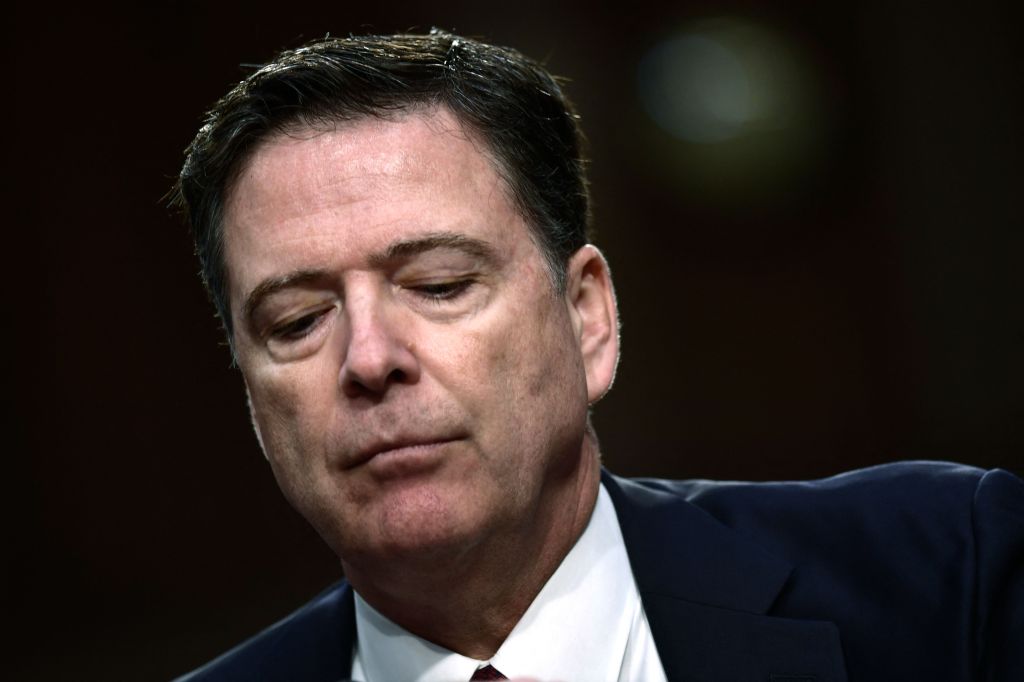
The Department of Justice’s recent indictment of former FBI Director James Comey has been rightly criticized as flimsy and an affront to the First Amendment. This is nothing more than a naked use of federal authority to intimidate a notable critic of President Donald Trump. It’s also something that should make conservatives uneasy.
The Republican Party won’t always control the government, but by treating hostile political symbolism as a threat, the Department of Justice has opened a door that future administrations may be all too willing to walk through.
DOJ first sought to indict Comey in September 2025, alleging that he lied to Congress during testimony he gave in 2020. A federal judge dismissed that indictment in December on the grounds that the prosecutor, acting U.S. Attorney Lindsey Halligan, had been unlawfully appointed. In late April, Comey was indicted again, this time over a nearly year-old social media post in which Comey had spelled out “86 47” in seashells. The government called that “a threat to take the life of, and to inflict bodily harm upon, the President of the United States.”
How are numbers threatening? The indictment has no answer, but “86” commonly means to “get rid of” or “throw out” (with “47” meaning Trump, the 47th president). To argue that “86” means “assassinate” or “kill” requires taking an uncharitable interpretation of Comey’s post, to say the least. Even Amazon sells “8647” and “8646” (referring to former President Joe Biden) decals explicitly branded as “anti-Trump” and “funny Joe Biden bumper stickers.”
It stretches credulity to suggest that any American who buys and sells those stickers threatens death on the president. But if the DOJ’s theory were to hold, there’s no reason a future Democratic administration couldn’t say that anti-Biden or anti-Democratic Party slogans sold online, chanted at rallies, or posted on social media are evidence of criminal intent.
Whatever one thinks of Comey’s seashell arrangement, it falls comically short of the level the Constitution requires for prosecuting a “true threat.” Under the First Amendment, all speech is protected unless it falls under one of a small number of narrowly defined categories. “True threats” are one such category, but the threshold requires a serious threat to commit an act of unlawful violence.
The government will soon learn just how narrow that category is. The First Amendment gives plenty of “breathing room” for even “vehement, caustic, and sometimes unpleasantly sharp attacks,” including on presidents. The brilliance of these words—from Watts v. United States(1969)—is that they don’t take sides. They protect the anti-war protester just as much as the Trump rallygoer, the pro-life demonstrator, or the gun-rights activist.
In Watts, a young man attending a rally on the National Mall complained about the Vietnam War draft, stating, “If they ever make me carry a rifle the first man I want to get in my sights is L.B.J.” Watts was convicted for threatening President Lyndon Johnson.
The Supreme Court overturned Watts’ conviction in 1969, holding that his remarks were constitutionally protected “political hyperbole.” Recognizing that the “language of the political arena” can be “abusive” and “inexact,” the court emphasized that Watts’ “only offense” was a “kind of very crude offensive method of stating a political opposition to the President.”
In other words, Watts merely used sharp rhetoric to criticize a war effort he saw as unjust. Comey’s shells are no different. If anything, they’re even further outside the category of true threats than Watts’ statement about training a rifle on Johnson. But any ambiguity here is exactly why conservatives and liberals alike shouldn’t want prosecutors rummaging through our social media feeds, fishing for any hostile political slogan that could be construed as a threat.
What’s more, just because the government brands Comey’s shells as a threat doesn’t make it so. As the Supreme Court recently said in Chiles v. Salazar, “the First Amendment is no word game.” So too here. The government can’t magically disappear criticism by using ominous buzzwords like “harassment,” “misinformation,” or “threats.”
As the Supreme Court said in Watts, our “profound national commitment” to “uninhibited, robust, and wide-open” political debate requires our public officials to keep their hands off the levers of criminal charges whenever they’re offended by a critic.
The DOJ should not have brought these charges. Thanks to the First Amendment, they likely won’t stand up in court. But they may leave a lasting impact on our political culture and our willingness to tolerate sharp criticism. The next target may not be a former FBI director with elite legal representation and national media attention. It could be you: a county party member, a student with minority views on campus, or a parent who posts online about what their kids learn in school.