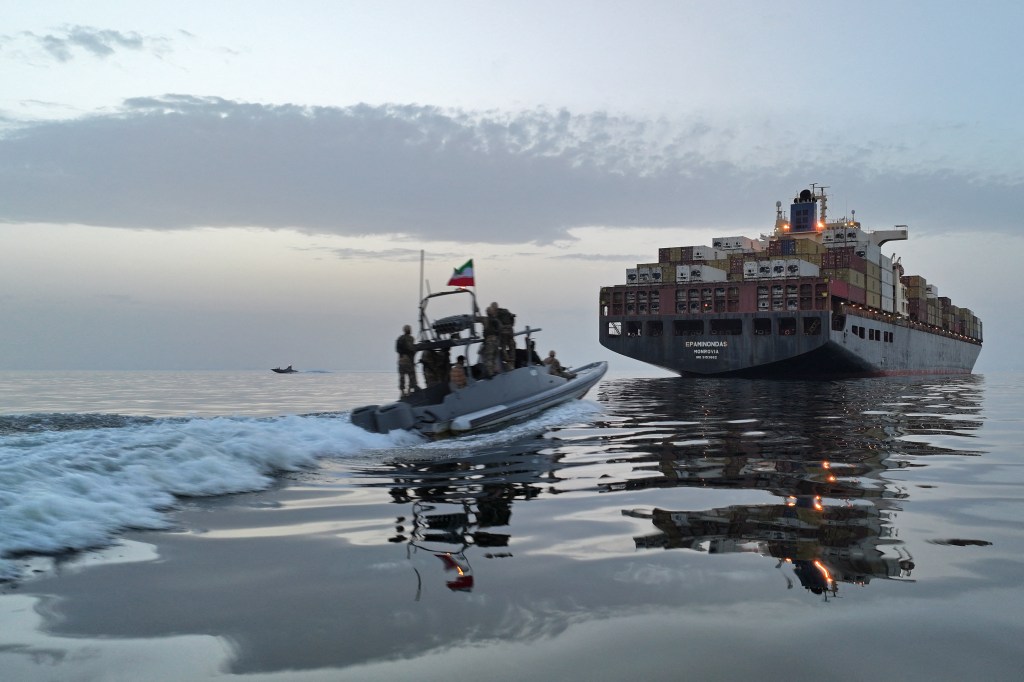
The Trump administration has sealed off the Strait of Hormuz in retaliation for Iran’s earlier closure, a geopolitical retort echoing the jab, “You can’t fire me! I quit!” It isn’t a perfect scene of Coriolanus screaming “I banish you!” at his adversaries, but it will have to suffice as a stand-in.
The question facing the world—and the White House, and the American voter—is not who can close the Strait of Hormuz but who can keep it open.
These are not the same question. The Trump administration seems to believe that keeping the strait open is a task that should be entrusted to Tehran, even though the Strait of Hormuz is not sovereign Iranian territory and despite the fact that the Iranian government is the last party on Earth that any reasonable person would want in charge of a strategically sensitive waterway.
Anyone with a modest amount of firepower can close the Strait of Hormuz—the U.S. military, certainly, but also Iran, or, presumably, the Royal Navy of Oman, if their authorities in Muscat were willing to bear the consequences, not to mention more consequential sea powers such as the United Kingdom, India, or China, or indeed any state or private actor ready to deploy the small cost of a few mines. There are drug cartels with resources enough to perform the closing, if there is profit to be earned.
The Strait of Hormuz is an international waterway governed by maritime law, but the Trump administration insists on treating the strait as if it were Iranian sovereign territory, a stance born of incompetence and political cowardice. Washington has engaged with Tehran on a sovereign-to-sovereign basis, offering concessions in exchange for restoring open international access to the Strait of Hormuz, and however Donald Trump and his war-fighting team choose to shade it—part Village People, part Apple Dumpling Gang—that amounts to acknowledging Iranian sovereignty over the strait. Iran appears to be losing the war so badly that it has effectively been granted recognized sovereignty over new territory. So much winning.
Even a loosely organized band of pirates could mount a credible effort to close the strait. Keeping it open and secure is a far heavier lift—which is why the Trump administration, whose principal figures have typically lifted nothing heavier than money, would prefer that the Iranians undertake the job. Never mind the inescapable instability that would follow from leaving the strait’s control in the hands of an unstable Islamist faction—one whose most effective and accessible geopolitical weapon is disrupting traffic through the strait—for the administration, the alternative is something unthinkable: real work that yields little immediate payoff.
U.S. forces could maintain a clear channel through the strait on their own, if Washington so chose, but doing so would entail real costs and considerable risk, including the danger that millions of Americans might one day watch on their phones as a $15 billion U.S. Navy vessel burns and sinks after being attacked by drones worth half a million dollars or encountering a mine costing ten thousand dollars.
Alternatively, Washington could attempt to assemble an international coalition to keep the strait open—if Washington had any competent international partners who regarded the administration as a credible, reliable, good-faith partner. Yet, alas for that hope, Paris, London, and Berlin are not currently inclined toward such an extraordinary degree of self-delusion, even if those capitals are just as prone to dupes and dunces as Washington. Oman, long a junior partner in the strait, has good reason to believe that Iran remains a more credible adversary than the United States is an ally.
From Ottawa to Tokyo, it is clear to the world that the United States—not Iran—is the reigning champion in cynically weaponizing trade and trade relations for strategic ends. Word has reached Brussels—and even Copenhagen—that the United States harbors a pronounced contempt for its former allies, a sentiment felt most strongly by senior administration figures such as J.D. Vance and Pete Hegseth. It is hard to imagine Ursula von der Leyen lifting her eyes from constant LinkedIn activity long enough to endorse a flood of euros to rescue a U.S. administration that only months ago threatened to wage war on a NATO ally and EU member. What would Europeans gain from such a move? If anything, cautious continental leaders might prefer that the Strait of Hormuz be dominated by a power that is weak rather than by one that is truly imposing. They may not be ready for a major confrontation, but they can still offer incentives and bribes.
Keeping the strait open means commanding the water and adjacent land not only within the strait itself but also in the immediate surroundings. There is little doubt that U.S. forces could perform the task, but it would be a bloody and costly undertaking so long as Iran remains committed to continued fighting. And given the unpredictability of events, we are far from the moment of that “unconditional surrender” the president hinted at merely moments earlier. Perhaps Tehran will suffer a domestic fracture that creates an opening for Washington.
But any settlement built on the assumption—whether stated or implied—that access to the Strait of Hormuz is Tehran’s to grant or revoke will accomplish nothing. It could, however, grant the Iranians what they want: time, including the opportunity to revisit the atomic question.