When I imagine, as people often do, what I would grab if my house were on fire, one of the first contenders is the Library of America’s two‑volume collection of World War II reporting. Yet, after a moment’s reflection, I realize that it probably wouldn’t rank that high, since a fresh copy could be bought, whereas securing a new family would be both awkward and legally complicated.
Still, simply thinking of it at all signals the exceedingly high regard in which I hold these volumes.
Perhaps the most striking feature of these books is the remarkable variety of voices in American journalism of that era. There are men and women, white reporters and Black reporters, people with Ivy League diplomas and others who never finished high school. And yet every writer seems to possess a distinct, memorable, and persuasive voice. Reading most journalism today—the revered pages of The Dispatch aside, of course—is a rather dreary experience by comparison, since we inhabit a world in which nearly all of the journalists whose names we know attended the same handful of schools, were schooled in the same shibboleths, and share nearly identical sensibilities. The World War II correspondents of that time were the antithesis of that trend.
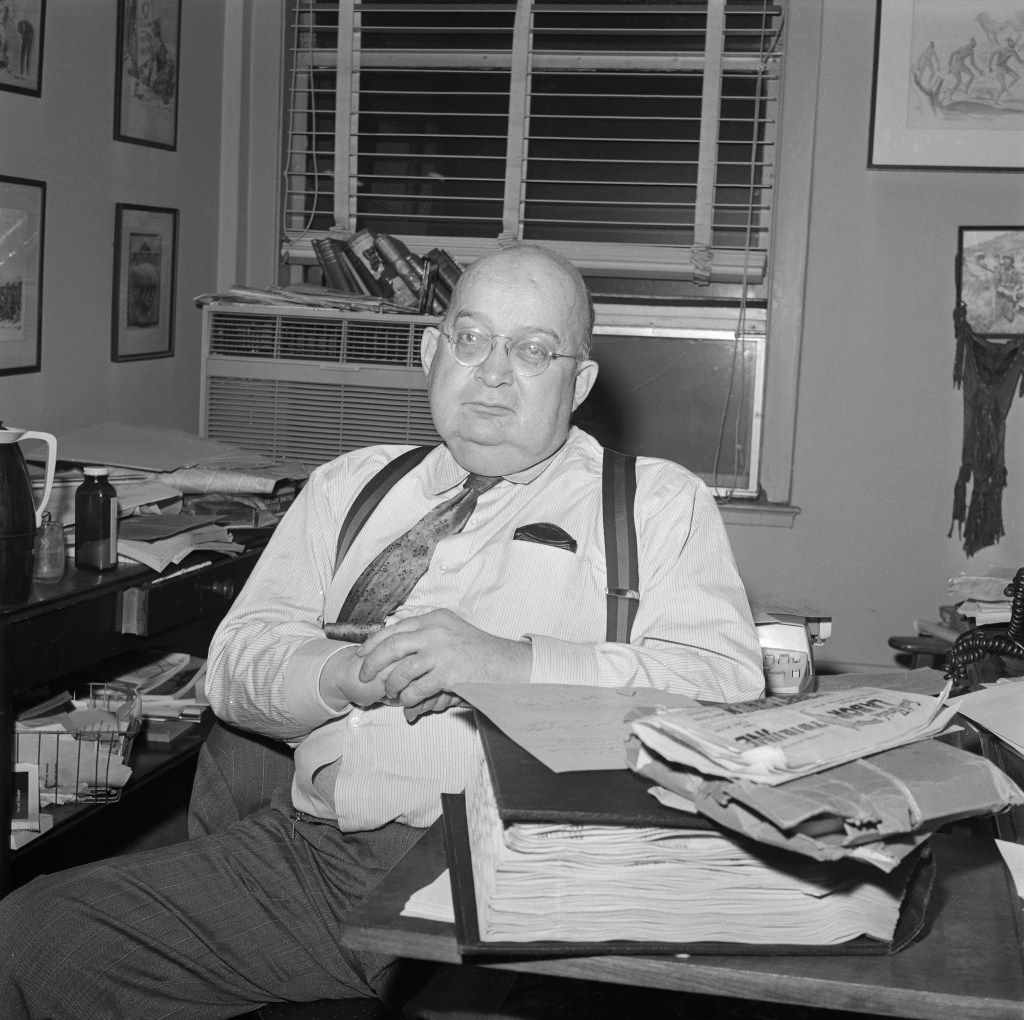
Among these reporters, A.J. Liebling stands out as especially compelling, serving first as The New Yorker’s man in Paris, then in London, then in North Africa, and finally back to France during the war’s course. Liebling’s writings circulated beautifully on many topics—boxing and cuisine being notable among them—but he may well be the finest war journalist I’ve ever read, and his work deserves far wider recognition than it currently enjoys.
Abbot Joseph Liebling, born in New York City in 1904, came from a family where his father, an Austrian Jew who had arrived in the United States at age 12 and apprenticed to a furrier, eventually built a successful wholesale fur business and turned to real estate investment. Consequently, Joe was raised in the comfort of Manhattan’s Upper West Side. The family occasionally visited France, and the young Liebling—later to be known among friends as Joe—developed a strong Francophile streak and a fascination with French history. By the age of eight, he could name all of Napoleon’s marshals.
After finishing high school he entered Dartmouth College, where he was suspended and then expelled for skipping chapel, a compulsory obligation at the time. (Liebling’s parents were non‑observant Jews, and he would later describe himself as “without religion.”) He eventually moved on to Columbia University to study journalism, but in the meantime he took courses in French and grew to love the Middle Ages. Early in his war reporting he offers a recollection that hints at his voice:
The valleys, vaux, of the two little rivers, les vaux de Vire, gave the word vaudeville its name, according to a plausible—though now, I’m convinced, inaccurate—theory I once heard in an old French course at Columbia. I first reached Vire in 1926 because of that odd fact. I had always loved vaudeville at the Palace in New York. Moreover, [my French friend] Henri told me that during the last war he and another sergeant had escorted some German prisoners from the front to a camp on the West Coast, and that on the return trip they had stopped in Vire, which happened to be the other sergeant’s hometown, and that they had eaten and drunk wonderfully well at the Cheval Blanc. Since I was an amateur medievalist and a vaudeville fan and a glutton, I went to Vire.
This memorable visit occurred not long after Liebling lost his first job as a journalist: The New York Times dismissed him for submitting sports stories in which he invented the names of athletes. After roaming around Europe for a period on his father’s stipend, he studied at the Sorbonne, but eventually returned to the United States, worked for several newspapers that apparently were undeterred by—or unaware of—his fabrication history, and, in 1935, was hired by Harold Ross, the editor of a still-young weekly called The New Yorker. This would become his principal journalistic home for the rest of his life, even as he wrote for many other outlets.
When World War II began, Liebling’s fluency in French and his extensive knowledge of French history and culture made him the ideal reporter for the war on the Western Front. He writes about France during this fraught moment with remarkable clarity, at a time when collapse seemed inevitable yet was not openly acknowledged. The emotional complexity of war—for both the soldiers and the home front—is captured with a precision and vividness that, in my view, few others have matched. And his precision and vividness extend to every detail. The excellence of his journalism begins with his powers of observation and description. Consider, for example, his portrayals of French mustaches.
Of a farmer in Vire riding a horse: “The farmer had thick legs and a great heavy belly that rode in front of him like a sack of grain. He had a red face and a long mustache that drooped like a ship’s ensign in a dead calm.”
Of a French colonel: “He wore a brown beret which was barely balanced on the side of his head. … His cheeks were old rose and his eyes cobalt blue, and his long white mustaches did not droop, but descended in a powerful, rhythmic sweep, like the horns of a musk ox.”
Of a chef: “M. Bisque cried easily. Like most fine cooks, he was emotional and a heavy drinker. He had a long nose like a woodcock and a mustache which had been steamed over cookpots until it hung lifeless from his lip.”
These passages reveal not only Liebling’s humor but also his ability to summon a vivid image in the reader’s mind.
When France fell, Liebling joined the mass exodus from the country, making his way by car and train to the far south. He crossed the Pyrenees into Spain, eventually reached Lisbon, and from there returned to the United States. Yet he did not stay away for long.
Liebling does not delve into his private life in these war dispatches, but one curious note about his arrival in Spain reads: “The weather, so beautiful through that ghastly spring, wore the mask of a false unchanging smile. I walked for the first time in nine months without thinking of France. I became aware of this and felt guilty, as you do when you walk out of a hospital where your wife is and, a few blocks away, you find yourself whistling.” It’s an odd comparison, but his wife was in a mental hospital at the time and spent much of the rest of her life there. This may explain why he would spend the next several years largely at war; soon after returning from France, he crossed the sea again—this time to England. When he was forced back to the U.S., hitchhiking aboard an empty Norwegian oil tanker (a voyage he recounts with humor), it didn’t take him long to report for duty once more: he accompanied Allied troops in North Africa as what we would now call an embedded reporter.
On the way to Africa, one of his journalistic colleagues asked him where they hoped to land—having been told nothing beyond what the soldiers themselves were told—and he replied, “Someplace where resistance has ceased.” This, to me, undersells his readiness to be on the front line and to witness the fighting up close. He saw a great deal of combat up close, and much of it, in the early days, was brutal. In his dispatches, he does not spare Allied leadership, especially the generals, in North Africa. Their performance was generally lamentable, and while, to be fair, they were still learning on the job, some learned less than others. One example:
General Fredendall obviously did not formulate our policy for the North African theater. He got his directives from Algiers, where General Eisenhower and Robert Murphy of the State Department were running the show, and it was of course impossible to know whether they themselves were making policy or receiving it from Washington. But Fredendall’s complacency in matters of detail jarred me. I spent part of one Sunday afternoon talking to him about the Service d’Ordre de la Légion, commonly spoken of as the S.O.L., the members of which had formed an elite guard of uniformed fascism, like the German SS after which they were patterned. The next time he saw me, in the lobby of the town’s principal hotel, which had been requisitioned by the Army, he graciously approached me and said, “You don’t have to worry about those S.O.L.’s anymore. Their secret intelligence section is working with us now.” Within a few days they had probably turned in the name of every De Gaullist in Oran as a candidate for a concentration camp.
Yet if Liebling’s writing is shrewdly critical, it is also intensely patriotic, and patriotic in a way that I think is unimaginable among most American journalists today. He bears a deep affection for the young American soldiers among whom he travels:
I hadn’t been around so many Americans so young in twenty years, and I thought they had an edge on my own college generation, though perhaps I was less than fair in retrospect because I had been an insecure, intolerant undergraduate myself. All the boys had to do, I thought, was to look around at each other and they would understand that democracy was worth defending. The noncoms they rode with, six sergeants to a Fortress, were just as different from products of other regimes as the officers. They were all high-school men, even though in civilian life they had worked in grocery stores or driven laundry trucks. They had no sense that they were bound by any social class, and they thought for themselves about everything they saw and did. They were good stuff.
And when in North Africa he had the opportunity to witness an American battalion—led by Gen. Ted Roosevelt (the son of President Theodore Roosevelt)—notably defeating a Panzer battalion, it filled him with exhilaration:
If one American division could beat one German division, I thought then, a hundred American divisions could beat a hundred German divisions. Only, the era when Germany possessed a hundred divisions to spare from the Russian front—plus God knows how many more to confront the British—and garrison troops for all the occupied territories, was already over. Deep inside me I knew, after that, that the path back to Paris was clear.
Those are the closing lines of his first book of war reportage, The Road Back to Paris.
Later he would revisit that North African experience in memory: Mollie lingered in his thoughts. Mollie wasn’t a woman, but an American soldier killed in Tunisia’s La Piste Forestière (the Forester’s Track). His sergeant described the soldier for Liebling:
“That’s Mollie. Comrade Molotov. The Mayor of Broadway. Didn’t you ever hear of him? Jeez, Mac, he once captured six hundred Italians by himself and brought them all back with him. A sniper got him, I guess. I don’t know, because he went out with the French, and he was found dead up there in the hills. He always liked to do crazy things — go off by himself with a pair of big field glasses he had and watch the enemy place mines, or take off as an artillery spotter for a while, or drive a tank. From the moment he laid eyes on those frogs, he was bound to go with them.”
His name wasn’t Molotov, but Liebling initially couldn’t figure out why his comrades called him that. Mollie struck him as quite a character: he claimed to be a gambler and to be a big deal on Broadway. Mollie was so vivid in Liebling’s memory—“he has become a posthumous pal”—that upon returning to New York he felt compelled to uncover Mollie’s true identity. And so he did.
Mollie’s legal name was Karl Warner, though his birth name was Petuskia. Before the war he worked as a busboy at Jimmy Kelly’s, a Sullivan Street club in lower Manhattan. He belonged to the local waiters’ and waitresses’ union and often spoke up at meetings, though he was later expelled for failing to pay dues. Still, the union secretary told Liebling that he would have wanted Mollie restored to good standing in the union. After all, Curly—his nickname for his curly blond hair—was the first member of that local to die in the war.
I imagined how pleased Mollie would have been to be readmitted to the union without paying any dues. Then I pictured how much fun he would’ve had on the Mall in Central Park in summertime, if only he could have marched there with his Silver Star ribbon and a bundle of enemy keepsakes. And I thought about how far La Piste Forestière was from the kitchen at Jimmy Kelly’s.
The pity of war—as the great poet Wilfred Owen did for World War I—rarely leaves Liebling’s mind in his writings. Yet he also remembered those war years as among the best of his life. He later wrote, “The times were full of certainties: we could be certain we were right — and we were — and that certainty made us certain that anything we did was right, too. I have seldom been sure I was right since.” And:
I know that it is socially acceptable to depict war as an unmitigated horror, but subjectively at least, that portrayal isn’t entirely true, and you can feel its pull on men’s memories at the maudlin reunions of war divisions. They mourn their dead, but they also mourn for war.
As, he implies, did he. You can acquire Liebling’s collected war writings from the Library of America, and you ought to, but those works ought to be more widely and affordably available. Also Joe Liebling at War should be a film, ideally directed by Richard Linklater. Richard: if you happen to read this and could use help with a screenplay, reach out. I have plenty of ideas.