
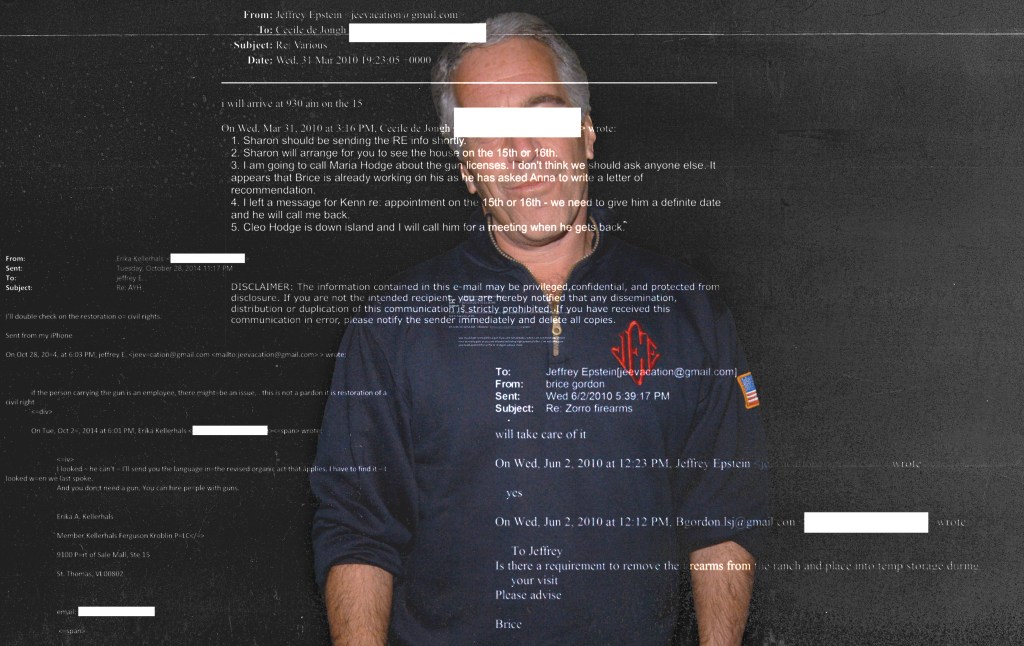
A fresh wave of investigators descended on Jeffrey Epstein’s infamous Zorro Ranch in New Mexico last month as part of a broader probe into his alleged sex trafficking of hundreds of young women and girls. Yet a review of investigation files that the Department of Justice had previously released indicates that Epstein and his staff may have engaged in gun-related crimes at the ranch and on other properties as well.
The New York Times reported on March 9 that New Mexico state law enforcement officials and local county sheriff’s deputies searched Epstein’s property, which he called Zorro Ranch, as part of a new inquiry into his criminal operation. A review of the Epstein files released by the DOJ shows that Epstein maintained a potentially illegal level of control over dozens of firearms after he pleaded guilty to soliciting sex from a minor in 2008, rendering him ineligible to possess firearms or even have effective control over them under federal law. That means that both he and his staff were likely breaking federal firearms laws in the decade-long lead-up to his second arrest for child sex trafficking in 2019.
The files raise the specter of a crime called “constructive possession,” a federal offense under 18 U.S.C. § 922(g)(1).
“Constructive possession under federal law is a broad concept, and prosecutors often rely on it when they cannot show that a person physically handled a firearm,” Todd Spodek, an attorney with 18 years of criminal defense experience that includes handling such cases, told The Dispatch. “Instead, the focus is on whether the individual knew the firearm was present and had the ability to exercise control over it.”
“A state attorney would have no problem charging him under 922(g),” Matthew Larosiere, a gun lawyer who has advised on so-called constructive possession cases, told The Dispatch.
While legal questions about Epstein’s control over firearms pale in comparison to the allegations of sex trafficking and abuse, they also demonstrate that his potential crimes were broader than previously reported and may also implicate some of his longtime staff and associates who are still alive.
The files reveal Epstein’s long history with firearms, both before and after his conviction, and even through the period he was serving his work-release prison sentence.
Epstein appears to have owned dozens of firearms spread across his properties in Florida, New Mexico, and the U.S. Virgin Islands. He held a Florida concealed carry license from the 1990s through his first sex crime arrest.
Even after his felony conviction, Epstein repeatedly agreed to go on shooting trips with prominent men—including the head of Dubai’s biggest port operator and the son of a British arms dealer—though nothing in the files indicates whether he went on those trips. He also discussed buying a distressed gun wholesaler with Hyatt Hotels billionaire Tom Pritzker in the wake of the 2012 Sandy Hook shooting.
All the while, Epstein clearly understood he wasn’t able to legally own guns as a result of his felony conviction. The files show that he repeatedly asked his lawyers about the limits of that prohibition. And he made increasingly desperate plans to have his ability to own guns restored, up to and including an email to his lawyers the night before the Miami Herald published its landmark report in November 2018 on the serious problems with his initial prosecution. (That reporting prompted a renewed investigation of Epstein, leading to his arrest in July 2019.)
“can you researc= to see if the governor can restore my civil rights and allow me to own a g=n?” Epstein asked lawyer Erika A. Kellerhals about owning guns in the Virgin Islands back in 2014.
“I looked — he can’t — I’ll send you the language in=the revised organic act that applies. I have to find it — I looked w=en we last spoke,” Kellerhals responded. “And you don’t need a gun. You can hire pe=ple with guns.”
Epstein was skeptical about directing his staff to carry guns, seemingly understanding it could cause legal problems for everyone involved.
“if the person carrying the gun is an employee, there might=be an issue, . this is not a pardon it is restoration of a civil right,” Epstein said to Kellerhals.
There are other files, though, that indicate he did employ armed security at times after his felony conviction—and that law enforcement raised concerns about it. Additionally, his various attempts to regain his gun rights were unsuccessful, and his concerns about legal problems didn’t stop him or his staff from operating in a way that indicated he maintained control of many of the guns on his property after his conviction.
“When somebody is a convicted felon and, therefore, is precluded from owning a gun, the law is clear, not just about who has the fee interest in the gun, but also who has dominion and control over it.”
Mitchell Epner
/ Former assistant U.S. attorney
The files reveal that before his guilty plea, Epstein was commonly in direct control of the guns kept on his properties, often telling employees where guns should be stored and even ordering them to buy guns for use on the properties under their own names. Those practices appear to have continued even after Epstein’s felony conviction. Documents released by the DOJ establish that he was aware of where the guns on his property were stored and consulted about what should be done with them.
Spodek noted constructive possession can be a problem for employers and employees alike, thanks to 18 U.S.C. § 922(h)(1).
“In situations involving a convicted felon who has personal staff, prosecutors will typically look at the relationship between the individual and the place where the firearms are kept,” he said. “If guns are stored in a residence, office, or other property the person owns, leases, or otherwise controls, that can raise questions about constructive possession. Even if a staff member claims the firearms belong to them, the government may argue that the person with authority over the premises had the ability to control access to those weapons.”
Mitchell Epner, who served as an assistant U.S. attorney for the District of New Jersey from 2001 to 2004, where he spent time running the office’s anti-sex-trafficking group, agreed with that assessment.
“When somebody is a convicted felon and, therefore, is precluded from owning a gun, the law is clear, not just about who has the fee interest in the gun, but also who has dominion and control over it,” he told The Dispatch.
Those descriptions closely match those of Epstein’s own lawyers. A 2011 report from one of Epstein’s lawyers, Gaylin Vogel, examined the legality of Epstein’s employees’ keeping guns on his private island, given his criminal record. She concluded it would be legal only if Epstein were entirely unable to direct the employee’s use of the gun and he were unable to access it.
“Facially, the statute does not appear to be a prohibition against a residential employee to purchase, use and possess a firearm for that employee’s personal use only,” she wrote. “However, the firearm cannot be used or in any way supported by the covered employer. The covered employer cannot in any way direct the use of the firearm. The employer cannot require the employee to possess a firearm. The employee cannot take any direction from the covered employer with respect to the firearm.”
Documents and emails released by the DOJ show that before his legal troubles, Epstein’s employees often reported to him on what was going on with the guns on his properties, waited for him to decide what to do with them, and carried out those orders.
For instance, somebody on Epstein’s staff created weekly reports on the operations at his various properties. Those often included discussions on different actions to be taken with the guns on those properties. One example from September 6, 2002, shows Epstein instructed two staff members identified only by their first name or initials to buy guns for use on the Zorro Ranch in New Mexico and in Epstein’s fleet of cars.
The document also shows Epstein authorized staff to buy a gun safe for his Palm Beach property. A similar report from about a year later shows staff waiting to get Epstein’s decision on whether to buy a clay pigeon thrower for the outdoor range on Zorro ranch. That’s something he must have agreed to since dozens of photos included in the files show people, sometimes young women who’ve had their identities redacted and sometimes Epstein himself, shooting sporting clays on the Zorro range. The shooting photos in the files are undated, though some are preceded by CDs that indicate they may be from August 2005.
Records show that Epstein continued to direct what happened with guns and shooting facilities on his properties after his 2009 felony conviction, potentially in violation of state and federal law.
A June 2009 email, sent while Epstein was still serving his work-release prison sentence, shows Epstein and Brice Gordon, who managed the Zorro property and is seen handling guns in undated pictures from the files—including one where he appears alongside disgraced French model scout Jean-Luc Brunel—discussing a gun safe on Epstein’s island in the U.S. Virgin Islands. An exchange from March 21, 2010, shows Epstein directing Gordon to “get licenced for a gun” and “have as many guns as you are allowed including high powered rifles” when Epstein is not around. An email thread from later that month shows Cecile de Jongh, who worked for one of Epstein’s companies and served as first lady of the Virgin Islands, updating him about gun licenses that appear to be for his staff members on the island.
“The government does not need to show that the gun was actually touched or used. Legal issues can also arise when there is any direction or involvement with the firearms. … Even indirect involvement can become a focal point in an investigation.”
Todd Spodek
/ defense attorney
“I am going to call Maria Hodge about the gun licenses,” de Jongh told Epstein on March 31, 2010. “I don’t think we should ask anyone else. It appears that Brice is already working on his as he has asked Anna to write a letter of recommendation.”
That summer, Epstein had another email exchange with Gordon that Larosiere identified as the strongest evidence that Epstein illegally maintained constructive possession of firearms after his felony conviction. On June 2, 2010, nearly two years after Epstein entered his felony guilty plea, Gordon asked Epstein if there’s “a requirement to remove the firearms from the ranch and place into temp storage during your visit.” Epstein said there was, and Gordon said he would “take care of it.”
A few days later, Gordon emailed him with questions on what exactly to do with the ranch’s guns. He gave him two options for handling the firearms. One involved buying a new gun safe and renting a storage locker in Albuquerque. The other was to relocate the guns and safes, still stored at the Zorro main house and shooting range, to “Larry’s house,” an apparent reference to Epstein’s longtime pilot Larry Visoski–whom Epstein gave a plot of land to build a house on the ranch and would also advise to buy a gun in a later exchange.
“Approach is, this land is deeded to Larry, therefore guns have been removed from your property,” Gordon told Epstein. “Larry’s on board with this approach.”
“Please advise if any of the above options meet your requirements,” Gordon concluded.
“larry,” Epstein replied.
“ok,” Gordon responded.
“This pretty clearly contemplates the guns are presently in his control,” Larosiere told The Dispatch.
The pattern of Epstein overseeing Zorro’s shooting facilities and weapon collection—seemingly numbering in the dozens—persisted for years afterward. A June 2013 document lists two gun cabinets at Zorro insured by Epstein for $57,529. An August 2013 email seeks his approval to ship shooting supplies to Zorro. A June 2015 report sent to Epstein also mentions completion of work on a gun cabinet. A 2016 email exchange shows Epstein approving a redevelopment that removed Zorro’s shooting range.
In August 2018, a break-in at the ranch left several employees reporting that as many as 30 guns had been stolen from the property.
“I just wanted to give everyone a run down of what I have done with the Gun Safe and its contents,” a redacted employee emailed Epstein and other staff. “Cynthia and I looked at each gun and compared serial numbers and photos to what was already documented in the Inventory List. Included in the attachment with this email will be another copy of the Inventory List which will have the guns we found crossed out and checked marked. We took additional photos of the guns with the serial numbers, make & model if it was available ( reference the existing Inventory List ). According to what guns are accounted for to what is on the list, we are missing 33 guns.”
The document indicates the inventory was attached to the original email, but it does not appear in the DOJ database of released files. Gordon also sent a follow-up specifically to Epstein the next month, where he said “the gun thing is very concerning and tricky.”
Richard Kahn, Epstein’s longtime accountant, appears to have investigated the incident alongside Visoski. The pair reported to Epstein the same month that Gordon ended up finding some of the missing guns in his house on the ranch. They expressed skepticism about Gordon’s story about the burglary, which was never solved by police. The Dispatch emailed Kahn’s lawyer seeking comment but did not receive a response.
Larosiere said those emails were “wildly problematic” for Epstein and the staff from a legal standpoint.
Spodek noted that access is a key factor when prosecutors consider whether to charge somebody with constructive possession.
“If firearms are kept in areas that the felon can freely enter, such as shared living spaces, vehicles, or rooms within a residence, prosecutors may argue that the person had the practical ability to exercise control over the weapons,” he told The Dispatch. “The government does not need to show that the gun was actually touched or used. Legal issues can also arise when there is any direction or involvement with the firearms. For example, if staff members are instructed to store, transport, or secure firearms on the property, prosecutors may view that as evidence that the person exercised control through others. Even indirect involvement can become a focal point in an investigation.”
Less than a year later, on July 6, 2019, federal agents arrested Epstein on charges of sex trafficking of minors. On August 10, 2019, prison officials found Epstein dead in his Manhattan jail cell.
On August 12, 2019, federal agents searched Epstein’s Virgin Islands property. Documents show they recovered two Glock pistols, but don’t clearly indicate who owned them. In some copies of the evidence sheet released by the DOJ, two names written next to the Glocks are redacted. However, in others, they aren’t.
While the experts who spoke to The Dispatch acknowledged Epstein and his staff’s handling of firearms after the former’s conviction may well have been illegal, they argued it’s unlikely anyone will be prosecuted today: Epstein is dead, and the statute of limitations has likely run out for his surviving staff members. They also expressed doubt that prosecutors would’ve taken on a case like this back when Epstein was alive and the crimes were fresh.
“I think there’s enough haziness to kill it,” Larosiere said.
Epner agreed.
“Having been a federal prosecutor and around federal law enforcement for the better part of 30 years, here is the reason why I am not surprised there were no meaningful prosecutions or even meaningful investigations into what his employees were doing with regard to guns: if I am a U.S. attorney and I prosecute the ranch hands for holding onto Epstein’s guns and Epstein does not get prosecuted then I then I look like a sh-t,” he said.
Language aside, Epner said a prosecution of just the staff would have been “completely unpalatable.”
“And it’s a really tough prosecution because Epstein got a lot of high-priced lawyers involved in creating something that at least had the patina of legality.”
Epner said he agrees that the emails indicate Epstein and his staff may have broken the law, but pointed to another high-profile incident as an example of why a prosecution would be difficult.
“Alec Baldwin literally shot and killed a woman in New Mexico,” he said. “New Mexico law enforcement was so inept that they couldn’t successfully prosecute, and they never got the case to a verdict, let alone a guilty verdict. So, if you are the District of New Mexico, you might have, you know, a few dozen AUSAs. You know that if you go up against Jeffrey Epstein, you are going to be outresourced at every turn.”
He said that wasn’t a reason to turn away from a prosecution if the evidence is strong. However, he said it does play into the calculation on which cases to pursue.
“But it’s something that is appropriate for a federal prosecutor to be thinking about, because part of the way that federal prosecutors keep the system running is they get guilty pleas over 90 percent of their cases, right? Because they get convictions in over 95 percent of the cases,” Epner said. “And if you start taking long-shot cases, you’re going to encourage people to stop pleading. And if people stop pleading, the whole system breaks down.”
Additionally, Epner noted there may not be any avenue to prosecute Epstein’s staff today, even if the evidence could conclusively prove they helped him constructively possess firearms.
“If there were crimes that were committed because people were essentially functioning as cutouts to allow Epstein to continue to have dominion and control over firearms after he was a convicted felon, the statute of limitations on those crimes has long since passed,” he concluded.
De Jongh did not respond to a message sent through her public Facebook page. Visoski did not respond to a message sent to the email address he used in the files. A message sent to the email address used by Gordon in the files bounced back.
While Maxwell was convicted of conspiracy to sexually abuse minors and sentenced to 20 years in federal prison in 2022, neither Gordon, de Jongh, Visoski, nor Kahn has faced charges over any aspect of their involvement with Epstein. However, the reopening of the New Mexico investigation into Epstein’s crimes could change that going forward.
Even if it doesn’t, as New Mexico Attorney General Raúl Torrez recently wrote in the Albuquerque Journal, a public accounting of what Epstein and his associates have done is still important.
“I want to be honest about the challenges ahead,” Torrez wrote. “Epstein has been dead for years. Zorro Ranch has changed ownership. Physical evidence may no longer exist, and the statute of limitations has likely run on many potential offenses. These are real obstacles, and survivors deserve to hear them stated plainly. But we will follow the evidence wherever it leads and leave no credible question unexplored. At the conclusion of our investigation, we will issue a full public report. The people of New Mexico, and those who were harmed, are entitled to a complete and transparent accounting of what we found and what we did not.”