The doom-laden forecasts of the past few years had ample evidence that the European project was losing momentum.
Brexit punctured the notion that deeper integration was inescapable, and likewise Viktor Orbán’s Hungary transformed into a veto-driven regime within the bloc’s borders. Orbán’s legacy of hostility to the European Union—blocking sanctions and thwarting aid packages—frequently tangled European Council deliberations that demanded unanimous agreement.
Over the course of the 2000s, the bloc’s enlargement stalled, as applicant countries in the western Balkans faced delays of ten years or more before any forward momentum on their bids. At the same time, the far right made gains in the 2024 European Parliament elections, with Marine Le Pen’s National Rally capturing roughly 31 percent of France’s vote, the AfD rising to become Germany’s second-largest parliamentary force, and Italy’s Brothers of Italy substantially increasing its seats. The analysts who warned that the EU’s gravitational pull was waning were simply echoing the available data. A senior fellow at Carnegie Europe described the situation in 2025 by saying, “the EU today looks weak and powerless.”
Yet this mood must be weighed against fresh developments and data from the past year, which, in combination, point toward a renewed strengthening of European integration. None of these shifts is without a caveat, but collectively they resist dismissal more forcefully than any single trend alone.
Arguably the most striking turn is the latest: Hungarian voters handed Orbán a decisive defeat last month, ending his sixteen-year tenure. Péter Magyar’s Tisza Party gained 141 of 199 seats with about 53 percent of the vote, while Orbán’s Fidesz managed only 52 seats. Voter turnout surpassed 78 percent, the highest in any Hungarian election since the fall of communism. The victory grants Magyar the constitutional mandate to reverse many of Orbán’s controversial and institutionally disruptive moves, rather than merely navigating around them. Analysts at the German Marshall Fund observed that Magyar’s victory overcame foreign meddling and united a coalition of ideological diversity by focusing on restoration and economic opportunity rather than cultural wars. In particular, Magyar cast Hungary’s economic decline, fraught relations with the EU, and frozen funds as consequences of Orban’s governance and anti-democratic behavior. This framing resonated with voters who had grown weary after sixteen years of increasingly corrupt and pro-Russian domestic politics.
The consequences of Orbán’s ouster would be consequential for the EU, given Hungary’s obstructionist stance—blocking sanctions on Russia, hindering a 90 billion euro loan package for Ukraine, and thwarting numerous European Council decisions. As a result of Hungary’s illiberal and anti-democratic leanings, the EU froze more than 16 billion euros earmarked for Hungary due to failures in judicial independence, the rule of law, and corruption. Releasing those funds will be among Magyar’s initial priorities. Equally important for the bloc will be allowing Hungary to roll back Orbán’s anti-democratic measures, such as weakening the Constitutional Court and imposing extensive media censorship. Lessons from Poland indicate this is feasible, as Prime Minister Donald Tusk’s coalition toppled a similarly entrenched government in 2023. Hungary has begun to imitate those moves, and that trend matters as a counterexample to the claim that authoritarian consolidation within the EU is unstoppable.
A second shift, while less conspicuous, may prove more foundational over time. At the start of 2025, the EU unveiled the ReArm Europe initiative, permitting as much as 800 billion euros for defense by suspending ordinary budget rules to enable member states to increase spending. This represents a major turn, aligning with what the Eurobarometer had already suggested at the level of public opinion: 79 percent of EU citizens backing a shared defense and security framework.
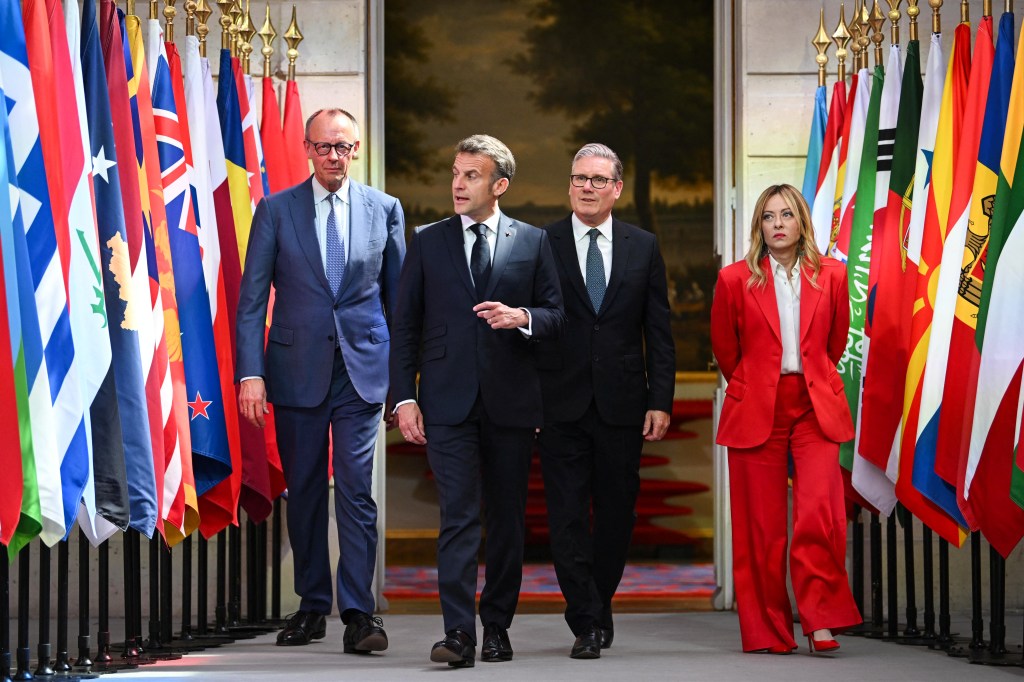
Earlier still, the Kensington Treaty, concluded in London last July between United Kingdom Prime Minister Keir Starmer and German Chancellor Friedrich Merz, marks the first bilateral accord between Britain and Germany since World War II. It encompasses defense, economic relations, migration, science and research, and people-to-people exchanges. The agreement takes on added significance as the United States moves to pull 5,000 troops out of Germany, signaling a diminishing reliability of American security guarantees.
Merz’s visit followed a state visit by French President Emmanuel Macron, during which Paris and London committed to aligning their nuclear deterrents. Chatham House described the outcome as bringing the United Kingdom, Germany, and France back to the forefront of European security. Even after Brexit, these three states are reasserting themselves as a central force in the continent’s security framework, united by Russian aggression and the United States’ unreliable strategic posture.
A third shift is slower to unfold but perhaps the most consequential in the long run. Russia’s 2022 invasion of Ukraine disrupted the EU’s enlargement deadlock, reframing enlargement as a security necessity. The European Commission now indicates that Montenegro and Albania could complete their accession talks by 2028. Romania and Bulgaria, ahead of these Western Balkan states, have already accomplished full Schengen accession as of January 2025, with Bulgaria also joining the euro area. Brussels is considering more flexible arrangements that let candidate countries participate in specific EU policies and markets before obtaining full membership. With Hungary’s veto gone, the pace of accession might accelerate even further.
Even amid enlargement hurdles, public opinion across Europe has shifted to be markedly more favorable toward deeper integration than at any time in recent memory. The Spring 2025 Eurobarometer showed the highest trust in the EU in 18 years—52 percent of Europeans said they trust the institution, and 75 percent felt they were EU citizens. The following autumn, nearly three-quarters affirmed that their country benefited from membership. A dedicated Eurobarometer on enlargement found 56 percent supporting further expansion, with particularly strong backing among younger people. In candidate countries, the willingness is even starker: 91 percent of Albanians back accession, while 68 percent of Ukrainians and 74 percent of Georgians share that view.
Even per enlargement’s complications, the scenario has produced a clearly more favorable public mood toward European integration than at any point in recent memory. The spring 2025 Eurobarometer recorded the highest level of trust in the EU in 18 years, with 52 percent of Europeans saying they trust the institution and 75 percent feeling they are citizens of the EU. By the autumn survey, nearly three-quarters said their country had benefited from membership. A special Eurobarometer on enlargement found 56 percent in favor of further expansion, with support particularly high among younger Europeans. In candidate countries, the figures are more striking still, with 91 percent of Albanian citizens supporting accession and 68 percent and 74 percent of Ukrainian and Georgian citizens, respectively.
In short, Russia’s invasion created a security emergency that shifted accession into an urgent—rather than merely desirable—issue. The EU has not become more attractive on its own merits so much as the outside world has become more threatening.
That distinction is important because the pro-European mood is contingent on external factors rather than internally consolidated, which is problematic amid rising populism and right-wing sentiments. For instance, France’s National Rally has consistently led polls ahead of the 2027 presidential election, while the AfD has at times topped German polls since February 2025. A far-right, Euroskeptic French presidency would transform the EU’s internal balance of power far more profoundly than Orbán’s attempts. In simple terms, a French government actively hostile to EU institutions and enlargement, wielding a nuclear deterrent and a seat on the United Nations Security Council, would pose a challenge of a different magnitude. However, Magyar’s win in Hungary (and Tusk’s in Poland) does show that populist consolidation is not permanent and that a campaign built on anti-corruption and economic policy can win against Euroskeptics like Orbán.“Europe’s heart is beating stronger in Hungary tonight,” said European Commission President Ursula von der Leyen following Orbán’s defeat. That beat is perhaps just as strong in more places than the pessimists expected.