As two fresh entrants prepare to back Republican hopefuls, the most influential one operates on both sides of the political aisle.
When Illinois Lt. Gov. Juliana Stratton clinched the Democratic nomination for the Senate in March, she did more than beat her fellow Democrats; she also withstood a $10.3 million bid by the crypto sector’s biggest PAC, Fairshake, to derail her candidacy.
Across the primary, Fairshake poured roughly $9.8 million into ads opposing Stratton, while one of its partisan offshoots, Protect Progress, simultaneously funneled more than $400,000 in support of her rivals.
As lieutenant governor, Stratton was second to Illinois Gov. JB Pritzker when, in 2025, he enacted rules regulating digital assets within the state. That regulation drew the crypto industry’s ire and put Stratton in its sights. She also earned a high-profile endorsement from Sen. Elizabeth Warren, a vocal crypto critic, and was later labeled by Stand With Crypto—a nonprofit advocacy group founded by Coinbase that ranks candidates by their stance toward the crypto industry’s agenda—as strongly opposed to the industry.
The spending drive mirrored a similar $10 million assault on Senate hopeful Katie Porter in the 2024 California Senate primary. Porter wasn’t as overtly anti-crypto as Stratton, but she was a close progressive ally of Warren and ran against Rep. Adam Schiff, who was seen as an ally of the industry. By Election Day in November 2024, Fairshake and its affiliates had spent more than $130 million on House and Senate races across the country. The crypto industry, now armed with two additional PACs, is aiming to repeat that endeavor in 2026.
By the end of March, Fairshake, Digital Defense Fund, and Fellowship—the three largest crypto PACs in the country—had already invested nearly $30 million in 2026 races. That level of spending is expected to persist, and likely accelerate, through the summer and fall. Taken together, the trio boasts a war chest surpassing $190 million to deploy from now until November in support of the crypto industry’s policy program. With a crypto-friendly president in office and more allies in the House and Senate, the industry has already secured one major legislative win under the Trump administration. Its signature achievement—a landmark market-structure bill that crypto advocates believe could propel the sector into the mainstream—remains elusive, and the Republican majorities that have embraced the industry could change in November.
But even as it’s clear the crypto sector is prepared to spend heavily on this cycle, which races their PACs will target, and whether they’ll succeed in electing even more pro-crypto candidates to the House and Senate, remains uncertain.
The crypto behemoth.
Fairshake, the country’s largest and most influential crypto PAC, was founded in March 2023 to advocate for the interests of the cryptocurrency and decentralized finance (DeFi) industries in national elections. The PAC is primarily funded by Coinbase and Ripple, alongside venture capital firm Andreessen Horowitz. They seeded the PAC with more than $180 million during the 2024 election cycle. Like many large donors, Fairshake operates across the partisan divide, spending to back both pro-crypto Republicans and pro-crypto Democrats. The organization contends that it needs allies in both parties to help pass favorable legislation in Congress, and has thus far avoided turning crypto into a partisan issue. Yet while Fairshake itself is nonpartisan, it also maintains two partisan affiliate PACs under its umbrella: Defend American Jobs, which supports Republican candidates, and Protect Progress, which backs Democratic candidates.
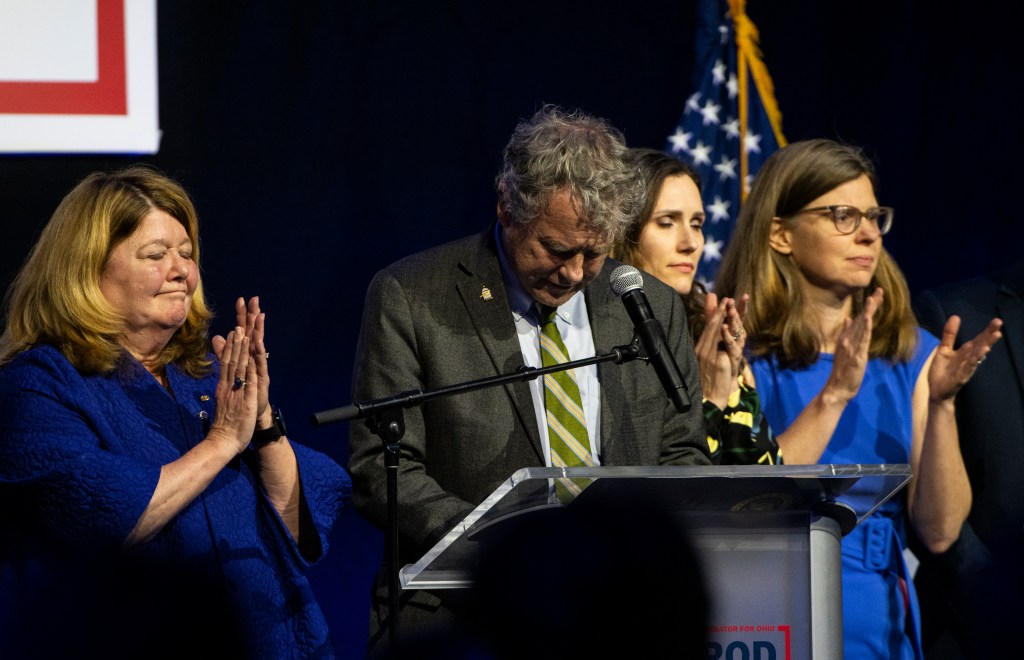
During the 2024 elections, Fairshake and its affiliates backed or opposed candidates in several high-profile Senate contests and in more than 50 House races, collectively spending more than $130 million. The most notable victory came in Ohio, where Defend American Jobs invested $40 million to help Republican Bernie Moreno topple Democratic incumbent Sherrod Brown, who, as chair of the Senate Banking Committee, had drawn the crypto industry’s ire for voting against a key piece of legislation it backed. Protect Progress, meanwhile, put more than $10 million into supporting Democrats Elissa Slotkin of Michigan and Ruben Gallego of Arizona—both seen as crypto industry allies—in their Senate campaigns. Fairshake encountered a mixed record in House races, backing some winners like Alabama Democrat Shomari Figures and North Carolina Democrat Don Davis, and some losers such as Virginia Democrat Dan Helmer and California Republican Michelle Steele.
As with most PACs, Fairshake and its affiliates mostly allocate funds to advertising—on television, digital outlets, or through mailed materials. Notably, the group’s ads seldom, if ever, mention crypto as an issue. According to Politico, in Fairshake’s 2024 spending spree to back Moreno, the two most-run Ohio ads in the cycle were both sponsored by Defend American Jobs, and neither mentioned crypto directly. That is not unusual for a single-issue PAC. “These PACs [might know that voters are not necessarily interested in their issue … so they make the strategic assumption that a particular message—maybe it’s going after the opponent’s character, a mistake they made, or economic discontent—might work better,” Michael Franz, a political science professor at Bowdoin College who studies campaign advertising and interest groups, told The Dispatch. “It’s not really about promoting their agenda … it’s really just about electing candidates.”
What’s in store for 2026?
Since late 2024, Fairshake and its affiliates have spent on several special elections—suggesting their tactic of broad spending across House races will endure. In 2025, Defend American Jobs and Protect Progress spent nearly $3 million supporting Republicans Randy Fine and Jimmy Patronis in Florida, as well as Virginia Democrat James Walkinshaw in three special congressional elections. The group’s 2026 activity began in February and March with a flurry of spending on both primaries and general elections, much of it directed at the Illinois Stratton campaign mentioned above. The PACs also provided substantial backing to Barry Moore in Alabama’s Republican Senate primary, Christian Menefee in Texas’s newly drawn 18th District Democratic primary runoff, Jasmine Clark in Georgia’s 13th District Democratic primary, and a number of other House candidates.
As of early April, the Fairshake network held roughly $170 million in cash on hand ready to deploy for additional 2026 primaries and general races. If the group’s spending mirrors its 2024 pattern, it should continue to spend modestly between now and July on friendly candidates in primaries, before ramping up dramatically in the three months leading to the November 3 general election.
With numerous primaries still on the slate ahead of the midterms, it remains unclear which Senate contests the PACs might target in 2026. Fairshake did not respond to a question from The Dispatch about the group’s 2026 strategy.
The industry’s long-sought market-structure legislation is still winding its way through Senate committees, and lawmakers’ actions—or inaction—on that bill before Election Day could influence which races the PACs decide to engage in. A likely destination for Fairshake spending is Ohio’s Senate race, where the PAC could attempt to replay its 2024 approach. There, Sherrod Brown—Moreno’s opponent in 2024—returns to run again, this time against crypto ally Jon Husted. A less certain target could be Maine, where Republican Susan Collins, broadly supportive of crypto legislation, will face either Graham Platner or Janet Mills in the general election; neither has expressed strong views on crypto regulation. Franz, who lives in Maine and follows the state’s races closely, thinks backing Collins could be a prudent move for a PAC seeking a victory. “It would be a safe, relatively decent bet to get involved in the Maine race,” Franz said. “It’s cheap compared to other states. It’s winnable. And then you can put that in the ‘win’ column.” A third state to watch is North Carolina, where Sen. Thom Tillis will be replaced by either Democrat Roy Cooper or Republican Michael Whatley. Tillis has supported crypto and played a key role in negotiating a dispute between the crypto and traditional financial services sectors that has, thus far, stalled progress on market-structure legislation.
If crypto market-structure legislation fails to pass before the election, lawmakers who opposed the bill or refused to advance it from committee could face targeted spending. If the bill does pass, however, a tax-modernization bill for crypto attest will likely become the next priority for the industry, meaning vulnerable crypto allies on the House Ways and Means or Senate Finance committees could receive extra attention. GOP strategist Andrew Surabian, whose Belmont Strategies is being paid by Defend American Jobs for consulting services, also did not respond to a request for comment.
New kids on the block.
In the 2024 cycle, nearly all crypto industry PAC money flowed through Fairshake or its partisan affiliates. In 2026, that unified approach is fracturing. “At least on the crypto side, we’re seeing a split in terms of where folks are putting their PAC dollars to work,” one crypto policy advocate, who was not authorized to speak on the record, told The Dispatch. Two new crypto groups, Digital Freedom Fund and Fellowship PAC, are breaking away from Fairshake’s nonpartisan stance and doubling down on backing pro-crypto Republicans.
Founded by Tyler and Cameron Winklevoss, owners of the Gemini exchange, in July 2025, Digital Freedom Fund intends, per Tyler Winklevoss, to “identify and support champions of President Trump’s crypto agenda in primary races and the midterm elections.” The group was initially seeded with around 188 bitcoin, valued at roughly $21 million at the time. The PAC has yet to spend in any races, and according to its most recent Federal Election Commission filing, had only $643,428 in cash on hand at the end of March. However, details about whether the group intends to liquidate any of its bitcoin remain scant, and the assets have fallen in value by about a third since transfer to the PAC. Its strategy is unclear, but it appears to be positioning itself within the “Make America Great Again” ecosystem; FEC filings show Digital Freedom Fund paying Advancing Strategies, an LLC run by former Trump campaign manager Chris LaCivita, $15,000 per month for consulting services. Neither LaCivita nor the Winklevosses responded to requests for comment from The Dispatch.
Fellowship PAC was launched in August 2025 and is closely tied to the cryptocurrency firm Tether. Tether’s head of government affairs, Jesse Spiro, heads the PAC, which has so far paid several million dollars to advertising firm NXUM Group, partly owned by Tether’s adviser for digital assets and U.S. strategy, Bo Hines. Before joining Tether, Hines was the director of the President’s Council of Advisers on Digital Assets and a key White House negotiator on crypto legislation. Of the $11 million the PAC has raised so far, $10 million came from Cantor Fitzgerald, the investment firm formerly run by Secretary of Commerce Howard Lutnick. Cantor Fitzgerald serves as custodian for the billions of dollars backing Tether’s stablecoin. Last September, Fellowship claimed commitments totaling more than $100 million, though that commitment has not yet appeared on its balance sheet.
Unlike the Digital Freedom Fund, Fellowship has begun to formally endorse candidates and spend in primaries. Earlier this month, the group endorsed Alan Wilson in South Carolina’s gubernatorial race, Rep. Mike Collins in Georgia’s Senate race, Rep. Julia Letlow in Louisiana’s Senate race, incumbent Pete Ricketts in Nebraska’s Senate race, Nate Morris in Kentucky’s Senate race, and Blake Miguez in Louisiana’s 5th District House race. By the end of March, the group reported about $8 million in cash on hand, and since then has invested $4.55 million in eight House and Senate races. Notably, Fellowship disclosed in an April 21 filing that it spent $1.75 million backing Ken Paxton in his Republican Senate primary runoff against incumbent John Cornyn, despite Cornyn’s broad support for crypto legislation. The status of the more than $90 million in commitments outstanding to the PAC remains unknown. Spiro and Fellowship did not respond to requests for comment from The Dispatch.
‘Sending a signal.’
With millions poured into dozens of races, what exactly are these crypto PACs after, especially when political science research generally finds that campaign messaging has limited measurable impact on voters’ choice?
Beyond potentially lifting a candidate to victory, PACs are often more interested in shaping behavior among incumbents than in altering any given race. “A group that wants to make a point can effectively put a lot of money behind a challenger and try to create a narrative,” Robert Boatright, a political science professor at Clark University who studies interest groups and elections, told The Dispatch. “In a lot of cases, it’s a matter of sending a signal.” For the crypto PACs, that signal may be that the crypto industry can step into races and spend millions in both support and opposition to candidates, meaning lawmakers should be cautious about blocking the industry’s legislative agenda. That looming threat of crypto dollars being used against them appears to influence lawmakers as discussions on a market-structure bill progress. “It’s definitely on the minds of members, especially with the whole bank vs. crypto fight on the stablecoin yield issue,” the crypto policy advocate said. But that pressure comes from two directions. “The banks are definitely trying to send a message to Senators right now as well,” the advocate added. “[They’re] saying, ‘Hey, we can play ball too.’”
Exactly how the Fairshake network, Digital Freedom Fund, and Fellowship will deploy their tens of millions in 2026 remains to be seen, but it will undoubtedly influence candidate and voter behavior, particularly in the remaining primaries. Measuring that impact, however, will be far from straightforward. “Primaries are pretty unpredictable. Turnout is crazy low—the typical primary turnout hovers around 20 percent—and primaries are often driven by factors beyond the candidates’ control,” Boatright said. “I would be very careful of drawing conclusions about crypto spending from individual primary results.”
The success of PAC advertising, after all, is likely to be limited at best. But crucially, that doesn’t mean it will be without any effect. “Advertising influence], at the end of the day, all comes down to very tiny margins,” Franz said. “But a very close race will be decided by tiny margins.”