
“But progressives only believe in nice things!”
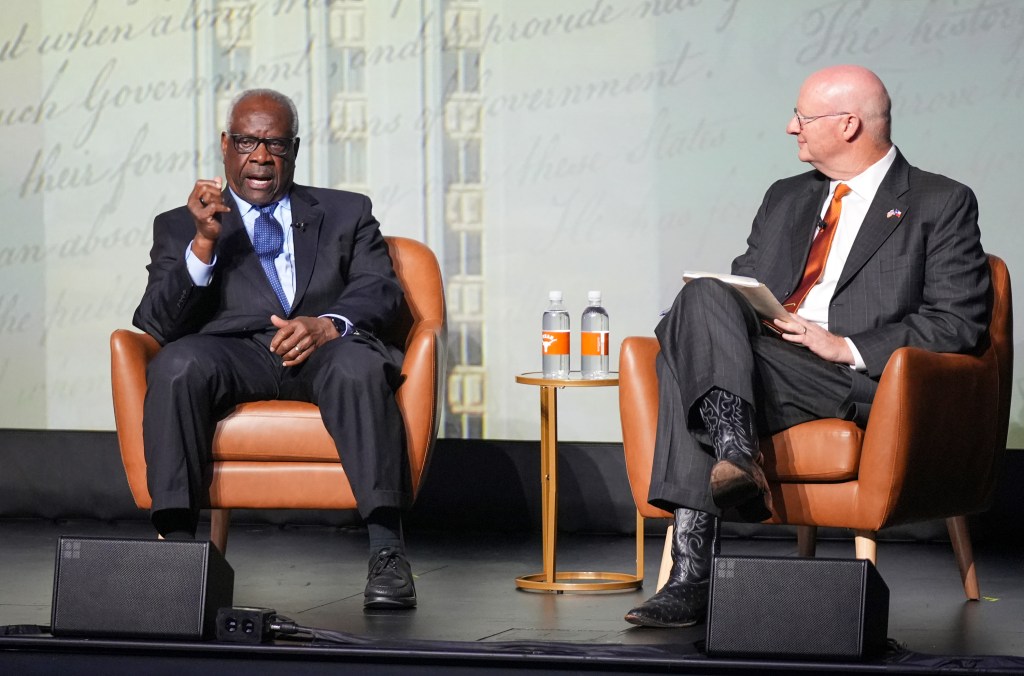
That terse charge rose from the most uninformed and idle corners of American public life after Supreme Court Justice Clarence Thomas delivered a personal, moving—and, in truth, entirely unproblematic—address at the University of Texas, in which he laid out two sets of guiding principles and assumptions contending for dominance in our political culture: the ideas enshrined in the Declaration of Independence 250 years ago and those introduced during the Progressive Era about a century ago.
Justice Thomas speaks about Woodrow Wilson and Otto von Bismarck, and we are met with a chorus of partisan dullards who clearly think he is addressing James Talarico—or Thurgood Marshall.
Erwin Chemerinsky is no fool, but—if the judges will forgive me for staying intra-squad here—his account on SCOTUSblog typifies the problem: “Thomas implies that the country began to go wrong early in the 20th century with the presidency of Woodrow Wilson. It is true that Wilson regarded himself a progressive. But, on race issues, he was among the least progressive presidents, denying Black individuals access to the federal civil service.”
It is not merely that Wilson “considered himself a progressive.” It is the case that Wilson, in his era, was the single most powerful and consequential leader within the American progressive movement. As Justice Thomas explained—and the point is hardly controversial among those with a historical education—Wilson despised the principles of the Declaration of Independence and the Bill of Rights, preferring instead a government governed by relatively unfettered “scientific” expertise. There existed a Progressive Party, whose most successful presidential candidate—perhaps you have heard of Teddy Roosevelt—advocated white supremacy and argued that the majority of African Americans in the South were “wholly unfit for the suffrage.” His running mate was the California governor who signed the Alien Land Law of 1913, designed to prevent Asian immigrants (already barred from naturalizing as citizens) from owning land in California. Wilson, the godfather of American progressivism, did not merely tolerate racial segregation in the federal workforce but imposed it on the federal civil service where it had not previously existed.
Wilson did not stand alone in this impulse. The progressive champion Oliver Wendell Holmes Jr. secured the Supreme Court’s approval of forced sterilization for eugenic purposes in Buckv.Bell and was supported in this by the progressive heroine Margaret Sanger. Soon after, the New Deal coalition formed around progressive officeholders, primarily Democrats, who backed Franklin Roosevelt on priorities such as business regulation, economic stewardship, and welfare spending, yet who were also committed segregationists. You do not need to take my word for it—or Jonah Goldberg’s—you can consult Ta-Nehisi Coates or any reputable history book.