
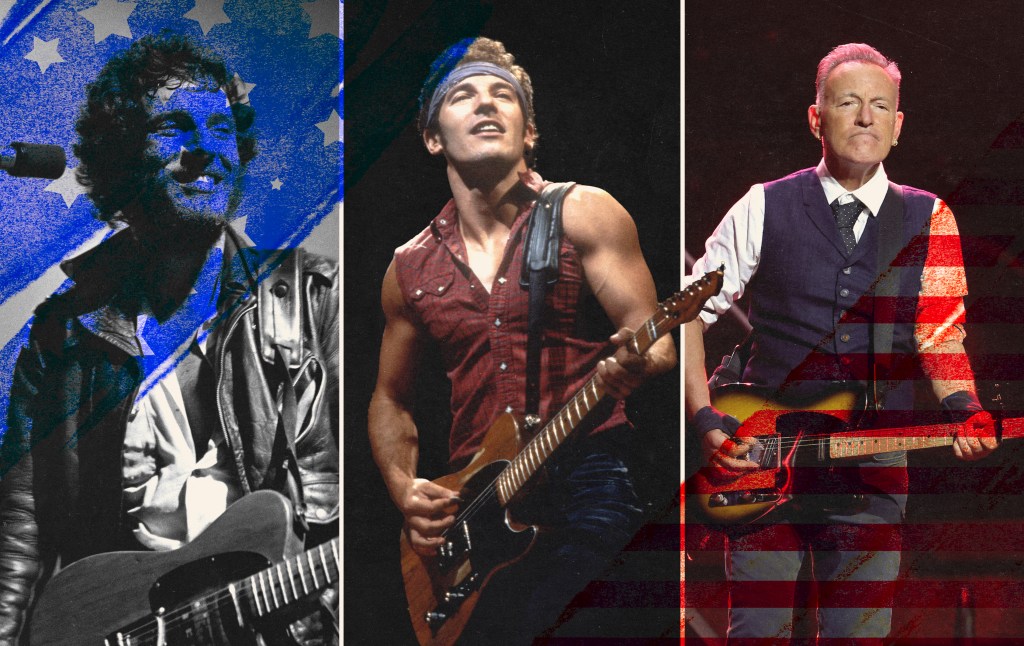
Just days ago I found myself at a No Kings gathering in Newark, New Jersey. In strict terms, the event marked the seventh stop on Bruce Springsteen’s current tour—an itinerary he admitted he hadn’t anticipated undertaking. “We never planned this run,” he told the crowd, “but we pressed forward because I needed to feel your hope, your strength, and I needed to hear your voices.”
There’s something reassuring about assembling an entire arena full of devoted followers who sing back the thoughts you once had at twenty-five, especially when you’ve been feeling a touch disconnected. Some men pursue connection through platforms like OnlyFans, yet Springsteen connected with roughly 20,000 fans because venues couldn’t accommodate more. It’s alright—he has earned that affirmation.
What compelled Springsteen to hit the road were the pressures weighing on many of us. Earlier this winter he wrote about the shootings of Renee Good and Alex Pretti in a track titled “Streets of Minneapolis.” At the concert, images of the two appeared on the screens. He echoed Good’s apparent final words, “I’m not mad at you,” tucked into one of his characteristic stretches of stage banter.
Springsteen tends to be a subtle songwriter, yet his judgments about systemic virtue and vice don’t tread the same nuanced ground as his portraits of people toiling in blue-collar jobs. And that’s perfectly fine. Bob Dylan remains the gimlet-eyed poet for that kind of writing. Springsteen seems to cast himself more in the Woody Guthrie tradition, where there is a clear dichotomy between the powerful and the common folk.
All that said, the new song itself isn’t particularly strong. It carries a hurried, offhand quality—perhaps a reflection of Springsteen’s claim that he finished it in roughly a day. A protest song’s power comes not only from sentiment but from precise lyricism, and in “Streets of Minneapolis” Springsteen doesn’t exhibit the rigor he’s shown in many earlier works. He rhymes “singing through the bloody mist” with “and the stranger in our midst.” He sings “King Trump’s private army from the DHS / Guns belted to their coats / Came to Minneapolis to enforce the law / or so their story goes.” I don’t object to the near-rhyme of “coats” with “goes,” but the notion that police carry guns strapped to their coats isn’t accurate. Is this meant to evoke Pinkertons, some broad notion of ominous figures, or, more likely, did he simply need a rhyme for “or so their story goes”?
Springsteen seems to sense that, however vital the sentiment, the composition doesn’t quite suit the moment. Three times during the performance the arena lights brightened as Springsteen urged the crowd to chant, “ICE OUT NOW!” trusting less in the moment’s power to carry itself.
Nevertheless, I find it forgivable for Springsteen. That single song was a misfire, especially when contrasted with his 2001 track “American Skin (41 Shots),” which also grapples with a real police shooting and employs genuinely deft lyricism and musicality to lift sentiment above the sloganeering of “Street of Minneapolis.”
Yet the song remains sincere and imbued with that hallmark quality Springsteen has always radiated: earnestness. Springsteen has always been earnest, and his fans reciprocate with genuine devotion, some absorbing from him the energizing, fist-pumping vibe while reserving politics for others to unpack.
As the 76-year-old moved across the Newark stage with his characteristic swagger and agitation, I found myself pondering how Springsteen’s politics stack up against those of younger generations.
One example of a politically engaged, somewhat younger musician sharing the stage was 61-year-old Tom Morello of Rage Against the Machine. Morello, a Springsteen collaborator for more than two decades, is a committed leftist who even sports a hammer and sickle on his “Arm the Homeless” guitar. Springsteen never struck me as embracing that kind of radical political dedication. He has always given the impression of an FDR Democrat who’s shaking his head at what his country has become. In fact, he and former Sen. Sherrod Brown, the politician I suspect he resembles most, share a gravelly vocal quality and a soft spot for Youngstown, Ohio, with its blast furnace that “made the cannon balls/ That helped the Union win the war.”
If Springsteen’s catalog functioned as an infrastructure bill it would lower unemployment to the Fed’s target of 2 percent.
The newest generation of musicians features Billie Eilish, who recently invoked the fashionable idea that America rests on stolen land. Springsteen has written about Native Americans often and with profound sensitivity. Yet he embraces the seemingly dated concept of the melting pot in the track, singing, in “American Land” that “The McNicholases, the Posalskis, the Smiths, Zerillis too/ The blacks, the Irish, Italians, the Germans and the Jews … Their hands that built the country we’re always trying to keep down.”
Indeed, and this is what endears me to Springsteen and what I’ll miss about his generation of baby boomers. They were raised in what a Billie Eilish type might call the stew of propaganda behind American exceptionalism. And while the Vietnam War widened Springsteen’s and his peers’ horizons, nothing could permanently overturn the idea of America as the land of opportunity, or dislodge its standing, to cite the Newark concert’s rendition of “The Promised Land.”
The disappointment in not attaining our national ideals is, for baby boomers, a promise unmet—a dream that, even if not currently fulfilled, remains not a falsehood. Still, Springsteen builds. He does so figuratively through his music, through the deliberate arrangement of his backing band as a community, and through the bond with his fans. But I also mean that Springsteen is committed to building, both in metaphor and in the physical sense of architecture. His generation believed in construction. They believed in structures. Their landscape is one of edifices, and their monuments were of concrete and steel, not abstract or electronic. This explains why Springsteen has sung about towers, churches, jails, tunnels, skylines, reservoirs, bridges, trestles, rises, mansions (of glory, of fear, on the hill), sidewalks, roads, streets, avenues, boulevards, girders, promenades, railroad tracks, rafters, and, in at least three songs, refineries. If Springsteen’s catalog were an infrastructure bill, it would push unemployment down to the Fed’s 2 percent target. He has referenced “highways” more often in his lyrics—over 400 times, according to SpringsteenLyrics.com—than there are active highways in New Jersey (117, per Wikipedia).
The people who built this country, in Springsteen’s telling, deserve praise for their industry rather than condemnation as despoilers or thieves of stolen land. Springsteen himself remains, at times disappointed but never cynical, a citizen of an America that builds. He consistently offers a message that might not always uplift, but is always, in a practical sense, constructive. He is an artist whose role isn’t to persuade you to tear everything down, but to argue that there is ground to believe in something worth preserving.
Correction, April 29, 2026: This piece has been amended to remove a misidentified reference to Springsteen’s guitar.