
You’re reading Dispatch Markets, a weekly dive into the forces driving economic growth—and those holding it back—featuring Scott Lincicome, Kyla Scanlon, Karl Smith, Marian Tupy, and Adam Ozimek.
Last week the Pentagon’s chief technology officer tweeted a photo of President Donald Trump pumping his fist, with overlaid text declaring, “Americanism, Not Effective Altruism.” The post itself stated, “The United States will NEVER be an effective altruist country.” It’s fair to say that most of the 2.8 million viewers who saw it were left puzzled, a small portion were outraged, and I, as they say, was shocked but not surprised.
Let’s bring everyone up to speed. Effective altruism is a movement that began to take shape in the late 2000s, built on the idea that we have not only a responsibility to help those in need but to do so in the most scientifically effective manner possible.
From its outset, the group skewed toward a nerdy, intensely online crowd. Over time, it evolved into a label for a Silicon Valley‑centered subculture and the particular values it prized. One of those values related to the growing field of artificial intelligence. This is the juncture where Trump enters the narrative.
Effective altruists were among the earliest and most vocal advocates for stringent regulation of AI, or even an outright ban. The Trump administration views such proposals as contrary to national interests, treating AI as a decisive arena in an escalating cold war with China. They contend that trying to curb or slow American AI progress merely serves Beijing’s aims.
Consequently, the Department of Defense, and especially the Office of the Undersecretary for Research and Engineering, regard effective altruists as unpatriotic at best, if not anti-American. The recent tweet arises from the growing prominence of AI safety in public discourse in recent weeks, following disclosures by a former OpenAI employee and later an Anthropic insider about what they perceived as overly lax safety practices at both firms.
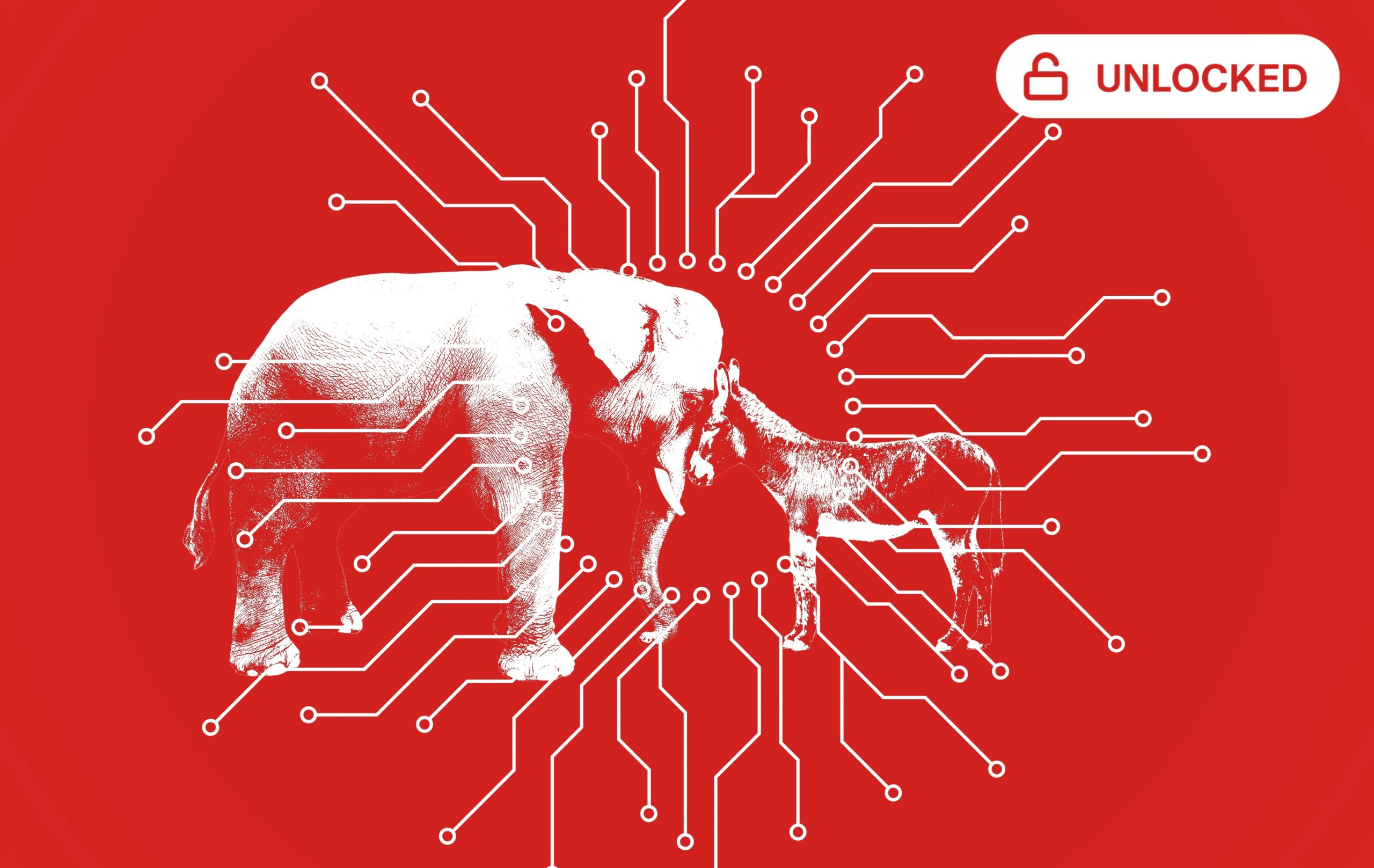
Beyond that, the undersecretary’s office was drawing the ideological battle lines: Republicans, who the president expects to back AI initiatives, versus Democrats, who are increasingly expressing skepticism—and, in some cases, outright opposition—to the AI sector.
As strange as this whole scenario is—and it is odd—there is a sense of predictability, even a curiously comforting one, in watching the AI politics unfold in this fashion. In a real sense, both parties are returning to their roots.
The deep structure of U.S. political alignment.
The Republican Party has long stood for business interests, while Democrats have been the party more suspicious of—or even hostile toward—the corporate sector. This dichotomy, more than any other, has shaped the two parties’ relative stances through thick and thin. It stems from fundamental socioeconomic realities of the American economy.
Stay ahead of the policies shaping free enterprise and impacting American business.
Get the U.S. Chamber’s free newsletter for insights on the economic policy, workforce trends, and regulatory landscape that affect businesses and markets.
Subscribe for free
By subscribing you agree to receive communications from the U.S. Chamber of Commerce.
A curious shift began to take shape around the turn of the millennium, softening the stark divide. It never dissolved entirely, but it grew to the point that many large firms leaned toward Democratic positions on the era’s hottest debates, while the Republican base found its strength in working-class voters.
It’s difficult to pinpoint the exact moment this softening started, yet the final years of the second Clinton term offer a convenient starting point. That era saw a historic run-up in stock prices driven by the dot-com boom, with the most explosive gains concentrated in tech firms based in the Bay Area, a region long associated with left-of-center politics.
Notably, then-Vice President Al Gore—a pioneer in championing the Internet—maintained a distinctive rapport with the tech giants at the heart of this surge. Gore was also an early voice on climate risks, urging the need for new green technologies even then.
This proximity between the economy’s fastest-growing sector and the soon-to-be Democratic nominee reflected more than Gore’s quirks. It signaled a deeper transformation in the politics of profit: from an economy run by tangible, physical capital to one dominated by intangible, digital capital.
A history of not-so-strange bedfellows.
Since the mid-1800s, big business has been tied to industrial growth. Large concentrations of ore, steel, and power were built on the back of combustion and combustion-driven processes, naturally drawing certain adversaries. The Republican Party emerged as the defender of industrialists, while the Democrats evolved into the advocates of their rivals.
The simplest antagonists of industrial growth are environmentalists. By the late 1800s, long before climate science, Americans grew increasingly alarmed by the smoke, soot, and effluent flowing from industry as a standard byproduct of production. People spanned a spectrum—from viewing pollution as a regrettable but necessary evil to characterizing it as outright malevolence. The latter were the precursors of modern environmentalism.
Environmental activism rose to prominence in the mid-20th century, though its most storied institutions trace back nearly a century. And, as Ted Nordhaus of Breakthrough Institute convincingly argues, the core organizing principle of mainstream environmentalists has long been opposition to the expansion of heavy industry. That framework made it structurally difficult for environmentalism to anchor itself within the Republican coalition, and thus it naturally evolved into a Democratic stronghold.
Beyond environmentalists, the Democratic Party’s enduring opponents were readily identifiable: labor unions, left-leaning economic progressives, and what we could call technocrats. The inevitable tension among these groups and big business is hardly surprising, though explaining it structurally is a touch more intricate. Unlike environmentalists, none of these three are inherently opposed to industrialization itself.
Labor unions, unlike other forms of organized labor, rely on industrial activity to exist. Trade unions gain leverage by disrupting the flow of skills through the economy, while craft unions wield power by depriving factory owners of access to their tools. This is the force of the picket line, enabled by the existence of factories, railways, oil rigs, and other industrial assets that can be blocked or controlled.
As those fixed hubs of production gave way to office work that could be conducted in essentially any suitable building, the leverage of labor unions and their intrinsic friction with big business diminished. That dynamic was a major driver of the politics surrounding the turn of the millennium.
But before we move deeper into that era, let’s briefly address the other two natural opponents of industry: economic progressives and technocrats.
Building and operating a single factory—or an entire industrial empire—is profoundly different from working for one. This is not universal, but many professions share this gradient: running a large law firm is quite different from being a junior associate, and similarly, the path of a trained tradesperson differs from that of a master professional.
Importantly, hiring many junior lawyers or bringing in numerous pipefitting apprentices now tends to expand the pool of future partners and masters. Consequently, the incomes of those at the bottom are, to some degree, tied to those at the top.
Yet industrial magnates have enjoyed a history of wealth and earnings that are detached from the fortunes of their workers since the outset. The wealth of a magnate did not measure the typical wage of a skilled worker; it captured ownership of an enterprise that could become more valuable without any single worker becoming more valuable. Working in a mill did not train someone to become its owner.
Across many sectors, top earners can outpace those at the bottom by substantial margins. Nevertheless, professional firms with wealthy partners often pay their associates well, and lawyers at every level typically earn more than welders but less than physicians of comparable talent and experience within their fields.
That’s where economic progressives fit in. They recognize individuals contributing to the same productive enterprise while the rewards accumulate in starkly different ways. Advancing one’s skills doesn’t automatically close the gap, and training more workers doesn’t necessarily create more competitors for the owner. A progressive may welcome the factory and its productivity, while arguing that the resulting income distribution calls for policy correction. The owner, for their part, can sincerely argue that the wealth is compensation for building something that otherwise wouldn’t exist.
As for technocrats, they’re those who specialize in guiding society on how to proceed. This includes traditional experts from academia and nonprofit sectors, as well as “social planners” in government—traffic engineers, city zoning authorities, electricity-grid operators, and regulators of many sorts.
The tension is straightforward: private-sector industrialists and public-sector technocrats represent two principal centers of power in the economy. Legislation that amplifies one’s discretion inevitably curtails the other’s.
Then software ate the world.
When the dot-com crash struck in 2000, the value of internet-enabled companies plummeted, yet the internet’s impact on the American economy continued its rapid acceleration. In 2000, Walmart earned over 70 times Amazon’s revenue. By 2005, Walmart’s edge had shrunk by half, and from 2005 to 2010, it was reduced by another third.
Across the economy, software‑driven firms like Salesforce were coming to dominate the value chain of many U.S. products. Software also enabled the coordination of sprawling global supply chains, hastening deindustrialization. Marc Andreessen, co‑founder of Netscape and later a venture capitalist, famously noted that software was “eating” the world.
This shift reshaped the economic fundamentals of American politics. The largest corporations began resembling engineering firms more than heavy industrial giants. By 2010, Apple—then the world’s largest consumer electronics company—was mainly producing its hardware through overseas contractors. As the pinnacle of the economy moved from physical manufacture to information and design, the friction between big business and environmentalism softened.
During the same span, U.S. manufacturing jobs plummeted from 17 million in 2001 to 11.5 million in 2010, eroding what remained of industrial labor unions’ political influence.
The flattened structure of the tech industry also shifted perceptions of income inequality. The founders behind Silicon Valley’s megacorporations amassed immense wealth, yet broad stock options helped ensure that many early employees weren’t left completely behind.
Finally, a growing number of founders came from academia and maintained close, respectful ties with the technocratic class. This made them more amenable to technocrats’ interests and, perhaps more importantly, eased anxieties about a lightly regulated tech sector. In one sweep, the Democratic Party’s structural opposition to big business largely collapsed.
That has been the world we’ve inhabited for nearly twenty years. The absence of a tight economic-political alignment allowed culture wars to take the foreground. The highly educated, urban, socially liberal tech sector drifted toward the Democrats, while the GOP morphed into the party of the working class.
Industrialization strikes back.
AI, however, has almost instantly revived the old structural alignment between business and the Republican Party. AI depends on vast data centers to function, and those centers demand enormous amounts of electrical power. Providing that infrastructure requires robust domestic industrial capacity. Unsurprisingly, environmentalists were among the first to oppose this development.
Yet soon after, the technocratic class joined in, voicing concerns about AI’s potential harms, most clearly expressed by the effective altruists. That dynamic helps explain why Trump’s tweet felt so foreseeable. As soon as advancing AI equaled rapid reindustrialization, the GOP naturally lined up with industry, and Trump signaled that realignment in the most provocative manner possible.
But this is not the end. The rest of the realignment follows a similar logic. Already, worries about AI and income inequality are surfacing within the left wing of the Democratic Party. Labor will be a key pillar in any shift, and growing demand for electricians, pipefitters, and construction workers across trades makes a resurgence of politically influential labor organizations likely.
What we are observing is a dramatic, yet fundamentally foreseeable, realignment in American politics—and it’s only beginning.
Markets FTW
The ascent of Barnes & Noble illustrates why the adaptability and vigor of the free market can’t be outmatched. B&N rose to national prominence amid a wave of big-box retailers that emphasized scale and uniformity. The idea was that a centrally planned layout, stock management, and pricing could yield efficiency gains that would fund an enhanced customer experience.
This line of thinking appeals to many enthusiastic social planners who imagine a government-run economy could provide everything people want at prices everyone can afford. And indeed, free-market proponents must acknowledge there is some truth to that. The challenge is stepping back from centralization when it isn’t delivering results. Governments seldom manage that pivot effectively, but James Daunt, Barnes & Noble’s current chief executive, pulled it off brilliantly.
Daunt flipped the big-box model on its head. He let individual stores decide which books to stock and what prices to set. He opened smaller locations and increased full-time staffing, moves that ran counter to the efficiency-first creed of big-box retailers. And by the looks of it, Barnes & Noble appears to be thriving, with around 60 new stores planned for this year.
Chart of the Week
On his Substack, economist and former Goldman Sachs chief foreign exchange strategist Robin J. Brooks discussed a potential ban on U.S. diesel exports. While he concludes that an outright ban is unlikely at current prices, the chart below illustrates why a number of vulnerable Republicans are advocating for one ahead of the midterms.
Disclaimer: The opinions expressed above do not necessarily reflect those of the presenting sponsor.