
You’re reading Dispatch Energy, a regular dive into the politics, policy, and innovation shaping America’s energy future, featuring a roster of subject-matter experts including Alex Trembath, Philip Rossetti, Lynne Kiesling, Rory Johnston, and Roger Pielke Jr.
Editor’s Note: Beginning this week, Dispatch Energy will be in your inbox every two weeks. So keep an eye out for the next edition on August 25.
Greetings to Dispatch Energy! Crude prices stay under $100 per barrel even as the Strait of Hormuz has seen near-continuous shutdowns for more than five months. Much of the early worry about what such a lengthy blockage might mean for global oil prices has not yet come to pass. Indeed, pump prices remain elevated, driven in part by an ongoing bottleneck in refining capacity, as I noted in my previous issue. Yet even after accounting for these record-high refining margins, pump prices have not climbed back to the highs seen from March to April, and they are far below what one might expect given such a sharp supply disruption.
What drives this outcome? A dramatic drop in crude imports by China, which I’ve labeled the “Beijing Swing,” has dampened the price spike from the crisis. From prewar levels through June, China trimmed its seaborne crude imports by about 5.4 million barrels per day, absorbing the bulk of the unmitigated supply loss caused by Hormuz’s closure. That amount represents more than 40 percent of China’s total prewar imports and is roughly on par with India’s entire petroleum demand. The reduction pushed Chinese crude imports to their lowest point since 2015 and cut seaborne crude import demand by more than the combined volume of all IEA member states’ strategic petroleum releases.
How China managed to achieve this reduction remains a matter of intense debate, as does the motive behind these actions.
The Beijing Swing stands out as the key—yet broadly unanticipated—offset within this crisis. At first glance, the decline in imports seemed modest: expectations of a drop in China’s intake were consistent with Asia’s overall pattern, as the region’s Middle East-origin crude supplies dominate. Then, while other Asian economies’ crude imports bottomed in April to May and recovered through June, China’s continued decline persisted. It was the combination of diminished Chinese competition for scarce sea-borne barrels and the large-scale release of global strategic inventories that enabled an uneven recovery across Asia. Beijing even reduced its seaborne imports of Russian crude from prewar levels, even though Russian crude exports were not only insulated from Hormuz disruptions but had actually risen during the conflict.
One of the main difficulties in tracking this shift is that Chinese data is opaque and incomplete; unlike most other major consumers, China does not publish official monthly consumption figures or any data on crude or refined-product stockpiles—neither commercial nor strategic stocks. Consequently, we must infer “apparent” demand from officially reported refined-product output (gasoline, diesel, etc.) plus net imports. These apparent-demand estimates, which are heavily driven by domestic refining activity, have fallen at a pace not seen before.
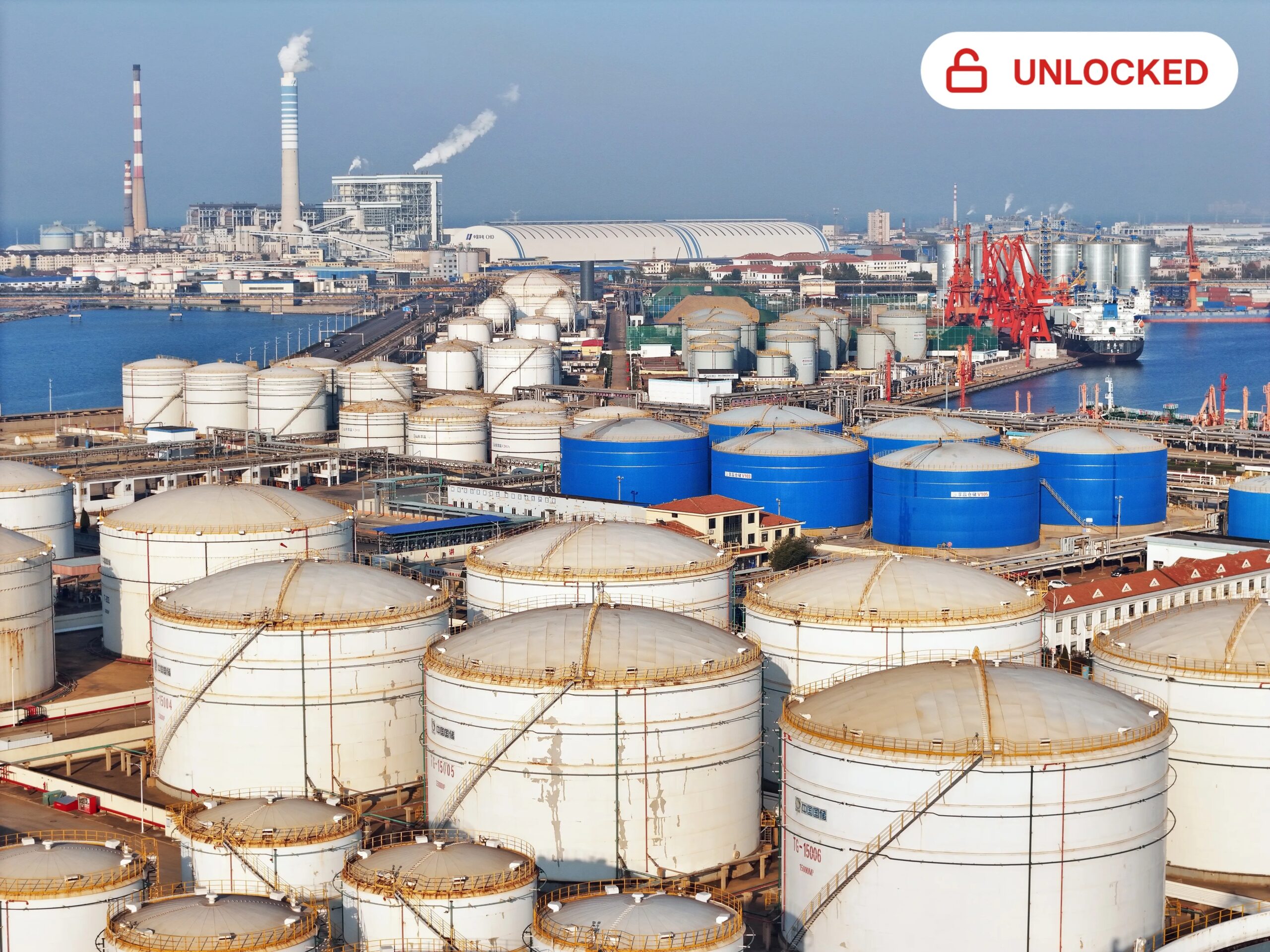
In broad terms, crude oil in China can go to two destinations: refineries, where it is transformed into finished consumer products (or petrochemical intermediates), or storage within China’s expanding commercial and strategic stockpiles. The decline in refining activity accounts for roughly half of the import reduction. Official figures from the Chinese National Bureau of Statistics show that the country’s refining runs—the volume of crude routed through refineries—dropped by 2.7 million barrels per day from prewar levels through June. This marked the steepest contraction in runs on record, surpassing even the troughs seen during the COVID-zero period in 2022.
The other half of the import decline is tied to China’s stockpiles, both commercial and strategic. The backdrop here is China’s truly monumental reserve, with estimates of total oil in storage around 1.2 billion barrels, though official data remains elusive. China had been aggressively stocking up on oil just before the Iran conflict amid ample supply and softer prices, providing a crucial safety net to a fragile oil market as I noted in my inaugural Dispatch Energy piece.
One particular challenge in assessing prewar stockpiling is that estimates based on official Chinese data—domestic production plus net imports minus refinery runs—imply that Beijing was adding about 1.7 million barrels per day to its stockpiles in the three months before Hormuz closed. Yet this figure is suspect: it’s higher than plausible and pessimistic about future demand, given that those barrels were surplus to China’s prewar needs. In fact, if this estimate is correct, it would imply that since 2017 Chinese crude inventories have grown by nearly 3 billion barrels, significantly higher than other estimates, which place total Chinese inventories far closer to 450 million barrels based on satellite imagery.
Meanwhile, third-party estimates place China’s prewar stockbuilding at a much more conservative pace of around 550,000 barrels per day. The catch is that this figure leaves a sizable portion of the import reductions unexplained. The unexplained portion likely stems from either larger refinery-run reductions than official data show or larger crude stock draws through June than third-party inventories imply—potentially due to underground strategic reserves not detectable by satellite analysis.
So what’s happening in China’s refined-products market? Chinese demand for petroleum products ranks second only to the United States, and for much of the last two decades has been a major driver of global demand growth. On one hand, the drop in refining runs could reflect shrinking margins. China sought to dampen the price surge from Hormuz by capping domestic pump prices—the guided diesel price, effectively a ceiling—rose by about 36 percent at its peak, even as global wholesale prices more than doubled. The result was a squeeze on refining margins driven by a combination of modest domestic product prices and the steep rise in imported crude costs.
China appears to be managing with notably less fuel moving through its economy, but explanations vary widely. Export bans on refined products such as diesel and jet fuel in the early weeks of Hormuz’s crisis can account for roughly 10 percent of the reduction in refining runs—a policy decision that, as discussed last month, has exacerbated the refining capacity crisis and helped keep pump prices elevated. Another 10 percent can be attributed to reductions in petrochemical output—often fueled by refined products like naphtha or liquefied petroleum gas (propane)—or substitution with natural gas or even coal-derived alternatives for those feedstocks.
Chinese EV sales have dominated headlines in recent years, yet they cannot fully explain a sudden decline of about 20 percent from prewar levels. Although more than half of new vehicles sold are electric or plug-in, internal combustion engines still outnumber their electric counterparts by roughly nine to one overall. That said, surging EV adoption has undeniably cooled domestic demand growth, and the rise in total EV charging is on track to displace over 300,000 daily barrels of Chinese gasoline demand this year, according to figures derived from the China Charging Alliance’s data. Importantly, this shift was underway before Hormuz became a focal point.
Likewise, the drop in apparent diesel consumption—also near 20 percent—cannot be fully explained by visible industrial activity. While a weakening construction sector and property slump contribute to some demand softness, the downturn extends beyond a few quarters; mobility indicators from truck fleets and urban congestion measures captured by firms like Baidu show no abrupt downturn in movement. Moreover, despite price controls, fuel costs have risen through the crisis but have not reached the levels observed in broader markets or U.S. pump prices—hardly the hallmark of immediate demand destruction driven by price spikes.
It’s possible that Beijing is releasing strategic or otherwise unseen stockpiles to close the supply gap. There’s no conclusive evidence that China is discharging gasoline or diesel from strategic reserves; we lack both official data and satellite-based estimates since most product inventories do not use floating roofs that satellite imagery can readily track. Nevertheless, analysts have long suspected that, beyond crude stockpiling, Beijing has accumulated refined products like gasoline and diesel to shore up energy security. It’s conceivable that China is drawing down refined-product stockpiles to cushion the impact of reduced refinery output. The same logic could extend to petrochemicals: official data show primary plastics output dropping faster than finished plastic products, signaling tighter upstream intermediate supplies.
In any case, the presence of unobservable Chinese stockpiles injects substantial uncertainty into global oil markets. In the short term, China’s current import reductions are unlikely to be sustainable if unvisible product stocks are being aggressively drawn down to stabilize the domestic economy. In the longer run, actual Chinese refined-product demand may prove smaller than forecast if what looked like consumption around late 2025 to early 2026 was in fact stockpile-building. The only sure bet is that the coming months will reveal more about China’s crude-buying behavior, gradually clarifying the state of the country’s opaque domestic stockpiles.
China is acting in its own perceived best interests. The simplest explanation is that Beijing needs external markets to absorb its exports, which would suffer if Hormuz-driven weakness persisted. The country has been seeking to diversify away from the U.S. market amid a fluctuating trade dispute, aiming it toward Asia and Europe as the two main large blocs to pursue. Unfortunately, both regions are particularly exposed to Hormuz-level price shocks due to their heavy reliance on energy trade with the Middle East, meaning a price-led recession could strike at an inopportune moment for Beijing’s export ambitions.
Still, analysts float a range of theories, some more speculative than others, including ideas of a secret deal between Xi and Trump or a tactic by Xi to blunt the U.S. economy temporarily only to tighten the screws again and boost imports before the midterm elections. While the more conspiratorial notions are unlikely, the possibility that China could wield this powerful energy lever in ways that hurt the West should be a signal to Washington and its allies to monitor developments closely.
The Beijing Swing has thus far been a boon for Western consumers. China’s ability to tilt global oil balances by roughly the same magnitude as the entire OPEC+ group has been demonstrated. Yet the United States carries a difficult history with OPEC+, an organization that frequently sets production through policy rather than market signals. It is troubling that a similar degree of market power is now being exercised on the demand side by a strategic rival.
Policy Watch
- The Iran conflict persists, and traffic through the Strait of Hormuz has fallen well short of the recent highs seen after the U.S.–Iran MOU was signed in June. The waterway’s 10-day average flow climbed to more than 15 million barrels per day by early July as ships hurried to exit, according to Kpler’s tanker-tracking data. Even after the MOU’s conclusion, Washington and Tehran clashed over traffic-control details through Hormuz, a dispute that sparked renewed tit-for-tat actions and strikes on regional shipping. Today, the 10-day moving average has dropped to about 5.5 million barrels per day, roughly a quarter of the prewar level, and there’s little sign that Hormuz’s security situation will improve soon.
- In late July, Yemen’s Iran-backed Houthi movement announced a maritime blockade targeting Saudi vessels in the Red Sea in response to a breakdown in a long-standing ceasefire with Riyadh. Such a blockade adds new complexity to the already sizable oil flow through the Red Sea and is especially troubling given the current geopolitics. Saudi Arabia’s East-West pipeline had been the principal rerouting channel for oil leaving Hormuz, but the pipeline’s infrastructure has faced renewed attacks amid Houthi efforts to strike Saudi energy facilities. Saudi exports through Red Sea ports before the war were typically under 2 million barrels per day, but that figure has surged to more than 5 million barrels daily during the conflict. The Houthi blockade has two major consequences for Saudi shipping: (1) most tankers now operate without identification transponders, making tracking harder for both observers and rivals; and (2) more Saudi barrels head north through the Suez Canal and the Suez-Mediterranean pipeline. The conflict has also spilled beyond waterways to assaults on Saudi oil installations, from the Jazan refinery to Abqaiq, the world’s largest oil-processing facility, located at the head of the East-West pipeline, capable of handling a significant portion of global output.
Innovation Spotlight
- Oil trading is beginning to shed some of its traditional weekday obsession, with rising attempts to roll out oil derivatives that trade around the clock. Classic West Texas Intermediate and Brent futures, traditionally traded on the New York Mercantile Exchange and the Intercontinental Exchange from Monday to Friday, are gradually giving way to 24/7 trading models. This shift aligns with periods of rapid, weekend-driven conflict in the Hormuz theater, boosting demand for weekend price-yielding mechanisms, including platforms leveraging cryptocurrencies like HyperLiquid that offer around-the-clock price discovery.
Further Reading
- This week, the U.S. Department of Energy disclosed that the volume of crude stored in the Strategic Petroleum Reserve (SPR) dipped below 300 million barrels for the first time since the reserve’s initial filling nearly five decades ago. With SPR inventories so lean, debate is intensifying over how much farther the SPR can be drawn down given the statutory and physical constraints of the U.S.-controlled caverns that make up the reserve. Nevertheless, I believe there remains substantial room for further SPR reductions, a view thoroughly argued by Arnab Datta in Bloomberg’s Odd Lots newsletter.