
You’re reading Dispatch Energy, a weekly newsletter on energy and climate policy featuring Alex Trembath, Philip Rossetti, Lynne Kiesling, Rory Johnston, and Roger Pielke Jr. To access more Dispatch reporting and analysis, become a member today.
Welcome to Dispatch Energy! The ongoing data center energy use issues continue to evolve, but rather than relentlessly beating that drum, I am taking inspiration from Jonah Goldberg to engage in some counter-programming. This month and next, I’ll tackle a topic that has captured my attention for most of my career: how the economics and technology of the power system interact and feed into the architecture of that system. The history of the power system as a system provides useful insights in a moment of turbulent transformation.
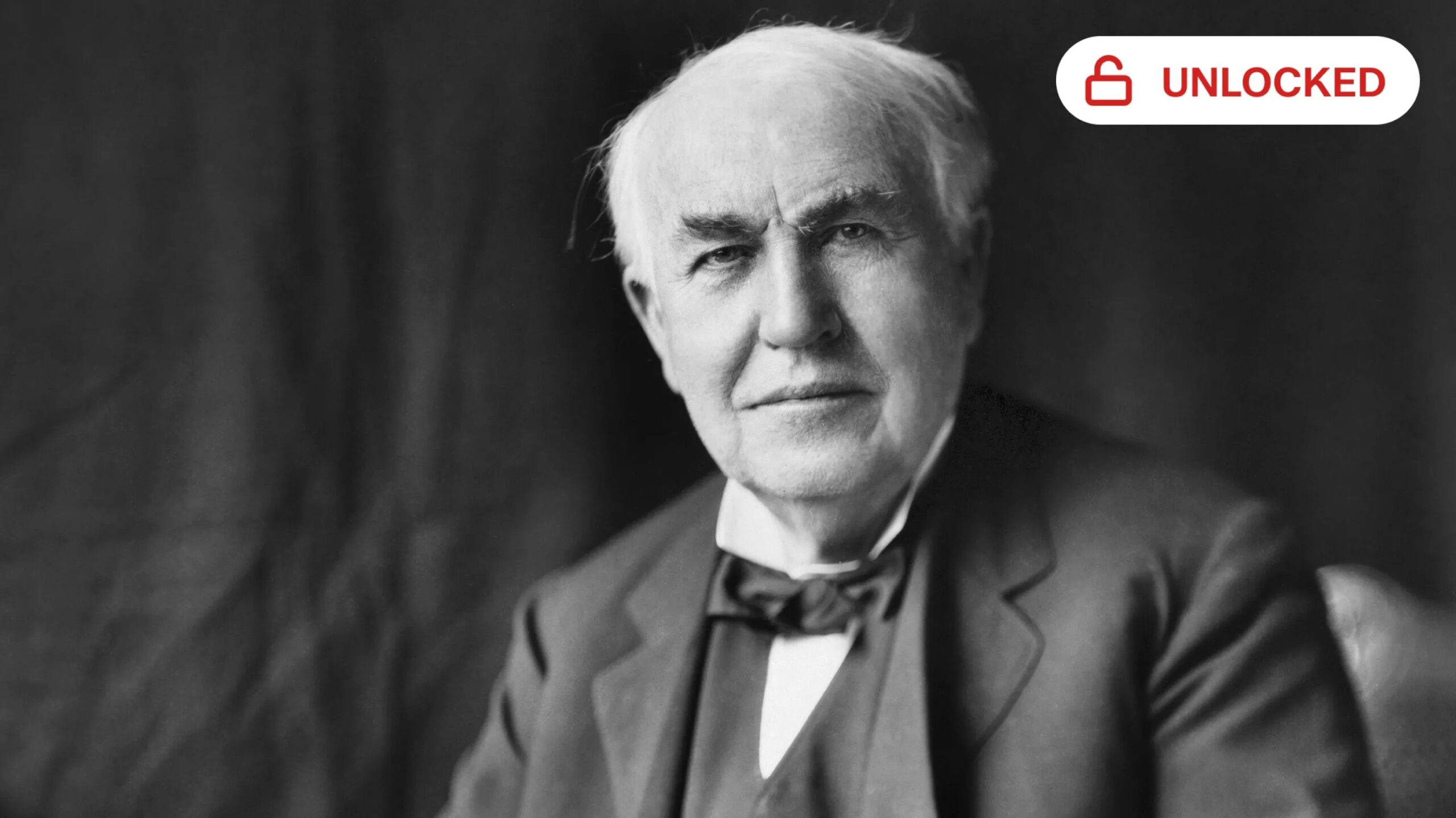
During the telecommunications revolution of the early 2000s, people often joked that Alexander Graham Bell would be bewildered by the modern communications network, while Thomas Edison would still recognize the electric system. The phone had become a pocket computer, a camera, a map, a shopping mall, a newsstand, and a small glowing portal into everyone’s opinions. The electric grid, by contrast, still looked like the same basic machine: big power plants, high-voltage wires, local distribution networks, mechanical meters, bills, and customers at the end of a one-way line.
For a long time, that joke worked because it was mostly true.
Edison would recognize more than the physical wires; he would recognize the logic of the system. Although the incandescent light bulb became his transformational invention, Edison’s real achievement was the creation of an integrated electric light and power system: generation, distribution, wiring, switches, meters, lamps, financing, installation, and customer service. The bulb was useful only if all of the other pieces worked to power it.
That system logic has shaped the electricity industry for more than a century. Electricity was unlike ordinary goods: a real-time network service produced by large, specialized assets that had to operate together. Generation, transmission, distribution, and consumption had to be coordinated continuously. The physics were unforgiving, the equipment expensive, and the transactions among the pieces difficult to measure and enforce. In that world, vertical integration was a business strategy grounded in a technology coordination problem.
Economists have a useful way to think about this problem. Ronald Coase argued in his 1937 article “The Nature of the Firm” that firms exist because markets are not free to use. Finding trading partners, writing contracts, measuring performance, resolving disputes, and adapting to changing conditions all impose transaction costs. When those costs are high, organizing activity inside a firm can be cheaper than relying on a web of market contracts. This form of organization—vertical integration—brings the many transactions of a supply chain within a single firm that owns and operates the assets and relationships that performance requires. Four decades later, economists Benjamin Klein, Robert Crawford, and Armen Alchian showed why vertical integration becomes especially attractive when parties make specialized investments.
Electricity fit that logic almost perfectly. Power plants, wires, substations, meters, control rooms, and customers were bound together in a tightly coupled electro-mechanical system. Once a generator, a transmission line, or a distribution network was built, its value depended on the rest of the system. The resulting industry, built around integrated utilities, exclusive service territories, and regulation, became a system of government-granted monopolies in exchange for an obligation to serve and public oversight.
That world is now changing amid innovations in digital technology. Sensors, software, communications networks, advanced meters, smart inverters, batteries, power electronics, electric vehicles, and distributed energy resource platforms make it cheaper to observe, measure, verify, forecast, and control electricity services within the grid and around its edge.
<section id="cross-promo" class="acf-block-cross-promo my-6 md:my-8" x-data='{"brand_term_id":108868,"brand_slug":"dispatch-markets","brand_name":"Dispatch Markets","brand_description":"A weekly dive into the forces driving economic growthu2014and those holding it backu2014from a roster of subject-matter experts, including Scott Lincicome, Kyla Scanlon, Karl Smith, Marian Tupy, and Adam Ozimek.","color_primary":"#c2ad9c","color_tertiary":"#e7ded7","author_avatar_url":"https://thedispatch.com/wp-content/uploads/2025/03/Scott-Linicome.png","message_type_id":156937,"postId":121204,"restUrl":"https://thedispatch.com/wp-json/dispatch/v1/cross-promo/recommend","hydrated":false,"state":"anon","pendingSubscribe":false}’ x-init="
(async () => {
// Toast dispatch + cookie consume now happens at app-init scope
// (see parts/alpine/index.js → user.dispatchCrossPromoToast)
// so the confirmation still fires when the block is below a
// paywall and stripped from rendered post content. We still
// read $store.user.justSubscribed below to drive the
// ‘just subscribed’ card state (pinned brand + guest gate).
$store.user.consumeToastCookie();
const waitFor = (test) => new Promise((r) => {
const tick = () => test() ? r() : setTimeout(tick, 30);
tick();
});
await waitFor(() => $store.user.loaded);
// Anon visitor landed here from a signed email-click subscribe;
// short-circuit to the terminal email_subscribed state.
if ($store.user.justSubscribed?.isGuest && !$store.user.valid) {
state=" email_subscribed hydrated="true;" return if await waitfor> $store.iterable.gotIterableUser);
}
try {
const params = new URLSearchParams({ post_id: String(postId) });
if ($store.user.valid) {
params.set('hydrated', '1');
($store.iterable.subscribedMessageTypeIds || []).forEach((id) => params.append('subs[]', String(id)));
($store.iterable.digestAuthorIds || []).forEach((id) => params.append('authors[]', String(id)));
[...($store.iterable.digestTopicIds || []), ...($store.iterable.digestProductIds || [])]
.forEach((id) => params.append('topics[]', String(id)));
}
const res = await fetch(restUrl + '?' + params.toString(), { credentials: 'same-origin' });
const data = await res.json();
state = data.state || 'hide';
if (data.brand_slug) {
brand_slug = data.brand_slug;
brand_term_id = data.brand_term_id;
brand_name = data.brand_name || brand_name;
brand_description = data.brand_description || '';
color_primary = data.color_primary || color_primary;
color_tertiary = data.color_tertiary || color_tertiary;
author_avatar_url = data.author_avatar_url || '';
message_type_id = data.message_type_id || 0;
}
// Iterable's read-after-write is eventually consistent — if
// the fresh fetch missed the just-subscribed MT, push it now
// and rewrite the prefs cache so the menu / header / future
// page loads reflect the correct state.
if (
$store.user.valid &&
message_type_id &&
$store.user.justSubscribed &&
!$store.iterable.subscribedMessageTypeIds.includes(message_type_id)
) {
$store.iterable.subscribedMessageTypeIds.push(message_type_id);
$store.iterable.unsubscribedMessageTypeIds =
$store.iterable.unsubscribedMessageTypeIds.filter((id) => id !== message_type_id);
$store.iterable.updateIterablePrefsCache?.();
}
} catch (e) {
console.error('[cross-promo] recommend fetch failed:', e);
state="hide";
}
hydrated = true;
if (state === 'anon' && !$store.signUp.email) {
const urlParams = new URLSearchParams(window.location.search);
if (urlParams.get('email')) $store.signUp.email = urlParams.get('email');
}
})();
"
x-effect="
// IIFE: Alpine wraps x-effect as `return (...)`, so a bare `if` errors.
(() => {
if (pendingSubscribe && !$store.signUp.isSubmitting && $store.user.valid) {
pendingSubscribe = false;
state="subscribe";
}
})();
">
<div class="container">
<!-- Skeleton: shown until user state + recommendation hydrate -->
<div x-show="!hydrated || !$store.user.loaded" role="status" aria-label="Loading">
</div>
<!-- Hydrated card -->
<div x-cloak x-show="hydrated && $store.user.loaded && state !== 'hide'">
</div>
</div>An economic interpretation of these innovations is that they lower transaction costs, which changes the boundary between firms and markets. Activities that once had to be coordinated inside a vertically integrated utility may now be coordinated through contracts, platforms, prices, standards, and protocols. The electric system may remain physically interconnected, but its institutional structure can become more modular. A modular system is built from standardized, self-contained parts that can be combined, rearranged, replaced, or expanded, like Lego blocks.
Edison might still recognize the grid’s bones. He would see central stations, wires, substations, meters, and customers. He might not recognize a system in which millions of devices can produce, store, shift, and manage electricity in response to prices, software, and system conditions. The old grid was a machine. The emerging grid is becoming a platform. Can our institutions keep up? Grappling with that question requires a deeper understanding of why the grid was built as an integrated machine in the first place, and why that design made economic sense for as long as it did.
Edison’s system.
Making electric light commercially useful required more than a better lamp; it required a network. Edison had to supply not only generators and wires but capital, customers, operating routines, technical standards, and enough confidence in reliability to displace gaslight, candles, and other familiar lighting technologies.
Beginning operations in 1882, the Pearl Street Station in lower Manhattan embodied this systems logic. What looked like a generator wired to a cluster of lamps inside buildings was in fact a central-station power system serving customers in a defined area with an integrated set of technologies. Edison’s direct-current system could not transmit power economically over long distances, so generation had to be located near customers. The physical limits of the technology shaped the organizational form.
That relationship between technology and organization is the central point. Edison’s system was integrated because its parts were deeply complementary: a generator without wires, wires without lamps, or lamps without dependable current each had little value. The system had to come first; the market could develop only after the system existed.
Electricity was therefore unlike most 19th-century industries in how tightly coupled its technology was. A shoemaker could sell shoes to customers who already had feet; a newspaper publisher could sell papers to readers who already had eyes and literacy. Electricity required an elaborate bundle of complementary assets before anyone could consume the product at all. In economic language, the business involved high asset specificity, strong complementarities, and significant coordination costs. Edison was building an institutional and technological ecosystem.
AC and the system’s first great expansion.
The transition from direct current to alternating current (AC) is often told as a high-stakes drama of Edison versus Nikola Tesla, with George Westinghouse entering as the commercial champion of Tesla’s AC. That story has some truth, and it keeps biographers and screenwriters busy. But as an explanation of the electricity system, the more important story is about scale, modularity, and coordination.
Direct current worked well enough over short distances, but it was difficult to transform from one voltage to another. Alternating current could be stepped up to higher voltages for long-distance transmission and then stepped down for local use. That technical feature changed the feasible geography of electric power. Generation no longer had to sit as close to customers, and power systems could extend across larger territories, connecting bigger generating stations to dispersed loads and exploiting economies of scale.
Tesla’s inventions in AC motors and system components were crucial, and Westinghouse’s role in commercialization mattered enormously. But the AC system was not the product of a single mind. It emerged over decades from a broader engineering and entrepreneurial ecosystem involving transformers, motors, meters, generators, insulation, transmission lines, protection systems, standards, financiers, managers, and customers. A new technological architecture changed the system’s economic possibilities.
AC loosened one constraint while reinforcing another. It made the power system geographically larger, but it did not make the system institutionally modular in the way that digital networks would later become. By enabling larger networks and larger generating stations, AC strengthened the case for coordinated planning and operation. A bigger synchronized machine required more elaborate coordination.
The early 20th-century electric utility emerged from this logic. The industry developed around large fixed investments, extensive network economies, and long-lived assets. Utilities built generation, transmission, and distribution systems; served customers within exclusive territories; recovered costs through regulated rates; and accepted an obligation to serve. Public utility regulation became the institutional bargain that made this structure politically and economically sustainable.
That bargain was imperfect, but it reflected the economic conditions of the technology. When the cost of coordinating through markets is high, hierarchy and centralized control become attractive. When duplication of infrastructure is wasteful, monopoly becomes feasible. When customers are captive, regulation becomes necessary. The vertically integrated utility was not just an exercise in corporate control; it was also an answer to a then-new question: How do you coordinate a tightly coupled, capital-intensive, real-time network whose services are essential and whose customers have few alternatives?
The logic behind vertical integration.
The traditional utility model emerged because it economized on real coordination costs. In ordinary economic models, markets often look almost frictionless. Buyers and sellers meet, prices adjust, contracts are enforced, and resources move to their highest-valued uses. In the real world, using markets is costly. People must find one another, discover prices, evaluate quality, write agreements, monitor performance, adapt to surprises, and resolve disputes. Those are transaction costs.
Coase’s insight was that firms and markets are alternative ways of organizing economic activity. A firm replaces some market transactions with managerial direction, and the boundary of the firm depends on the relative cost of coordination inside the firm versus coordination through markets. Klein, Crawford, and Alchian added that vertical integration becomes especially attractive when investments are specific to a particular relationship. If one party builds an asset that is valuable only when paired with another party’s asset, the parties may become vulnerable to opportunistic bargaining after the investment has been made. Economists call this the hold-up problem.
Electricity is full of such relationship-specific investments. A power plant is built to connect to a grid. A transmission line is built to move power between particular locations. A distribution network is built to serve a particular territory. Customers install equipment that depends on reliable electric service. These assets are expensive, long-lived, and difficult to redeploy.
The product itself adds another layer of complexity. Electricity must be balanced continuously because of the physics of AC networks. Supply and demand must match in real time, not approximately next quarter. The network has physical constraints, and actions at one point can affect conditions elsewhere. Reliability is a system property, not a simple bilateral transaction. Whether my lights stay on depends not only on my relationship with the utility but also on generation adequacy, transmission capacity, distribution operations, voltage control, system protection, and the behavior of many other users.
Under those conditions, vertical integration reduced transaction costs. Instead of contracting separately for every component of generation, wires, balancing, reliability, metering, billing, and customer service, the utility organized many of those activities internally. Regulation then supervised the resulting monopoly. The model had costs, including weak incentives for innovation and efficiency, but it economized on a genuine coordination problem.
The traditional electric utility was, in this sense, a Coasean institution built around an Edisonian machine. It endured, too, because state-level regulation reinforced the business model, creating the economic certainty utilities needed to build and expand this tightly coupled system around large-scale technologies and centralized organization.
The first institutional unbundling.
The late 20th-century restructuring of electricity regulation challenged the old model, especially in generation. Catalyzed in part by the combined-cycle natural gas turbine, policymakers and economists increasingly argued that generation did not always need to be owned by the same firm that owned transmission and distribution wires. Independent power producers, wholesale electricity markets, open-access transmission rules, regional transmission organizations, and competitive retail supply in some states all reflected efforts to separate potentially competitive functions from natural monopoly functions.
This restructuring showed that vertical integration was not an essential fact of electricity. Some functions could be unbundled. Markets could coordinate generation dispatch. Independent firms could build and operate power plants. Regional transmission organizations could run wholesale markets and manage transmission access across utility boundaries. Prices could convey information that had previously been embedded in utility planning and internal dispatch.
But restructuring has been incomplete, uneven, and institutionally constrained. Transmission and distribution remained network monopolies. Retail competition in different states produced mixed results. Wholesale markets required complex rules, administrative oversight, and constant adaptation. Reliability still required centralized coordination. Resource adequacy, transmission planning, interconnection, market power mitigation, and state policy integration all turned out to be harder than the 1990s reformers anticipated.
That experience offers an important lesson for the next phase of electricity transformation. Unbundling is not magic. Markets are not self-executing; they are institutionally grounded processes that require rules, measurement, enforcement, information, settlement systems, and governance. When those institutional complements are weak, unbundling can disappoint. When they are strong, unbundling can create enormous value.
This history leaves us with a sharper way to think about what comes next. The vertically integrated utility was neither an accident of corporate ambition nor a mere artifact of regulation; it was an economically sensible response to a real coordination problem, pairing Coase’s logic of the firm with Edison’s tightly coupled machine. Restructuring then demonstrated that some of those coordination costs had fallen far enough to support markets in generation, while also revealing how much institutional structure a working market actually requires. Both lessons travel with us into the transformation now in progress.
Digital technologies make a deeper form of unbundling possible, especially at the edge of the distribution network. But possible does not mean automatic. Digital technology will not decentralize the electric system on its own; whether institutions allow decentralized resources to be observed, valued, coordinated, and compensated in ways that make economic sense will shape what the architecture of future power systems looks like and enables.
Policy Watch
- This Thursday, the Federal Energy Regulatory Commission (FERC) is expected to issue a ruling on new policies for interconnecting data centers and other large-load customers to transmission systems. This proceeding began in October, when Secretary of Energy Chris Wright invoked Section 403 of the Department of Energy Organization Act and asked FERC to address the timely and orderly interconnection of large loads to the interstate transmission system. The proceeding responds to the rapid growth of electricity demand from data centers, advanced manufacturing, and other large commercial and industrial loads. Its central issue is whether, and how, FERC should establish more standardized, transparent, and nondiscriminatory procedures for connecting these large loads to transmission facilities, including foundational questions about issues like cost allocation, reliability, and the federal-state jurisdictional boundary. As readers of Dispatch Energy know, large-load interconnection has become one of the pressure points where AI-driven demand growth, transmission planning, resource adequacy, state retail regulation, and ratepayer protection all collide. Getting the rules right could speed investment and improve reliability, while getting them wrong could shift costs, create legal uncertainty, and perpetuate the delays and exclusion that would decelerate computing-driven economic growth. (Full disclosure: I submitted a public comment to FERC in this proceeding.)
Innovation Spotlight
- Researchers at MIT are developing electron-conducting carbon concrete, or ec³, an emerging multifunctional building material that combines ordinary cement, water, nanoscale carbon black, and electrolytes to create a conductive network inside concrete. Rather than treating walls, slabs, sidewalks, and bridges as passive infrastructure, ec³ points toward a future in which built structures can also store and release electricity as supercapacitors. Recent research reported in the Proceedings of the National Academy of Sciences shows a tenfold improvement over earlier versions, with roughly 5 cubic meters (about the volume of a typical basement wall) potentially storing enough energy to meet the daily electricity needs of an average U.S. household. The technology remains early-stage and will have to prove its durability, cost-effectiveness, safety, and constructability at scale. Still, by making concrete do double duty as both structure and energy storage, ec³ may promise to turn some of the world’s most common infrastructure into distributed assets for renewable integration, resilience, and grid-edge innovation.
Further Reading
- A recent report by the Pew Charitable Trusts, Distributed Energy Can Unleash the Resilient, Affordable Grid of the Future, offers a practical policy playbook for scaling distributed energy resources, including rooftop and community solar, batteries, smart appliances, managed EV charging, and virtual power plants. Its central contribution is to translate distributed energy resource (DER) modernization from a broad aspiration into an actionable governance agenda: integrate DERs into utility planning and procurement, reduce permitting and interconnection barriers, align utility incentives with DER deployment, and use DERs to strengthen community resilience. Organized around six recommendations, the report shows how distributed resources can become active grid assets rather than peripheral customer technologies. Its emphasis on DERs and virtual power plants as sources of peak-demand capability at 40 to 60 percent of the cost of traditional solutions makes the playbook especially timely as policymakers confront rising demand, affordability pressures, and reliability challenges. (I was a peer reviewer of the report, and the co-chairs of the project, Pat Wood III and Audrey Zibelman, have influenced my thinking and work profoundly on various topics, including integrating DERs into power systems through more extensive markets rather than mandates.)