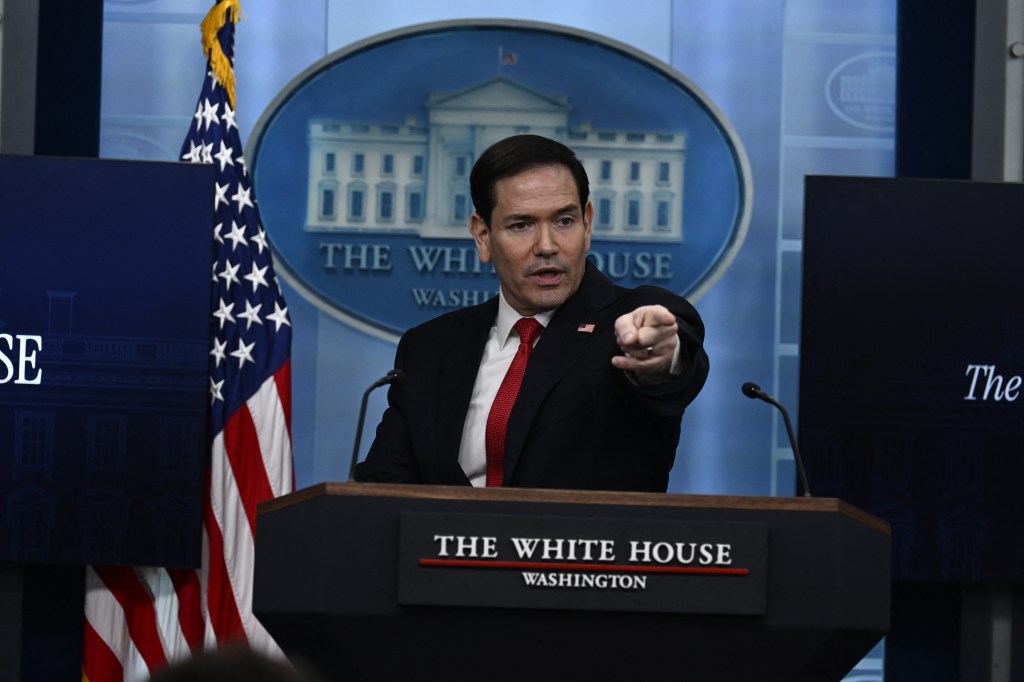
There’s a lot happening right now, so don’t beat yourself up if you didn’t notice that the secretary of state effectively signaled his bid for the presidency last night.
Give this clip 57 seconds of your time and tell me I’m mistaken.
There’s little justification for Marco Rubio uploading clips where he speaks grandly about America, accompanied by cinematic orchestral crescendos, unless the chatter about him surpassing J.D. Vance for the 2028 Republican nomination has inflated his ego.
One cut praising his remarks as “the most articulate answer I’ve heard to this question” circulated widely, being reposted 17,000 times on X—a remarkable level of virality for a politician spouting about what George H.W. Bush once dubbed “the vision thing.” It’s easy to understand why. Republicans have spent a decade without a leader who can speak eloquently and inspire, about anything, let alone the American dream.
Rubio’s remarks tapped into the irrepressible human itch for that vision thing. In a party whose leadership is stocked with fascists, grifters, and servile fools, he’s the last official capable of painting a picture of America that a decent person should want to hang on their wall.
Even so, the whole thing sure is strange.
The timing is odd, for one thing, as U.S. diplomacy—which the secretary of state nominally oversees—is in shambles at the moment. The president announced a new operation to guide tankers through the Strait of Hormuz on Monday but reportedly neither he nor Rubio bothered to let America’s Gulf allies know about it in advance. When the Saudis yanked permission to use their airspace for the operation, Donald Trump was forced to suspend it less than 24 hours after it began.
Rubio ended up looking like a chump, having defended the operation at length to reporters at a briefing on Tuesday before the rug was yanked out from under him. He looked like a chump again when, at the same briefing, he declared Operation Epic Fury over and claimed that the mission to reopen the strait was a new and distinct conflict. But if the original war is over, that means America has failed to achieve its goals: The Khomeinists are still in charge, their nuclear “dust” is still buried beneath their enrichment sites, and their missile arsenal is in better shape than anyone would hope.
To make matters worse, at last check the White House was on track for a peace deal that would commit the United States to “a gradual lifting of the sanctions imposed on Iran and the gradual release of billions of dollars in Iranian funds that are frozen around the world.” Those terms resemble Barack Obama’s 2015 nuclear bargain closely enough that some hawkish Trump supporters resorted to claiming that the news must be fake, as surely the president would never agree to such horrific terms.
The most one can say about all this for Marco Rubio, chief diplomat and alleged future president, is that he doesn’t seem very involved in the Iran war and therefore shouldn’t be blamed for its failures. But that’s a problem in its own right. Why hasn’t he been more involved? It’s nice that he can spout greeting-card sentiments about America to reporters off the cuff, but he’s supposed to be the competent one in the administration. His portfolio, U.S. foreign policy, could use a lot more competence right now.