
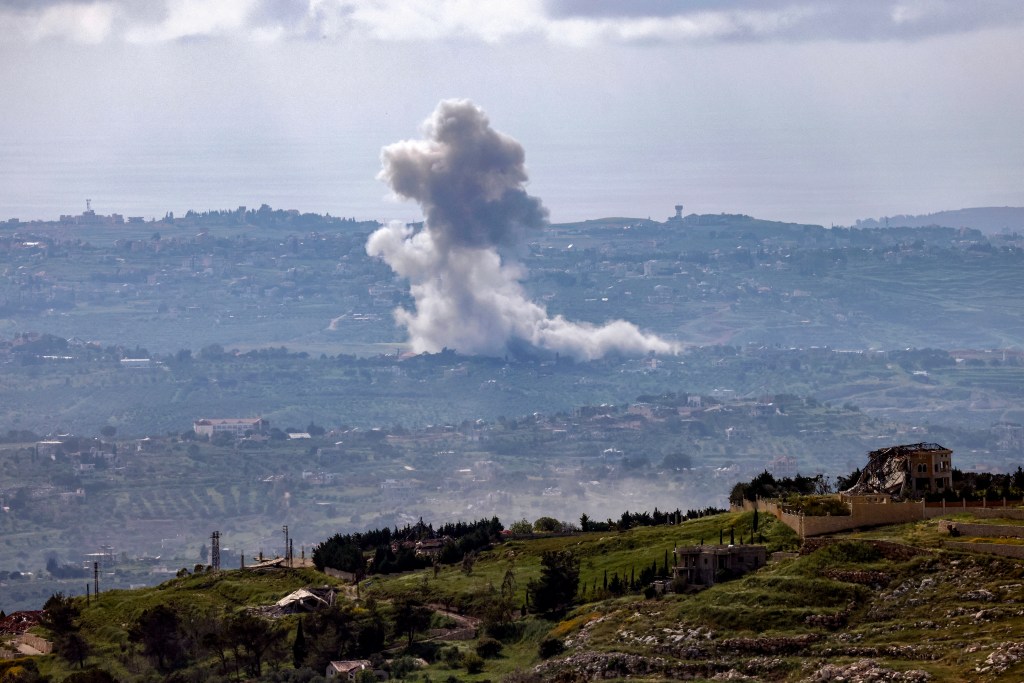
On Tuesday, Secretary of State Marco Rubio asserted that peace between Israel and Lebanon could be within reach—provided Beirut finally confronts Hezbollah. Yet even as Washington urges the two governments toward novel security understandings, Israel and Hezbollah continue exchanging fire along the southern Lebanese border.
The ceasefire announced by President Donald Trump on April 16, and then extended on April 23, now sits in a precarious balance.
For the governments of Israel and Lebanon, the uptick in violence arrives at a particularly delicate moment. The ambassadors from both nations have met twice in Washington to pursue fresh security understandings—but Hezbollah remains strong enough to impede these efforts.
The Israelis warned Hezbollah against joining the war amid joint U.S.-Israeli operations targeting Iran on February 28. But in early March, the Iranian-backed group fired five rockets into northern Israel. The Israelis responded with predictable force, reigniting the conflict between Israel and Iran’s most capable proxy.
In what is now commonly labeled the “October 8 mindset” in Israel (a reference to the repeated vow that lingering threats will no longer be tolerated), Israeli defense officials signaled that they were serious about action. The Israelis delivered their strongest bombardments to date, especially targeting Beirut, on April 8. This marked a shift away from another round of “mowing the lawn” with the Lebanon-based insurgent group.
Iran interpreted this campaign as Israel getting ready to deal Hezbollah potentially irreversible blows, including through a deeper ground incursion into south Lebanon. In a bid to safeguard its most important proxy, Tehran tied the continuation of its ceasefire with the United States to de-escalation in Lebanon. The Iranian regime believed that the ceasefire mattered enough to Donald Trump that its proxy could receive a reprieve.
The Lebanese government, recognizing that its sovereignty was at stake, pushed back, refusing to let Tehran speak for Lebanon’s national interests. Washington readily supported Beirut’s stance, organizing rare trilateral talks in Washington between the Israeli and Lebanese ambassadors.
That was the good news. The bad news was that Lebanon sought to use American pressure on Israel to revert to the same inaction that has long sustained Hezbollah. Beirut called for a ceasefire—mirroring Iran’s position. While this aimed to buy time for negotiations, it would also grant Hezbollah time to regroup. After decades of conflicts that ended in containment, Israel’s aim to destroy the terror organization now appears genuine. On October 8, 2023, when southern Israel’s ground was still stained with the blood of 1,200 Hamas victims, Hezbollah attacked Israel and triggered what would become a yearlong war of attrition. With the Hamas assault still fresh, Israel displayed unusual restraint. It was only in mid-September 2024, nearly a year later, that Israel confronted Hezbollah with force: its first major strike, sometimes described as an explosive beeper operation, killed or wounded hundreds of Hezbollah fighters. Israel then eliminated Hezbollah’s senior political and military figures, including Secretary-General Hassan Nasrallah; destroyed a substantial portion of the group’s arsenal; and conducted a limited ground incursion. Throughout, however, its aims remained focused on pushing Hezbollah back far enough from the border for northern Israeli residents to return home.
A fragile ceasefire followed. Israel kept Hezbollah on the defensive by striking its military assets once or twice daily, but over the last 17 months the group nevertheless managed to reconstitute. Now Israel seeks to continually erode Hezbollah until either the organization collapses or Lebanon is finally able, or willing, to disarm it.
When the U.S.-brokered ceasefire took effect in November 2024, Israelis hoped Beirut would step up and begin dismantling the terror group. After all, the mere existence of a well-armed and well-trained militia within the country challenges Lebanese sovereignty. Yet Lebanon’s government remains weak, and Lebanese society is notoriously fragmented along sectarian lines. This has left Beirut and the Lebanese Armed Forces fearful of civil war, or worse, losing one. Neither fear is unfounded. Hezbollah retains enough of its arsenal (roughly 20 percent of its prior stockpile of 150,000 rockets, plus a large amount of small arms, according to Israeli estimates) to make disarming it militarily daunting. Lebanese Shiites, who account for about a third of the population, remained broadly supportive of Hezbollah, enabling the group to threaten Lebanon with internal conflict. Beirut tried to persuade the group to surrender its arsenal voluntarily. Hezbollah, unsurprisingly, refused. And the country’s Shiites showed little opposition to the arrangement.
It is too soon to judge whether the renewed fighting, alongside ongoing diplomacy, has altered these conditions enough to break Lebanon’s barrier of fear. Ceasefire or not, diplomacy or not, Israel remains intent on pursuing a major military operation.
While the prospect of a large-scale operation remains, the Israelis are signaling more modest aims. The top brass do not appear to intend occupying Lebanese territory. Southern Lebanon poses the immediate security threat due to short-range munitions near border villages. Yet Hezbollah’s infrastructure extends well beyond this area: its political and operational nerve center sits in Beirut’s southern suburbs, and it maintains military assets and training sites in the far northern reaches of the Beqaa Valley, which sits along the Syrian border.
Israel simply lacks the manpower for a full-scale campaign across the entire terrain. And the soldiers it does have are worn out from more than two and a half years of fighting in Gaza.
This reality helps explain why Israeli military planners appear to favor a middle option: seize southern Lebanon up to the Litani River, then launch broad air operations to degrade the longer-range weapons Hezbollah holds further north.
Israel has already set the stage for such an incursion. Evacuation warnings have displaced hundreds of thousands of Lebanese civilians from southern Lebanon. Israel has gradually expanded its footprint there and is on the verge of capturing Bint Jbeil—the so-called “capital of the resistance.” Meanwhile, it has struck bridges and other critical infrastructure to complicate Hezbollah’s efforts to move reinforcements and materiel from positions farther north. Despite modest diplomatic progress, IDF ground troops remain tasked with securing this area and protecting border communities until Hezbollah’s presence is eliminated. Afterward, IDF planning envisions holding this zone as a “kill zone” in southern Lebanon (similar to the territory it maintains alongside Hamas-controlled areas in Gaza) while continuing to relentlessly target Hezbollah’s dangerous weapons stored farther north.
Critics have warned that this mirrors a failed strategy from late in the 20th century. Yet this revived southern security zone need not replicate the failures of its 1985-2000 predecessor, when Israel first confronted Hezbollah.
The very notion of a southern Lebanese security zone arose from the wreckage of Israel’s 1982 invasion of Lebanon, initially intended to clear the Palestine Liberation Organization from southern Lebanon—but which reached Beirut and ultimately proved unpopular with many Israelis. Hezbollah’s intervening ascent prevented a full Israeli withdrawal from Lebanon, while Israeli public opinion blocked pursuing a decisive victory over the emergent group. The IDF found itself in political and military limbo. Israeli troops engaged Hezbollah in a sequence of operations and limited clashes that, taken together, failed to achieve Israel’s aims. The Israeli public grew weary. This culminated in Israel’s unilateral withdrawal in 2000, enabling Hezbollah to claim it had forcibly expelled the IDF from southern Lebanon and thus secured victory.
Looking back, several clear lessons emerged for Israel. The IDF’s doctrinal strengths lie in mobility, initiative, and overwhelmingly effective combined-arms maneuvers. Yet the weight of public opinion pushed the army toward static defense in southern Lebanon. Israeli troops hunkered down in outposts that Hezbollah could harass at will. Lebanese proxies, such as the South Lebanon Army, proved largely unhelpful. If anything, they became a liability, as their forces were unprofessional and brutal.
The renewed southern security zone’s aim, by contrast, should not be to serve as a mere buffer. Instead, it should enable the IDF to leverage its advantages and to sustain direct, continuous pressure deep inside Hezbollah’s strongholds.
These operations will undoubtedly be costly. The longer Israeli soldiers remain in Lebanon, the greater the chance of rising casualties. Yet in the wake of the October 7 attacks and the broader, multi-front war now underway against the Islamic Republic of Iran and its proxies, Israelis today are likely to view prolonged actions against the group, and even the loss of soldiers, as a necessity. Recent polling indicates broad support among Israelis for continuing actions against Hezbollah, with these attitudes especially strong among people in the north.
There is, to be sure, a degree of resignation attached to this strategy. Reintroducing a security zone amounts to an admission that Lebanon will remain either unwilling or unable to disarm Hezbollah on its own for the foreseeable future. It also concedes that there may be no alternative way to control the northern front without exposing IDF forces to ongoing, direct clashes with a Hezbollah that remains determined to rearm and resume fighting.
But if Israel uses a zone in Lebanon’s south not as an end in itself, but as a means to degrade Hezbollah faster than it can recover, the overall effect could be devastating for Hezbollah. If the Lebanese government steps up, perhaps encouraged by the ongoing Washington talks, the IDF could reduce its operations in tandem and consider transferring control of stabilized portions of the revived security zone to the Lebanese Armed Forces. Peace will not arrive overnight, but a security zone could yield lasting quiet along the frontier and a non-belligerent relationship between Israel and Lebanon. Over time, a quieter border and less bloodshed may pave the way for continued Israeli-Lebanese talks and, eventually, for normalization to become a possibility.