Dear Reader (especially any newly minted Butlerian Jihadists),
In the Thuringian town of Jena, where the thinker Georg Wilhelm Friedrich Hegel was tying up his manuscript for The Phenomenology of Spirit, there occurred a rare incident one October night. On the eve of a pivotal battle, Napoleon Bonaparte rode out on horseback to survey the ground. The occasion left an impression on Hegel, who later wrote to a friend about the moment:
I observed the Emperor—this world-spirit—riding through the city to survey the terrain; it is, in truth, a remarkable sensation to behold such a figure, concentrated here at a single point, mounted on a horse, yet spanning the world and mastering it.
If you’ve ever heard the phrase “world spirit on horseback”—a line I’ve used more than once myself—this is the origin of that expression. And if you happen to use “whence” more than a few times a week, perhaps ease up on it.
You’re probably thinking: “When I subscribed to this newsletter, I was assured there wouldn’t be any Hegel.” Yet here we are. Hegel has surfaced in the news, and if you skim the fine print of our user agreement, I’m allowed to discuss any German philosopher who makes headlines. (My Google Alert for Edmund Husserl makes me feel like a Maytag repairman.)
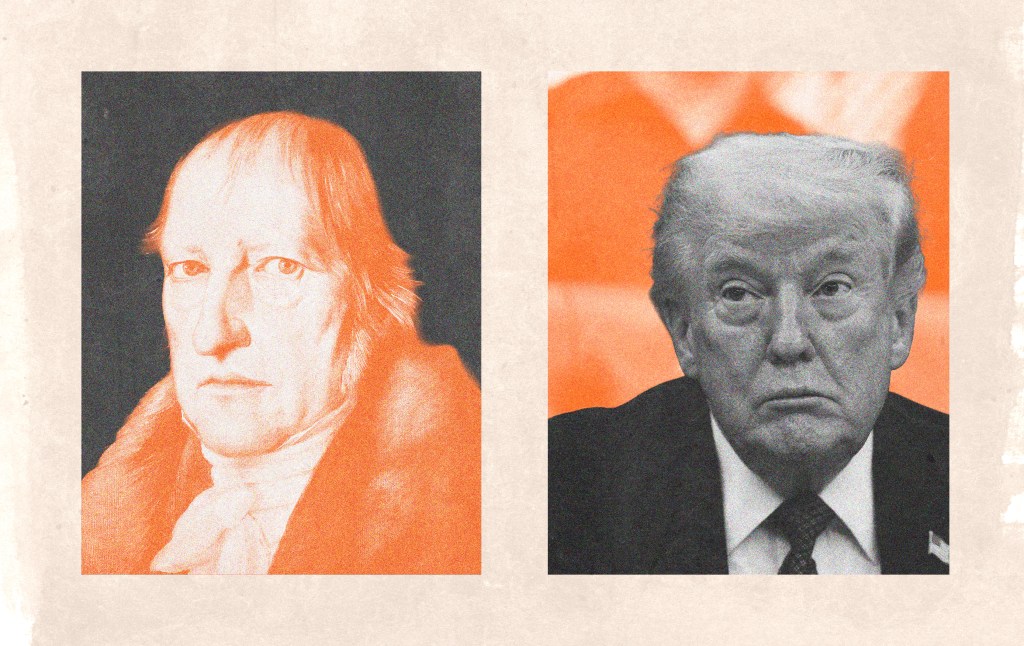
On Wednesday, Ashley Parker and Michael Scherer of The Atlantic—seasoned reporters who used to work at the Washington Post—opened their piece with a provocative query:
“Had President Trump, we wondered, perhaps been reading—or at least paging through—Georg Wilhelm Friedrich Hegel’s works?”
That’s their opening line. That’s the hook.
I’ll grant the benefit of the doubt to these accomplished journalists and chalk this up to literary license, caprice, lighthearted mischief, or simply a reader-game with the audience. Taken literally, however, the proposition seems like a wild leap. I can easily imagine a scenario in which one reporter nudges the other and whispers, “You know, Trump’s grandiose ambitions have become so precise and so unrestrained that maybe he’s been examining…” and they both erupt with:
“Hegel’s Lectures on the Philosophy of World History?”
“Whoa—Jinx! You owe me a Coke!”
However such they arrived at the point, the reporters pursued the possibility that Trump views himself through a Hegelian lens.
To be candid about journalism’s mood here, the vibe of their exploration recalls a scene in Good Will Hunting, where a grad student with a ponytail tries to humiliate Ben Affleck by pressing him for “insight about the evolution of the market economy in the southern colonies.”
The snag: White House officials did not bite. “When we asked several White House officials whether Trump had discovered or embraced Hegel’s writings, they dismissed the hypothesis with something like a hollow, almost-laughing response,” Parker and Scherer reported.
Almost laughing? Really?
Perhaps the officials restrained themselves from laughter to avoid making the president look ridiculous. One imagines a scenario in which The Atlantic would publish: “When we asked White House officials whether Trump had found and endorsed Hegel’s writings, they guffawed so hard that a senior aide needed an injection of oxygen from the White House doctor, another experienced a laugh-induced loss of bladder control, and an intern had to fetch a new pair of trousers.”
Another curious detail: The Atlantic piece doesn’t acknowledge that others have voiced a similar analysis previously. Last month, John Judis contributed a long essay to NOTUS, titled (and subtitled) “Trump as Alexander the Great: A Theory That Explains Iran (And Everything Else): Hegel figured it all out two centuries ago.”
And, when I investigated further, I discovered that several other writers have contemplated whether Trump qualifies as a “world-historical figure” in the Hegelian sense.
So, once again, you can see how this forms a legitimate exception to a no-Hegel rule.
Hegel for Afflecks.
Let’s pause for a moment to discuss Hegel. If philosophy were baseball, Hegel would have taken the field and posted a stellar stat line across several categories. He’d be a first-ballot pick for the German Philosophy Hall of Fame, likely right after Nietzsche and Heidegger.
Dipping into Hegel is a bit like peeling an onion: endless layers, hard to know where to stop, and your eyes tend to water at the end. Indeed, the mere act of peeling is often framed as “Onion Hegel” – a joke that hints at how expansive his scope was. Given the breadth of his reach, it’s tempting to invoke an “Everything Hegel.” The Atlantic’s failure to locate evidence that Trump had acquainted himself with Hegel since relocating from New York to Washington, D.C. isn’t surprising; as the joke goes, there aren’t many good Hegelians in the nation’s capital. Okay, I’ll move on.
What matters is Hegel’s grand theory of history, a concept he treated as history with a capital H. For him, History wasn’t a stray collection of events; it was a living, unfolding process that took place across the entire globe. As the leading light of German idealism, Hegel believed that this evolution was driven by ideas, by spirit, by consciousness, and by the way these internal contradictions and conflicts ripen and resolve themselves over time. Karl Marx later “turned Hegel on his head,” contending that the material conditions of life, not (only) consciousness, shape history: “It is not the consciousness of men that determines their existence; but their social existence that determines their consciousness.”
This historical process pushes us toward a final moment when world consciousness recognizes the superiority of the modern liberal state and the ethical primacy of universal freedom. Hegel did not imagine this in some creepy, body-snatcher fashion. He simply believed that History—capital H—was moving toward the universal recognition that a constitutional order grounded in ethics might be the optimal way to organize society.
In a popular Simpsons moment, the alien Kodos, inhabiting Bill Clinton’s form, captured a strand of this Hegelian arc: “My fellow Americans. As a boy I dreamed of playing baseball. But tonight I say we must move forward, not backward; upward, not forward; and always twirling, twirling, twirling toward freedom!”
We could spend thousands of words debating Francis Fukuyama, but that would be a fool’s errand that would cost millions of lives, so let’s press on. What matters here is that Hegel believed certain great men could accelerate this historical process. They may not intend to. They may not be virtuous. Still, their actions are so transformative that they propel humanity from one epoch into another. He called such individuals “world-historical figures.” And so, we return to where this began.
Napoleon was one such figure, and Hegel’s delight in seeing him in the flesh is palpable. In 1806, Napoleon was hailed by some as the Great Liberator (a nod reflected in the Polish national anthem). The two other figures most closely linked with this idea are Julius Caesar and Alexander the Great. Their motives aren’t the point; what matters is that they act as catalysts for change, embodying it and ushering it along. They surface when world-spirit or global consciousness—or whatever you want to call it—is ripe for development. (Now, one could reasonably observe that Trump has probably quoted that Hegelian phrase thousands of times, for example, “Atlantic City is ripe for development. We must simply clear that old obstruction out of the way.”)
John Judis summarized the idea well: “At these historical junctures, Hegel believed, a ‘world-historical individual’ could enact a decisive turn. Alexander the Great spread Greek culture across Asia and North Africa. Julius Caesar transformed Rome from a republic to an empire. Napoleon Bonaparte—Hegel’s contemporaneous exemplar and the model for his theory—did away with feudalism, introduced civil law via the Napoleonic Code, and ended the Holy Roman Empire, thus forging a continental framework of rival states.”
And if you crave an unadulterated taste of those Hegelian thoughts, here is the master himself:
Such are the great figures of history—whose aims reach toward the grand themes that lie within the will of the World Spirit. They are called Heroes to the extent that their aims and their calling do not spring from the usual, orderly flow of things, sanctioned by the current order; rather, they arise from a hidden source—one that does not yet appear in palpable, present existence—an inner Spirit that, when it encounters the outer world as on a shell, shatters that shell because the kernel within differs from what the shell contained. They are men who seem to draw the energy of their lives from within themselves; their deeds generate a state of affairs and a network of historical relations that appear to be driven solely by their personal interest and their labor.
One irony in this entire Hegel discourse is that its very rise resembles a Hegelian development. Hegel maintained that ideas, much like the avocados some writers like to pilfer, ripen independently of one another. So we might anticipate unconnected and unlike individuals independently arriving at the same conclusion about Trump as the embodiment of the world-spirit in flesh—like those multiple visitors who, independently, arrive at the same intuitions in a scenario reminiscent of Close Encounters of the Third Kind’s Devils Tower legend.
Thus, any day now we might expect Jesse Watters to declare that, “In Donald Trump, the American people witnessed the Weltgeist achieving Selbstbewusstsein—a nation awakening to its own Begriff, casting off the sterile abstractions of Verstand and finally realizing its Freiheit through the concrete Wirklichkeit of America First.” And, if you close your eyes, you can almost hear J. D. Vance explaining to Tucker Carlson that “Trump wasn’t merely a president; he was the concrete Dasein of the American Volksgeist, the historical Subjekt through which the nation accomplished the long-awaited Aufhebung of elite decadence and made a decisive stride toward the Ende der Geschichte.”
So, what is the answer?
Is Trump a world-historical figure in the Hegelian sense? The obvious answer is: no—of course not.
Parker and Scherer are more interested in whether Trump sees himself as a world-historical figure in Hegel’s sense. The answer to that question is also a resounding no. The guy doesn’t even bother with memos. Do you really think he’s paging through Hegel?
To be fair to them, their true aim is to illuminate the danger posed by Trump’s grandiose fantasies, and they succeed. After all, Trump once claimed that the only check on his will on the global stage was “My own morality. My own mind. It’s the only thing that can stop me.” Leave aside for a moment that this reads more Nietzschean than Hegelian (and Nietzsche loathed Hegel with a fervor comparable to Trump’s disdain for Liz Cheney). It’s also, frankly, pretty chilling.
“A confidant,” one source told Parker and Scherer, “has said he’s been talking lately about how he’s the most powerful person ever to live. He wants to be remembered as the one who accomplished things that others could not because of his sheer power and sheer will.”
I’m wary of discussions of presidents’ “sheer power and will” in any context. Still, there can be a constructive impulse in a president who knows how to translate ambition into real outcomes. It would be remarkable if he could channel that ambition into tackling the national debt he helped inflate (debt now flirting with 100 percent of GDP, by the way).
But Trump tends to prize the flash over the substance. He craves the headline, not the solution. The goal of solving Iran’s regime and nuclear program (two aspects of the same problem) is admirable; actually knowing how to do it is another matter.
This gets to Judis’s point. Trump’s Iran gambit signals a leader willing to break with the old order in service of creating a new epoch. “Trump’s break with neoliberalism and liberal internationalism fits Hegel’s profile of a world-historical individual at the center of a transition from one era to another,” Judis writes.
One snag: the whole point of Hegel’s philosophy was the conviction that history is moving toward something morally elevating, toward a more ethical order. It’s not about a few dramatic acts of destruction that reshuffle the deck. Judis notes that Hegel saw history’s stages as progressing in a positive direction; removing the Enlightenment’s optimistic frame makes the parallels to today rather strained.
Wait a moment: if you remove the Enlightenment’s optimism from Hegel, what, exactly, is the point of invoking Hegel at all? Why not lean on Thomas Carlyle’s Great Man theory or Time magazine’s old Person of the Year criterion? For Hegel, the motive for history to move toward a higher end is what makes someone a world-historical figure. Yes, a person can be immoral, or amoral, or simply dreadful, and still be immensely consequential. But if your own aims do not engage with those grand themes that belong to the will of the World Spirit, then, according to Hegel, you’re just a person who does things for personal reasons, and your actions do not constitute world-historical turning points. It’s not enough to say someone is the “new Jesus” because he’s a kind man with a beard who dabbles in carpentry. The distinctions matter.
According to The Atlantic, Trump appears to care little for the word “legacy.” When he was advised to select a running mate in 2024 who could carry forward his political movement, he shot back: “What do I care? I’ll be dead.” That isn’t the stuff of Hegelian idealism; that’s closer to Nietzschean nihilism. If there’s anything left after I die, it should be my triumphs and glory, not some grand normative project.
Napoleon’s reputed remark that he found the crown of France in the gutter and picked it up with his sword framed him for Hegel as a tragic hero. After Jena, Napoleon ceased to be viewed as a liberator extending the noble aims of the French Revolution; he restored monarchy and empire for his own purposes. He qualifies as a hero only because the unintended consequences of his life advanced the world-spirit, whether he liked it or not.
There are conservatives who embrace a similar view of Trump: he may not care about lofty ideas, but he nonetheless propels the world toward something better. It is possible that the resulting upheavals could be harnessed to restore norms, institutions, and alliances that have been damaged. In that reading, Trump could be cast as a world-historical figure, not merely consequential. But that is not the same as calling Trump an embodiment of Hegelian spirit. Because those who idolize him or instrumentalize him do not perceive Trump as moving things forward toward a better order; they see him as a force that could drag the liberal order backward toward an older dynamic of great-power competition or something like “Neo-Royalism.” Again, this is not Hegelian, because it discards the Enlightenment’s forward-looking optimism.
Yet there remains a theory of Providence that appeals to some: the idea that Trump is God’s chosen instrument. I don’t intend to mock anyone’s faith, but if ever there were a moment to acknowledge the limits of prophetic certainty, this would be it.
All of this, paradoxically, betrays a certain Hegelian optimism. Even those who reject the Enlightenment style can be seen as clinging to a sense that events are destined to unfold in a meaningful way. Strip away the technical jargon and a core idea persists: “This must mean something; what is happening must be part of a larger design or process that will culminate in something good.” My friend Yuval Levin dislikes the word “optimistic” because it suggests passive resignation rather than agency. In that sense, Hegel has a Romantic tilt: viewing the arc of history as something that will fulfill itself through human engagement, even if the path is messy. From that vantage, optimism can resemble a form of surrender—whether one adheres to Marxist materialism or Hegelian idealism, placing faith in unnamed, impersonal forces to render everything right again is, in a sense, a capitulation. Whether Trump’s impact will be positive, negative, or mixed depends entirely on how people respond to it.
It’s not a perfect analogy. Yet I keep thinking of the Saving Private Ryan moment near the end, when Captain Miller tells Private Ryan to “Earn this.” The carnage and sacrifice do not by themselves justify Ryan as a good man, but they lend those acts a meaning that redirects the experience toward something nobler. Ross Douthat has offered a bleak but thought-provoking column arguing that Trump could indeed be a world-historical figure, but in his telling the next stage of history would be decadence, decay, entropy. For Douthat, a figure of destiny looks like a path that ends in dissolution and despair. His pessimism carries its own metaphysical fault: it denies us the agency to leverage the good, to salvage the bad, and to learn from both.
I hold neither an outrightly optimistic nor a dourly pessimistic view of what lies ahead, because whatever comes next will be in our hands. We can slip and slide along a fragile slope, or we can plant our feet firmly and declare, “This is where it stops.” Decline is a choice; so too is ascent.
Author’s Note, May 1, 2026: An earlier version of this article used “from whence” instead of the simpler “whence.” After three trillion readers objected to the redundancy, the “from” was removed. The author notes, with a wink at the fastidious readership, that he is in good company—Shakespeare, Jane Austen, and others have employed this formulation.
Various & Sundry
Canine Update
I’m currently in Los Angeles, and the dogs aren’t happy about it (nor is the Fair Jessica, and I don’t blame her). The packing stress is evident, and the carpetless floors have not been kind to Zoë’s footing. Early Wednesday morning, I walked them at 5 a.m. and caught Pippa in a light that can be described as Edward Hopper-esque. We’re all anxious about how they’ll cope with the move, and with new surroundings. We’ll also have to figure out how to squeeze in playdates with Kirsten and her pack, because the old routine won’t work the same way. I’m imagining regular poker nights at Kirsten’s house. One of the pleasures of dog ownership is that, as long as they have their human companions, they tend to be happy regardless.
The Dispawtch
Member name: Nathaniel Sager
Why I’m a Dispatch Member: I followed Jonah and David from National Review.
Pet’s Name: Nyrissa
Pet’s Age: 3
Pet’s Breed: Lab mix
Gotcha Story: We adopted her from a local rescue. We visited her in her foster home, and she hopped onto the couch and stayed there as soon as we sat down. The rest is history.
Pet’s Likes: Running, shredding, chewing through toys, sunbathing, piles of pillows, and tug-of-war.
Pet’s Dislikes: Fire alarms, mud, needles, and any kind of precipitation.
Pet’s Proudest Moment: Finishing fifth in a local 5K to support an animal rescue. She wore a Batman costume (accompanied by a human Robin), and would likely have podiumed if she hadn’t had to turn around halfway through.
A Moment Someone (Wrongly) Accused Pet of Being Bad: She wears a gentle-leader style leash to prevent her from yanking on our arms, which some people mistake for a muzzle and fear.
ICYMI
Here we go again
A liberal in Jonah’s court
Violence, rhetoric, hypocrisy … oh my!
History repeats itself
Should Jonah invest in U.K. tobacco companies?
Stealing is wrong, kids
Clarence Thomas from the top rope
Weird Links
Public mischief was cleverer in my day
I respect dedication to one’s work
Technocratic Wilsonian bastards
Needless to say, this aged poorly
Good work, fellas