
Cheerful Monday! A humanoid robot completed the Beijing half-marathon this past Sunday, outpacing the current human best in the distance.
Impressive, perhaps, yet the idea that a machine can beat a human in a half-marathon has been the reality since the advent of the automobile.
Quick Hits: Today’s Top Stories
Mass Shooting in Kyiv
A gunman born in Moscow opened fire in Kyiv on Saturday, taking the lives of six individuals and wounding fourteen others, marking Ukraine’s most deadly mass shooting in years. The 58-year-old assailant had previously lived for years in the eastern Donetsk region, a focal point of the conflict with Russia. He started by setting his apartment ablaze, then stepped into the street with a legally registered rifle and fired at bystanders at close distance. Among the wounded was a 12-year-old boy whose father and aunt were killed and whose mother sustained serious injuries. The attacker then holed up inside a nearby Velmart supermarket, took several people hostage, and shot one hostage dead before police stormed the store, killing the gunman and freeing four captives. A sixth victim, a woman, later died in hospital. President Volodymyr Zelensky noted the perpetrator had a criminal history and said investigators were examining multiple possibilities, including his electronic devices and personal contacts.
- Ukraine’s Security Service updated the incident’s classification to terrorism, while Prosecutor General Ruslan Kravchenko stated that investigators have not yet determined a motive.
- On Sunday, the State Bureau of Investigation launched a case alleging negligence by the initial responding officers, who were suspended amid accusations that they did not shield a child and did not neutralize the assailant promptly.
- Interior Minister Ihor Klymenko also ordered an investigation into how the gunman, with a prior criminal record and what he described as a “clearly unstable mental state,” secured medical clearance for a gun license.
U.S. Stops Iranian Ship Amid Rising Tensions
On Sunday, President Donald Trump disclosed that a U.S. Navy guided-missile destroyer engaged and captured an Iranian-flagged freighter in the Gulf of Oman, a vessel previously subject to U.S. sanctions. In a post on Truth Social, he claimed that the U.S.S. Spruance intercepted the ship and ordered it to reverse course; the vessel allegedly refused, forcing the American warship to halt the vessel by creating a breach in its engine room. Iran denounced the action as “maritime piracy” and vowed to respond soon, describing the move as a violation of a ceasefire pact. Trump added that a U.S. delegation was heading to Islamabad, Pakistan, for another round of talks with Iran, which Axios says is once again steered by Vice President J.D. Vance. That same day, Trump repeated threats to demolish “every single power plant, and every single bridge, in Iran” if Tehran’s negotiators do not accept Washington’s terms.
- Iran’s messaging about the Strait of Hormuz changed through the weekend: Foreign Minister Abbas Araghchi claimed the waterway was fully open to merchant traffic on Friday, only to be contradicted hours later by parliamentary speaker Mohammad Bagher Ghalibaf, with the IRGC then reopening the strait’s closure on Saturday, arguing that U.S. port blockades persisted.
- On Saturday, IRGC gunboats fired upon two vessels flying the Indian flag—the crude carrier Sanmar Herald and the Jag Arnav—trying to transit the Strait of Hormuz, forcing them to retreat.
- The Wall Street Journal noted that the United Arab Emirates has opened discussions with the United States regarding a wartime financial safety net, as UAE Central Bank Governor Khaled Balama pitched a currency-swap mechanism during talks in Washington. Emirati officials contended that Washington’s Iran action dragged the UAE into the fray and warned that, if dollar liquidity tightens, the UAE might resort to using the Chinese yuan or other currencies for its oil transactions.
Treasury Extends Waiver on Russian Oil
Last Friday, the U.S. Treasury issued another waiver prolonging the sanctions exemption for Russian crude already afloat until May 16. The initial waiver had lapsed on April 11, and Treasury Secretary Scott Bessent indicated that the administration would not extend the exemption for either Russian or Iranian oil. A Treasury spokesperson cited ongoing talks with Iran as a reason for the extension, stating that as negotiations accelerate, the department aims to keep oil flowing to those in need. Russian envoy Kirill Dmitriev estimated the extension would impact roughly 100 million barrels of Russian oil—the same volume as the original waiver. The waiver did not cover Iranian oil, which expired that Sunday.
- Ukrainian President Volodymyr Zelensky condemned the move, arguing that every dollar spent on Russian oil finances the war against Ukraine.
- Over the weekend, Ukrainian and Russian authorities said Ukrainian drones hit two refineries in Russia’s Samara region along the Volga and an oil facility in Crimea, the Russian-occupied Ukrainian peninsula.
- During the weekend, Russia launched about 597 drones at Ukraine in three consecutive overnight strikes, affecting port infrastructure in Odesa, an energy facility in Chernihiv that cut power to around 380,000 households and businesses, and energy sites in Kyiv, resulting in at least two civilian deaths, among them a 16-year-old in Chernihiv.
Progressive Party Leads Bulgarian Election Results
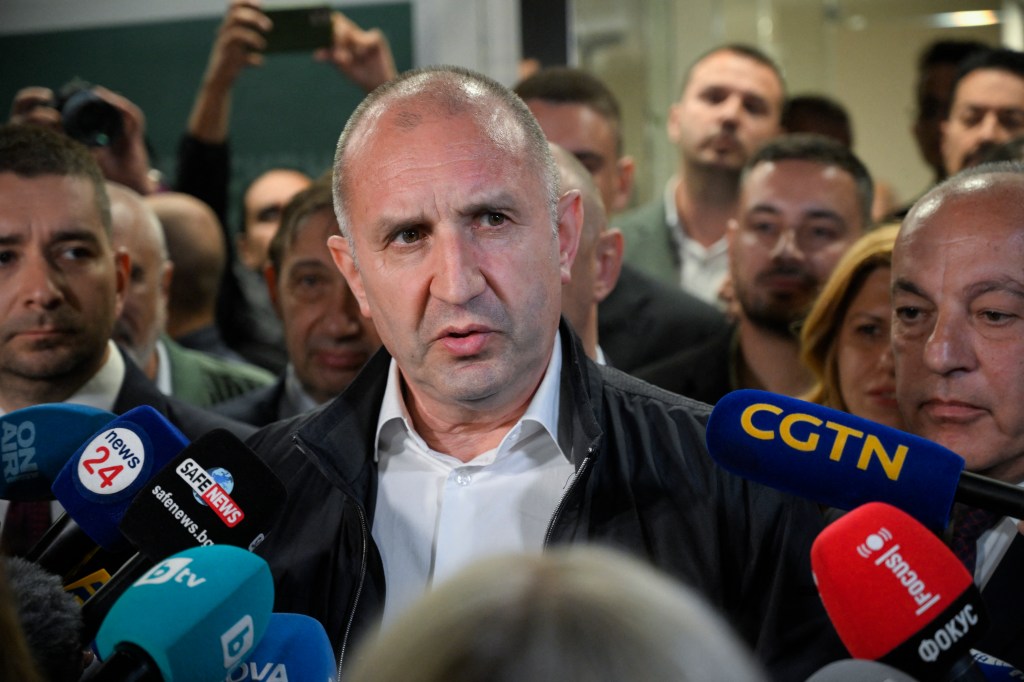
Early returns indicate that former Bulgarian president Rumen Radev, whose platform leans West and aligns with left-leaning nationalist sentiments, and his Progressive Bulgaria party, favored by voters critical of Russia, secured the parliamentary election on Sunday. With over 97% of ballots tallied, Radev’s bloc sits near 45%, while Boyko Borissov’s center-right GERB and the pro-EU We Continue the Change–Democratic Bulgaria coalition (referred to here as PP-DB) are both around 13%. Voter turnout surpassed 50%, following months of mass protests in December over corruption and an unpopular budget. For further analysis of the election’s implications for Bulgaria and the EU, consult the full piece in today’s TMD.
- In January, Radev resigned from the presidency, a largely ceremonial post, and established the Progressive Bulgaria party.
Several Louisiana Children Killed in ‘Domestic’ Shooting
In Shreveport, Louisiana, authorities reported that on Sunday morning a 31-year-old gunman killed eight children ranging from 3 to 11 years old across three locations, nearly all his own offspring. The assailant also wounded two women—his wife and a former girlfriend. After fleeing the third site, he carjacked a vehicle, and law enforcement ultimately shot him dead following a pursuit. Officials described the incident as strictly domestic, offering no concrete motive. Family members of the shooter, a Shreveport resident, told the New York Times that he struggled with mental health issues and had recently told them he was considering suicide after his wife had filed for divorce. The man had a prior arrest in 2019 and a conviction for illegal firearm possession.
- Authorities stated the attacker employed a small-caliber handgun during the attack and possessed a rifle-like handgun at the moment of his death.
- The U.S. Army indicated the man served in the Louisiana Army National Guard from 2013 to 2020, never advancing beyond private and not deployed.
Bulgarians have voted in seven snap elections since 2021. On Sunday, they went back to the polls for the eighth time—and it may have been their most consequential vote yet.
The Eastern Balkan country of nearly 6.5 million has long been one of the European Union’s least stable members. Transparency International’s 2025 Corruption Perceptions Index ranks it—alongside Hungary—among the bloc’s most corrupt, and Eurostat ranks it among the bloc’s poorest. Then, in November 2025, the government introduced its proposed 2026 budget: higher taxes and social security contributions for ordinary Bulgarians, and pay raises for state security employees.
Nearly 100,000 protesters took to the streets of Sofia, railing against the budget specifically, and the country’s endemic corruption and oligarchic influence more broadly. Prime Minister Rosen Zhelyazkov resigned—less than a year into the job—rather than face a no-confidence vote. His conservative GERB party failed to get the votes for a technocratic replacement, and a caretaker government under centrist Andrey Gyurov took over in February.
This was the sequence that led up to Sunday’s vote, which put a Russia-sympathetic, Euroskeptic former president on course to govern Bulgaria with an outright parliamentary majority—installing another Kremlin-aligned force in the European Union just as Viktor Orbán’s defeat in Hungary last week removed one.
So how did a former Communist Party member, long tied to the establishment he now denounces, sweep Bulgaria’s anti-corruption vote? And what does his win mean for the country and its relationship with the European Union?
Today’s Must-Read
In Other News
Today in America
- The Justice Department charged a Los Angeles resident born in Iran with arranging the supply of Iranian drones, munitions, and millions of rounds of ammunition to the Sudanese military.
- The U.S. military struck another alleged drug-trafficking boat in the Caribbean on Sunday, killing three.
- Trump signed an executive order to “accelerate” government-backed research and medical access to psychedelic drugs, including ibogaine.
- Assistant Attorney General for the Civil Rights Division, Harmeet Dhillon, sent a letter to Wayne County Clerk Cathy Garrett demanding access to all 2024 election ballots from Wayne County, Michigan, which includes Detroit.
- Police body-cam footage and records obtained by the Washington Post show that law enforcement officials in Washington, D.C., were prepared to arrest Republican Rep. Cory Mills of Florida following an assault allegation made against him last year, but were blocked from doing so by a police lieutenant and later by then-acting U.S. Attorney for D.C. Ed Martin.
- The U.S. Coast Guard is continuing to search for six crew members who were aboard a cargo ship that was found in the Pacific Ocean, north of the U.S. Mariana Islands, after Typhoon Sinlaku swept through the area.
Around the World
- A French soldier died while clearing a road in southern Lebanon; authorities believe the attacker was affiliated with Hezbollah.
- Spain’s Prime Minister Pedro Sánchez urged the European Union to terminate its 2000 association agreement with Israel, which governs political, trade, and cooperation ties between the two, stating that “a government that violates international law and, therefore, the principles of the European Union cannot be our partner.”
- The U.S. Embassy in Mexico said that two American officials and two Mexican officials were killed in a car crash in Mexico’s northern Chihuahua state while returning from an operation to dismantle cartel-affiliated laboratories.
- The State Department said that the Democratic Republic of the Congo’s government and a coalition representing rebel militia groups agreed to stop attacking civilians and pledged to provide for the safe passage of humanitarian aid and the workers transporting it.
- Australia signed a roughly $6.5 billion contract with Japan to build 11 frigates for its navy, the first three of which will be built in Japan, before transitioning construction to a shipyard in Western Australia for the subsequent eight.
- The Dominican Republic will reopen its airspace to flights to and from Haiti for the first time since March 2024.
On the Money
- Blue Origin conducted the third launch of its New Glenn rocket, joining SpaceX as the only space company to reuse a sea-launched orbital rocket booster.
- Meta Platforms is reportedly preparing an initial wave of job cuts totaling around 8,000 employees—roughly 10% of its worldwide staff—set for May 20, with more reductions anticipated later in 2026.
- Bill Peebles, the OpenAI executive in charge of its discontinued video generator project, Sora, departed the company, along with Kevin Weil, the head of OpenAI for Science, whose unit will be dispersed into other research teams.
- QXO plans to acquire insulation-maker TopBuild for about $17 billion, positioning Brad Jacobs’ firm as the second-largest publicly traded distributor of building products in North America.
- For a third straight weekend, Universal’s The Super Mario Galaxy Movie led the domestic box office with roughly $35 million, while Amazon MGM’s Project Hail Mary finished second in its fifth weekend with around $20.4 million.
Worth Your Time
- “Syrian billionaires needed a favor in Washington. They invoked the Trump name.” (New York Times)
- Daniel Engber investigates whether a profoundly autistic 28-year-old man truly authored a new best-selling book. (The Atlantic)
- Berber Jin and Kate Clark examine whether OpenAI CEO Sam Altman’s investments in external projects create potential conflicts of interest. (Wall Street Journal)
- NASA released free posters for the Artemis II mission and launched a site that renders your name using satellite imagery.
Presented Without Comment
New York Times: Humans Who Used a Bear Suit to Defraud Car Insurers Are Sentenced to Jail
Also Presented Without Comment
New York Times: Man Charged in Lego Theft Scheme of Replacing Pieces With Pasta, Police Say
Also Also Presented Without Comment
Deutsche Welle: Neighbor Attacked for Pounding Schnitzel Too Loudly
Let Us Know
Correction, April 20, 2026: This edition has been amended to note that two interview quotes came from Vessela Tcherneva, not Maria Spirova.