
CHERNOBYL, Ukraine—Click-click-click. Volodymyr Verbytskyi’s Geiger counter starts to act up, then settles after emitting a warning. Beyond the first stands of trees encircling the Vladimir Ilyich Lenin power station, the device beeps briefly before quieting. Verbytskyi, his face weathered by sun and wind, studies the numbers flickering on the display.
“It’s at 107 micro-roentgens per hour,” he explains. “The standard is up to 30, but within the exclusion zone that level is not unexpected.” Verbytskyi spent many years working as a “liquidator” — the term used for people sent to decontaminate the site of the worst civilian nuclear catastrophe in history.
On April 26, 1986, nearly four decades ago, one of the plant’s reactors blew up. A portion of the core ignited, radioactive particles billowed into the air, and debris scattered across the site. Within two days, radioactive fallout reached as far as Sweden. Over 300,000 people would eventually be evacuated, and thousands died from illnesses linked to radiation exposure.
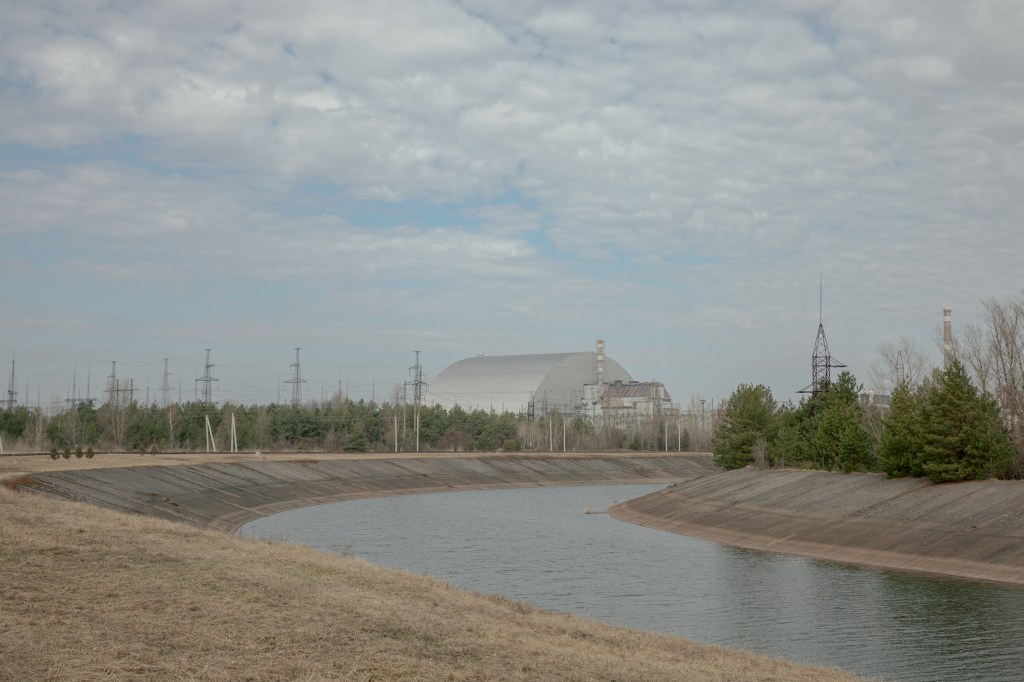
Today, yellow signs warn that the area is radioactive, dotting the landscape. The soil, rich with radioactive particles, remains hazardous. In the distance, from checkpoint to checkpoint along a dusty, reddish road, the vast silhouette of the sarcophagus enveloping the Chernobyl reactor comes into view.
The 1,600-square-mile exclusion zone stays mostly deserted. A few thousand workers still rotate through, keeping the site running and monitoring radiation. While the major cleanup ended long ago, ongoing decontamination and containment continue to occupy the area.
Each anniversary is a weighty occasion, says Mykola Yevsiienko, 70, an engineer who traces his origins to Chernobyl. As April 26 nears, memories flood back.
“I remember what I was doing, how I reacted,” he recounts. “My boss phoned me at five in the morning. I asked what was happening. He said: You’ll see. I immediately understood that something grave had occurred.”
He speaks with emotion about his former colleagues, most of whom perished in the disaster or its aftermath.
“Every anniversary is painful. You think of everyone you worked with who isn’t here anymore.”
The causes of the catastrophe are still debated. For Ukrainian historian Serhii Plokhy, the fault lies with a Soviet system that valued secrecy and productivity over safety. He highlights, in particular, design flaws in the RBMK reactor, known to the leadership but concealed from the operators.
In the early weeks, some 600,000 soldiers, firefighters, and liquidators — often without proper gear — were sent to the site to contain the disaster. Verbytskyi, a Pripyat native only five kilometers from the plant, was among them. He recalls weeks and months of relentless labor.
“We would rise, work all day, come back late at night, and head out again. That’s all I remember.”
Under constant threat.
At the base of the arched sarcophagus, which resembles an airplane hangar, time seems to have paused in the 1980s. Staff and engineers in deep indigo uniforms pass through retro turnstiles built to monitor radiation, their metallic frames and analog gauges reflecting late-Soviet design. Nearby, a Prometheus statue in a restrained Brutalist style stands, and wall mosaics still depict workers and nuclear imagery.
The plant continued generating electricity with the remaining reactors until 2000. After the Soviet collapse, the site passed under Ukrainian control, and Ukraine oversaw its final shutdown under international pressure. Today, the facility still employs personnel to manage dismantling operations and uphold safety systems.
Reactor 4 sits inside a second sarcophagus, completed in 2019. Known as the New Safe Confinement, it covers the original concrete shelter built in 1986, which had begun to deteriorate. The steel structure, outfitted with cranes and ventilation, stands 354 feet tall and 843 feet wide and is engineered to keep radioactive material contained for at least a century while enabling the dismantling of the reactor inside.
About six miles from the Belarus border, the exclusion zone has gained renewed strategic significance since 2022. It was among the first areas seized by Russian forces at the outset of the invasion, exposing a site already burdened by nuclear risk to the vagaries of war. Although no longer occupied, it remains exposed, with ongoing military activity, disrupted monitoring, and the constant danger of damage to containment structures raising fresh concerns about safety in a landscape still scarred by catastrophe.
“The Russians were here from February 24 to March 31, 2022,” explains Volodymyr Falshovnyk, 61, a shift supervisor at the plant. “From the start of the invasion, our team labored without interruption. On March 20, an agreement allowed a rotation. I was part of the crew sent to replace the workers. We crossed the front line escorted by Russian soldiers.”
While he reports no direct violence, he describes a systematic looting of laboratories and offices by Russian forces. They seized scientific gear, from radiation-measuring samples to hard drives and technical documents, along with vehicles and computers.
“They thought we were building a nuclear bomb,” says Kyrylo Akinin, 35, a lab technician responsible for tracking radioactive contamination. “The Russians stole a great deal of expensive equipment. Since then, our work has become far more complicated.”
He also notes that most plant personnel have historically lived in Slavutych, a small town in the Chernihiv region, about 40 kilometers from the plant.
“Earlier, we could pass through Belarus to reach work. It took less than an hour. But since the war began, the border has closed. We now have to go down to Kyiv to bypass the Dnipro River before returning to Chernobyl. It now takes more than six hours, so we often stay three or four days at a time and live on site.”
Falshovnyk says such logistical hurdles, combined with radiation exposure and the proximity to Belarus, complicate recruitment. But above all, the fear of a fresh Russian march keeps workers away.
“Today, we live under constant threat. Sirens blare regularly. Drones fly over the site. One of them, in February 2025, even struck the containment arch,” Falshovnyk says, pointing to the impact on the sarcophagus. “No one can predict what comes next.”
Forty years on.
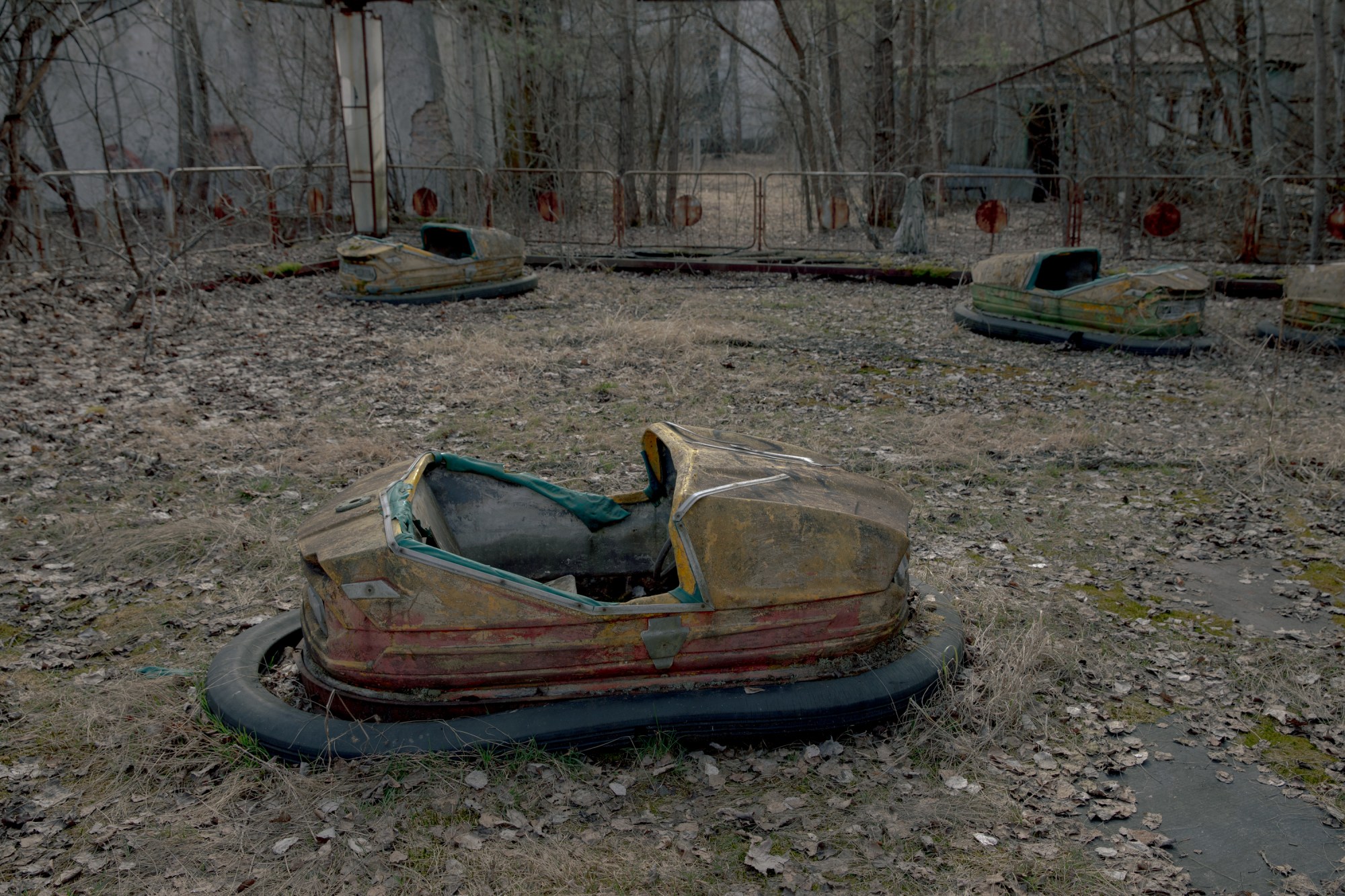
In Pripyat’s central square, bumper cars, eaten by rust and weeds, sit idle as if waiting for no one. The 50,000 residents who inhabited the city closest to the plant were evacuated in under 36 hours and never returned.
Murals of Lenin, tucked here and there along alleyways, hover like phantoms from another era. The cultural center, overrun by vines, leaks rust and water. Verbytskyi wanders through the places of his youth, tracing old memories.
“I helped place these mosaics when I was a child,” he recalls from a café in the city. “This is also where I had my first drink,” he adds with a smile.
Beside the river, he remembers summer evenings with friends and the boats that sometimes carried them as far as Odesa.
“It will take another three centuries before the zone becomes truly livable again,” he murmurs.
Among those evacuated from the exclusion zone, only a handful remained allowed to stay. Mykhailo Pavlovych, now 90, is one of them—a schoolteacher who survived a German bombing at six years old and moves about on two long crutches. His wife died of cancer, which he attributes to radioactive fallout, while he himself has never faced health issues.
With a hint of irony, he suggests his life bound to Chernobyl read like a scripted fate: German massacres, communist repression, the nuclear calamity, and then the Russian occupation in 2022.
“I was fishing when the first explosion happened. But no one told us anything. A day later, I went back to teach at the school where I worked.”
Only a week later did the children get evacuated. Mykhailo Pavlovych, his wife, and their sons left soon after.
“I returned three years later. My son found me a job at a local church, and I’ve stayed ever since.”
His wife later died from the disaster’s consequences. Pavlovych, now ninety, says he feels as strong as ever, unable to explain why he never fell ill, attributing it simply to his resilience.
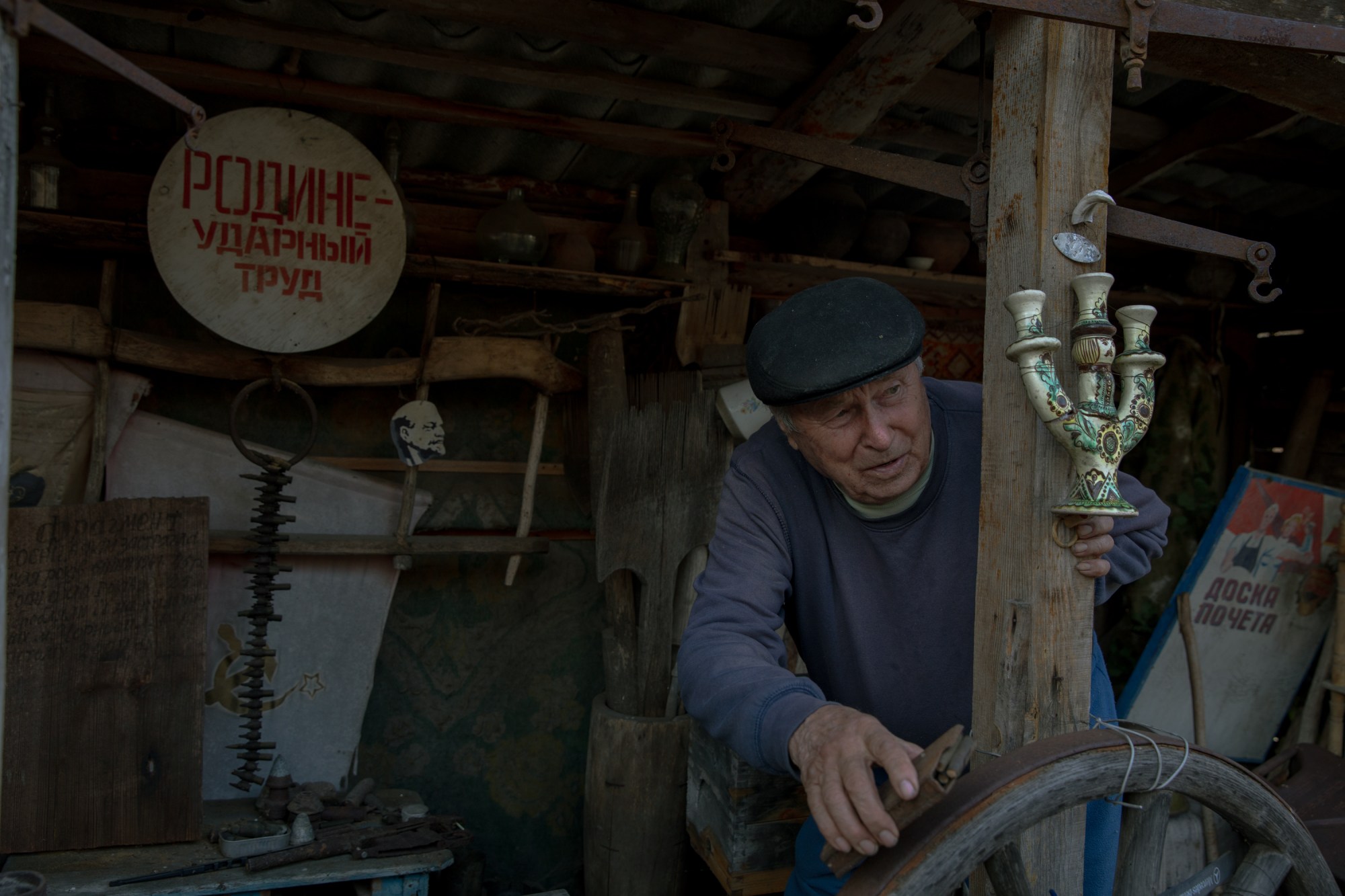
He largely lives alone in his small village, surviving on a pension and occasional visits from former students who bring him food.
“The worst came during the occupation. There was no one left to help me,” he notes. “When the Russians arrived, I repainted my gate as quickly as I could.”
Leaning on his cane, he points to a door hastily painted in blood-red. Beneath the dried paint, the hues of Ukraine linger faintly.
“If they had noticed my Ukrainian flag on that door,” he says, “they would have crucified me on it. I’m certain of it.”
He suggests the disaster was prefigured by the name itself: Chernobyl translates to “black grass” in Ukrainian. He repeats it like a hymn, softly: Chernobyl, Chernobyl.
Leaning on his crutches without emphasis, Mykhailo Pavlovych adds:
“Someone with foresight gave this city its name. He anticipated what would unfold. Here, people suffer. Contaminated waters flow from Pripyat into the Dnipro, onward to the Black Sea, and finally reach the Mediterranean.”
He pauses, then sums up:
“Only despicable beings could have built a nuclear power plant on this land. All of these facilities must be shut down immediately, and the soil allowed to recover. Only then will the land, and Ukraine, be reborn.”
Yet Mykhailo Pavlovych has never forced himself to leave his farm.
“I was here when the Germans invaded, and I came back home. The same after the nuclear disaster. And when the Russians arrived, I did not go away either. Why would I? This is my home.”