Happy Wednesday! And Unhappy Tax Day! Thankfully, the king of quirky tech tools, Riley Walz, has made a Spotify Wrapped for your taxes, showing you what the federal government spent your money on and how much crippling debt it is in.
Hoorah!
Also today is the last day to vote in our Dispawtch Bracket. We’re down to the final two contenders: Charlie and Teddy. It’s up to you to choose our Dispawtcher of the Year!
Brief Highlights: The Day’s Leading News
White House Seeks Renewed Iran Talks
As the ceasefire between Iran and the United States approaches its expiration in under a week, officials in the White House say they plan to reengage with Iranian negotiators soon, and that talks aimed at arranging this continue. On Tuesday, President Donald Trump indicated that discussions could “be happening over the next two days” and lauded Pakistani intermediaries for their mediation. In the meantime, on the inaugural day of Washington’s blockade of the Strait of Hormuz, six vessels turned away after warnings from American warships, retreating to Iranian ports. No shots were exchanged, and five of the ships were oil tankers, according to U.S. officials. For more on the blockade, see yesterday’s issue of TMD.
- The Financial Times reported that Iran’s Islamic Revolutionary Guard Corps secretly acquired a Chinese-built spy satellite in late 2024 for about $36.6 million and used it to surveil military bases across the Middle East hosting U.S. troops, including Saudi Arabia’s Prince Sultan Air Base, where five U.S. refueling aircraft were damaged.
- David Barnea, the head of Israel’s Mossad intelligence agency, told attendees on Tuesday that his country would persist in efforts to topple the Iranian regime. “Our obligation will be discharged only after this extremist regime is replaced,” he proclaimed. “This regime, which seeks our destruction, must pass from the world.”
Israel and Lebanon Talk in Washington
The Israeli and Lebanese ambassadors to the U.S. met in Washington on Tuesday—in a session hosted by Secretary of State Marco Rubio—to discuss the conflict between Israel and the Lebanese terror group Hezbollah. Envoys from both sides described the exchange as constructive yet not yielding immediate breakthroughs. Lebanese Ambassador to the U.S. Nada Hamadeh Moawad said she pressed for a ceasefire and argued for “the full sovereignty of the state over all Lebanese land.” Yechiel Leiter stated that both parties agreed to pursue a clearly delineated border and anticipated further talks in the weeks ahead. State Department principal deputy spokesman Thomas Pigott noted that the meeting “marked the first significant high-level engagement between the governments of Israel and Lebanon since 1993.”
- The Israel Defense Forces (IDF) reported one soldier was killed and three injured in a vehicle crash in Southern Lebanon on Sunday night, and ten paratroopers were wounded after clashing with Hezbollah fighters in Lebanon during the early hours of Monday. The military also said that an armored battalion commander was “seriously wounded” while conducting operations in Lebanon on Tuesday.
- A senior Palestinian official told the BBC on Tuesday that Hamas, the Gaza-based militant group, had rejected a disarmament plan proposed by the U.S.-led peace board’s top Gaza representative.
Spanish First Lady Charged with Corruption
Spain’s Prime Minister Pedro Sánchez saw his wife, Begoña Gómez, charged Monday with embezzlement, influence peddling, corruption in business dealings, and misappropriation of funds, alongside two others. Gómez allegedly used her status as the prime minister’s wife to create and oversee a chair at Complutense University in Madrid, and diverted government funds for private use. The judge overseeing the two-year probe, Juan Carlos Peinado, also charged Cristina Álvarez, a government aide at the prime minister’s official residence, and entrepreneur Juan Carlos Barrabés. Both Sánchez and Gómez have denied the charges, claiming the inquiry—which originated with an anti-corruption group with ties to Spain’s far-right—was a political move to undermine the socialist government.
- Peinado initiated the probe in 2024 after a complaint from the group Manos Limpias (“clean hands”), which has a track record of pursuing cases for right-wing causes.
- The charges arrive as Sánchez’s administration faces a string of corruption inquiries, including the indictment of his brother, David Sánchez, for alleged influence peddling and malfeasance, and the ongoing trial of former Transportation Minister José Luis Ábalos over a supposed kickback scheme.
Ukraine Makes Robot Combat Breakthrough
Ukrainian President Volodymyr Zelensky stated on Monday that his forces captured a position using only drones and ground-based robots—the first instance in the Russia-Ukraine war where an enemy position was seized exclusively by unmanned weapons systems. “The occupiers surrendered, and the operation proceeded without infantry and without losses on our side,” Zelensky said in a speech congratulating Arms Makers’ Day, a holiday recognizing the defense industry’s role in Ukraine’s defense. While drones have long aided Ukrainian operations, there has been a recent surge in missions employing ground-based drones for logistics support, casualty evacuation, and even as mounted gun platforms.
- On Tuesday, Zelensky disclosed that Ukraine and Germany had begun planning a joint drone and weapons-production deal. Germany also pledged a defense package valued at $4.7 billion.
- Russia fired three ballistic missiles and 324 drones—roughly 250 of them Shaheds—at Ukraine overnight, killing at least one person and injuring several others across Zaporizhzhia, Dnipro, Cherkasy, and the Odesa region. Ukrainian air defenses shot down or suppressed 309 of the drones.
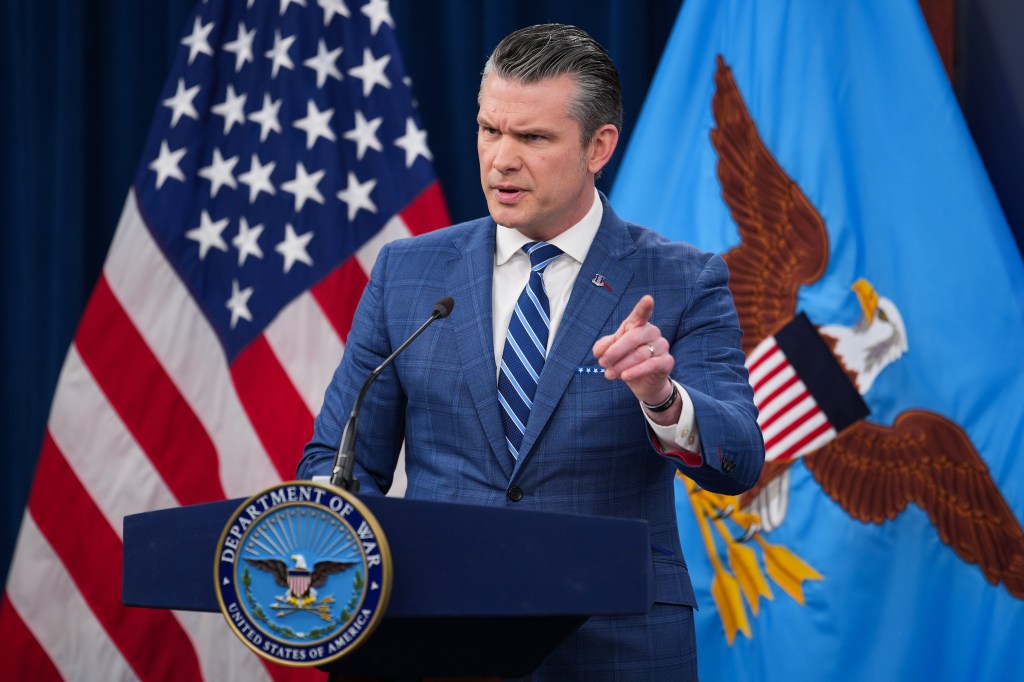
- Secretary of Defense Pete Hegseth will not attend April’s meeting of the Ukraine Defense Contact Group, a coalition of over 50 countries aiding Ukraine; Under Secretary of Defense for Policy Elbridge Colby will attend in his stead.
BLS Shows Cost Increases
The Bureau of Labor Statistics released March’s Producer Price Index on Tuesday, measuring the average month-to-month changes in prices received by domestic producers for their output. It showed a 0.5 percent rise for the month, well below the 1.1 percent forecast and matching February’s revised 0.5 percent. Fears that the Iran conflict and the resulting global supply shock in oil, natural gas, and fertilizer would drive inflation higher appeared overstated, though market watchers still expect the Federal Reserve to refrain from cutting rates at its upcoming meeting. Over the year ending last March, the overall PPI rose by 4.0 percent, up from February’s 3.4 percent annual gain and the highest annual PPI increase since February 2023. Energy costs climbed 8.5 percent for the month, driving much of the PPI uptick; removing volatile food and energy left the core PPI up by 0.1 percent. Inflation in services did not increase in March.
- The International Monetary Fund trimmed its global growth outlook on Tuesday, warning that the Iran conflict has prompted a downward revision—from 3.3 percent to 3.1 percent—for 2026, with a downside scenario where persistent energy disruptions could reduce growth to as low as 2.5 percent, heightening the risk of a global recession.
- The Personal Consumption Expenditures index, the Fed’s favored inflation measure, is slated for release later this month and is expected to stay above the two percent target.
It was only three months ago that Chinese leader Xi Jinping ousted the country’s highest-ranked military officer, Gen. Zhang Youxia, in a move that followed the purge of dozens of other high-ranking military officials since 2022. Zhang, officially, was under investigation for potential corruption—a common allegation against senior Chinese government leaders who have lost favor with Xi—and TMD described Zhang’s removal at the time as “one of the most sweeping leadership shake-ups in modern Chinese history.”
But something not dissimilar has been happening closer to home. Earlier this month, as the U.S. waged war on Iran, Defense Secretary Pete Hegseth dismissed three senior Army generals without explanation, the latest in a series of firings. According to the American Enterprise Institute (AEI), 21 flag or general officers have been fired since President Donald Trump returned to the White House in January 2025.
“While it is clearly a civilian prerogative to retire or fire senior officers, it’s never been done in a wholesale manner that the Trump administration is doing,” Kori Schake—a senior fellow at AEI, where she directs the think tank’s foreign and defense policy studies—told TMD. “It speaks incredibly ill of the administration that there are this many people that they don’t have confidence in.”
Hegseth entered the Pentagon with an explicit goal of purging what he considers ideological rot from the military’s leadership. But is the administration trying to turn the nation’s military leadership into a political instrument? And what is the long-term damage to an institution built on nonpartisanship?
Today’s Must-Read
In Other News
Today in America
- The Justice Department asked a federal appeals court to vacate the seditious conspiracy convictions of 12 Proud Boys and Oath Keepers members—the last January 6 defendants whose cases were not fully resolved by Trump’s 2025 clemency order.
- A new report from the Justice Department accused the Biden administration of improperly prosecuting pro-life activists under the Freedom of Access to Clinic Entrances Act and working with pro-choice activist groups to monitor their activities.
- Democratic Gov. Abigail Spanberger of Virginia signed a bill that will end tax exemptions for certain state-based groups associated with the Confederacy’s legacy, including the United Daughters of the Confederacy.
- A federal appeals court blocked U.S. District Judge James Boasberg from continuing his criminal contempt investigation into the Trump administration’s Alien Enemies Act deportation flights to El Salvador, ruling 2-1 that his yearlong probe was a “clear abuse of discretion” that improperly intruded on executive branch decision-making.
- The House of Representatives voted 396-10 to pass the Alert Act, a federal aviation safety bill written in response to the January 2025 collision between a commercial plane and a U.S. Army Black Hawk helicopter in Washington, D.C.
- White House Office of Science and Technology Policy Director Michael Kratsios issued a memo instructing NASA to develop space nuclear reactors “in orbit as early as 2028 and on the Moon as early as 2030.”
Around the World
- China reportedly deployed fishing boats and a 350-meter floating barrier to block the entrance to the disputed Scarborough Shoal in the South China Sea, as the Philippines reported 10 Chinese coast guard vessels in the area over the past week.
- European Union lawmakers reached an agreement to reduce the amount of foreign-made, tariff-free steel allowed into the bloc by 47 percent and impose a 50 percent tariff rate on excess steel imports.
- Italian Prime Minister Giorgia Meloni suspended a defense cooperation deal with Israel. Meloni’s government has recently criticized Israel’s military operations in Lebanon.
- French police were barred from searching French President Emmanuel Macron’s official home, the Élysée Palace, in a corruption case involving state events contracts. Macron is not a suspect.
- Canadian Prime Minister Mark Carney told reporters that Canada would suspend the federal fuel excise tax on gasoline and diesel until September 7, starting on April 20.
On the Money
- Amazon announced that it will acquire U.S.-based satellite telecommunications company Globalstar in a deal valued at $11.57 billion.
- The Danish-based pharmaceutical company Novo Nordisk announced a new partnership with OpenAI to deploy its AI tech to “bring new and better treatment options to patients faster.”
- Republican Texas Attorney General Ken Paxton’s office said it was investigating the Canadian-based clothing company Lululemon for allegedly using so-called “forever chemicals” in its athletic apparel. The company says it has not used the harmful chemicals in any product since January 2024.
Worth Your Time
- “The Paranoid Prophet of Loserdom” (Tablet)
- Rana Foroohar details why the Trump administration should reconsider its push to allow workers to invest in 401(k) retirement savings in private equity, arguing that it’s not worth the risk. (Financial Times)
- Billy Kenber and Phil Kemp expose the network of immigration advisers fabricating evidence—fake cover stories, staged photos, forged support letters—to help migrants file fraudulent gay asylum claims in Britain. (BBC)
- John Burn-Murdoch assesses why AI, unlike social media, could have a depolarizing effect on its users. (Financial Times)
- Amy Chozick profiles Lauren Sánchez Bezos. (New York Times)
Presented Without Comment
New York Times: Vance Says the Pope Should Be More Careful When Talking About Theology
Also Presented Without Comment
Mainichi: Japanese Fire Official Suspended for Forcing Colleagues To Play Board Games While Working
Also Also Presented Without Comment
Associated Press: Philippine President Marcos Does Jumping Jacks To Disprove Health Rumors