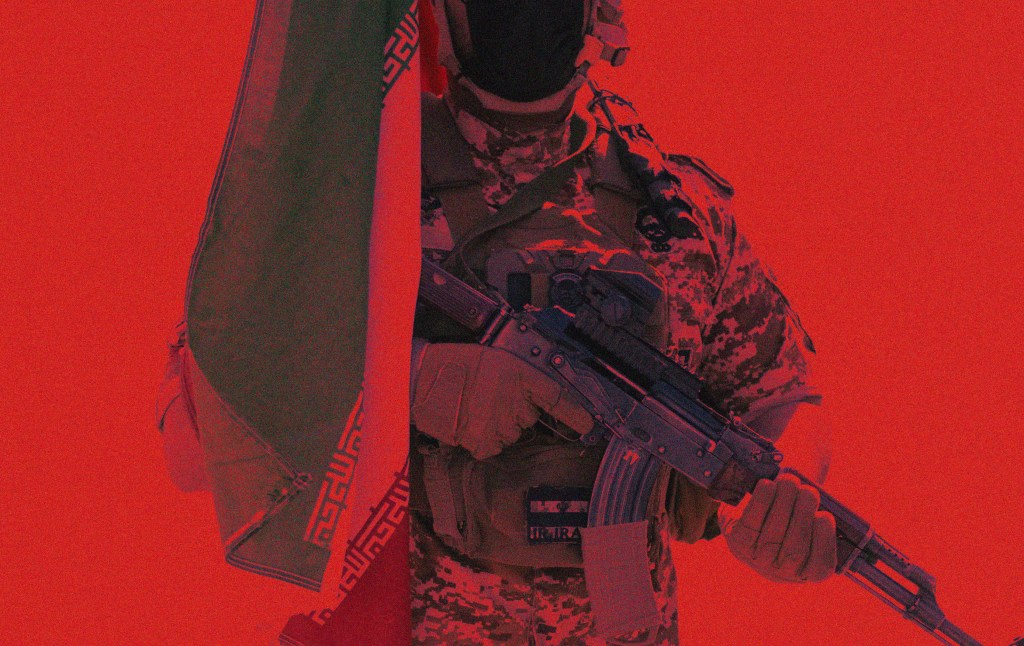
If you know a little bit about Iran, you’ve probably heard of the Islamic Revolutionary Guard Corps. A militia founded shortly after the Islamic Revolution of 1979, it has mushroomed to a mammoth force of economic, political, and military power within the country. Many informed observers of Iran have long predicted that the demise of Supreme Leader Ayatollah Ali Khamenei would shift power to the Guards, with authority passing from the clerics to soldiers.
Iran, experts prognosticated, could replace a religious dictatorship with a military one.
When an Israeli strike killed 86-year-old Khamenei in February, wartime Iran moved to replace him with his son, Mojtaba. Vindicating the experts, the Guards indeed appear to be the power behind the throne in Tehran now.
Their job is made easier because the shadowy Mojtaba Khamenei, who had next to no public profile prior to his elevation, was injured in the war. Some reports even claim he is in a coma—rumors bolstered by the fact that he has yet to appear in public more than six weeks into his supreme leadership. He has no plan to speak to media “for the time being,” a close relative and friend of Khamenei told me last week, speaking on the condition of anonymity. The Guards are now being treated as the real power in Iran by its adversaries. Last month, Israeli Prime Minister Benjamin Netanyahu dismissed Mojtaba as “a puppet of the Revolutionary Guards.”
The younger Khamenei has long had links to the Guards, and the idea that he’d team up with them to run the country isn’t new. As early as 2017, exiled journalist Ruhollah Zam spoke of the force’s “grand plan” to “securitize the country” and pave the path for Khamenei’s leadership. The plain-speaking Zam, who ran a sensationalist social media outlet, wasn’t taken seriously by the more polished members of Iran’s international diaspora at the time. But he proved enough of a threat for the regime to abduct him to Iran in 2019 and execute him a year later, and his most outlandish predictions about the IRGC now appear to be materializing.
But despite their notoriety, the Guards remain shrouded in mystery. One common misconception is the image of the militia as a unified power player that throws its weight around. This idea gives rise to the facile notion that the force could simply mount a coup and seize power. But the Guards are better understood as a decentralized hodgepodge of various networks. The force’s roughly 200,000 uniformed members don’t always act as one on the order of its top commander. This is why the killings of the force’s top commanders last year and in February—Hossein Salami and Mohammad Pakpour, respectively—haven’t done much to disrupt its day-to-day operations. Its new head, Ahmad Vahidi, commands more authority but even he can’t fully control the Guards’ massive network at will. An average node in this network could include a travel agency in Tehran, a front business in Thailand, a construction behemoth in Iran or Kazakhstan, or a branch of its autonomous volunteer force, the Basij, the millions-strong Brownshirts used to harass Iranian civilians in ordinary times and violently suppress protesters in more dire periods, such as the nationwide demonstrations in January.
Over the years, a few different centers of power have grown inside the ranks of the IRGC, often around particular personalities. Perhaps the most powerful such figure today is Mohammad Bagher Ghalibaf, the speaker of parliament who is now effectively running the Iranian war effort. A major commander of the Guards during the 1980 war against Saddam Hussein’s Iraq, Ghalibaf later served as mayor of Tehran and is a perennially unsuccessful presidential candidate. In the last few years, he has developed a relationship with Mojtaba Khamenei that could prove handy now. On May 19, 2024, hours after the then-President Ebrahim Raisi died in a helicopter crash, an associate of Ghalibaf told me that Mojtaba would succeed his father as the new supreme leader (Raisi had previously been the leading candidate for the job). It was obvious then, as it is now, that Islamic Republic elites view the two men as partners.
But no one man, not even the wily Ghalibaf, wields unchallenged control over the Guards. There are rival power centers in the force. One looks to former president Mahmoud Ahmadinejad, on whose mysterious rise and fall within the regime my colleague Graeme Wood has reported extensively. During his presidency, from 2005 to 2013, Ahmadinejad helped the Guards extend their hold over the Iranian government. His falling out with Ali Khamenei made the former president a political castaway, but many within the IRGC still root for him. Another powerful node of Guards revolves around Yahya Safavi, the force’s top commander from 1997 to 2007, whose loyalists still dominate sections of the force.
The Guards are not an ideological monolith, and many of them care more about power than ideology.
Guardsmen remain part of the organization’s sprawling network even after they leave their official positions there. They might instead move to a myriad of quasi-state-run bodies such as the Bonyads, entities funded by the public purse but that effectively operate like corporations with little oversight over their activities. One prime example is Saeed Mohammad. After serving as the head of the Guards’ powerful construction behemoth, Khatam al-Anbiya, since 2018, Mohammad had to quit his post in 2021 when he decided to run for the presidency. The clerical vetting body rejected his candidacy and he eventually moved to a top position at a Bonyad. But his political appetite remained. In the 2024 parliamentary elections, a political party he co-founded battled Ghalibaf and fared surprisingly well.
High-ranking IRGC officials often pass through the same networks. They often have similar educational backgrounds and forge an intimate familiarity with each other, banding together in times of crisis. But they nevertheless have sharp differences when it comes to the Islamic Republic’s direction and ideology—and simply over the pure pursuit of power.
Which brings me to another misconception: The Guards are often seen as the backbone of the regime’s hardline faction. Some analysts have even written about the spread of Islamist messianism among them. The force’s official statements do seem to confirm this perception, often reeking with belligerent anti-Americanism, a hatred of Israel, and hardcore Islamism. Many still remember how the Guards effectively worked as a hardline opposition party during the reformist presidency of Mohammad Khatami from 1997 to 2005. In response to the pro-democracy student protests of 1999, for example, top Guards commanders penned an open letter to Khatami, threatening to take things into their own hands unless the president suppressed the students. Ghalibaf was a signatory.
But the “Guards as hardliners” framework doesn’t capture the whole story. Although the IRGC does boast a political and ideological arm that tries to keep the ranks in check, membership in the force is also a vehicle for personal accumulation of riches and power, functioning similarly to the ruling communist parties in China today and the Soviet Union of yesteryear. In those countries, history shows that many opportunists join the parties not due to an ardent commitment to Marxism but simply because they are vehicles of power. With an estimated net worth of more than $28 billion, tech entrepreneur Jack Ma is not exactly a poster child for communism. But he is a longtime member of the Chinese Communist Party. After the fall of the Soviet Union, many longtime members of the ruling communist party adopted new nationalist ideologies overnight and continued to run their now-capitalist states.
In Iran, too, many people join the Guards in pursuit of power without necessarily sharing their ideological precepts. Ghalibaf might be fulminating against the “shameful life of the Zionist regime” in public. But in private settings, he has been known to gush about the engineering prowess of the Israeli army. When he ran for president in 2024, his team conducted outreach to journalists at foreign media outlets (including me) to present him as a Western-friendly technocrat who could reach a deal with the U.S. Some Guardsmen even supported the reformist candidacy of Mir-Hossein Mousavi in the hotly contested 2009 elections. Ayatollah Akbar Hashemi Rafsanjani, the grandfather of the regime’s West-facing pragmatic faction, had helped the Guards take over postwar reconstruction in the 1990s and still has many loyalists in the force. In short, the Guards are not an ideological monolith, and many of them care more about power than ideology.
A broader misconception about Iranian politics is linking ideological rigidity to military audacity. But how much of a staunch anti-Western revolutionary you are doesn’t necessarily determine how trigger-happy you can be. Despite stubbornly keeping Iran committed to an anti-Western line, Ali Khamenei remained a cautious, even cowardly, commander in chief, carefully avoiding direct confrontations with the U.S. and Israel in favor of cloak-and-dagger covert operations and deniable terror attacks. His removal from power might allow more militarily adventurous elements of the IRGC to take the helm. Some might even believe that they should do what the elder Khamenei never allowed: dare to build an atomic weapon. During the current war, the Guards have put into practice their fabled strategy of mosaic defense, in which various forces in the Guards determine their own targets and act without contact from the central command. Top regime officials, such as Foreign Minister Abbas Araghchi and President Masoud Pezeshkian, have already claimed that some of the strikes on neighboring countries were local initiatives.
The diversity and decentralized nature of the Guards ultimately mean that their accession to power won’t put an end to decades of factional infighting over the Islamic Republic’s policies and direction. Nor does it ensure a continued hardline position. Strategic issues such as the continuation of the war against U.S. and Israel, Iran’s relations with Saudi Arabia and other regional powers, and Iran’s domestic governance will continue to split the ruling elites—even if many of them now share membership in the IRGC.
Iran might be evolving into a new form of dictatorship. But it will not be a united one. The battle over its future will continue.