Joan Didion famously observed that “We tell ourselves stories in order to live.” The implication is that life without stories would be hollow—or perhaps descend into a diminished form of existence, a pseudo-life. Whatever the truth of the matter, it’s worth considering as our culture shifts from a predominantly text-based milieu to one guided by screens.
Confronting the Perpetual Present
Short-form video—the realm of TikTok, Instagram Reels, and a substantial portion of Twitter/X and YouTube—does not invite narrative. (Paradoxically, Instagram “Stories” aren’t narratives at all; they are fleeting bits of feeling, data, and imagery, released in bursts.) The closest these video platforms come to telling a story is when someone uploads an AI-generated clip about anthropomorphic foods being boiled together, or when a narrator briefly retells a folklore. For the most part, scrolling and bite-sized clips prize sensation over any sustained plot. Their prominence pushes us into unprecedented territory as a civilization.
It has become so commonplace to expect rapid consumption that sitting through a two-hour film, or patiently engaging with a novel, now reads as a sign of mental steadiness. As the “attention economy” relentlessly tilts toward short-form content, the ability to attend to something longer than a quick blurt seems worthy of praise. Meanwhile, Hollywood has suffered a marked decline, with adults’ monthly cinema attendance dropping from 39 percent in 2019 to 17 percent in 2025.
The state of reading isn’t any brighter. Enjoyment-reading among adults fell from 28 percent in 2004 to 16 percent in 2023. The typical American adult reads at roughly a seventh- to eighth-grade level—and alarmingly, 54 percent read below a sixth-grade level. More fundamentally, our capacity to simply pay attention has diminished: today, we manage roughly 47 seconds on a screen before diverting our attention elsewhere.
Those who track cultural decline likely aren’t surprised. Yet what does this mean for our ability to absorb and internalize narrative? And how can we relate to others without the means to share long-form stories? Fritz Breithaupt of Indiana University, author of The Narrative Brain, has stressed that narration is essential for sharing experience, forging social bonds, and processing painful experiences. It seems that without narrative, or with only fragments of narrative, these core cognitive tasks may falter (if they haven’t already).
Psychologists have long argued that stories underlie human cognition. When we enter a room, we don’t observe every object with perfect clarity; we interpret what the stories we carry lead us to notice. When a high school student walks into class, they don’t fixate on the tape dispenser or the random paper clips. They perceive drama: personality clashes, friendships that bloom and fade, new crushes and sworn rivals. This might suggest storytelling narrows our view of reality—but in truth, storytelling doesn’t merely reinforce a habitual way of thinking. It helps us become aware of the stories we tell and, potentially, revise them. We gain access to a wider range of narratives lying beneath the surface of daily life. We recognize that we possess an invisible organ, the imagination, which can operate automatically or consciously.
By engaging in storytelling, by learning to wield our imaginations, we begin to perceive reality as a narrative that unfolds around us. Jeffrey Kripal of Rice University has gone so far as to compare us to characters trapped within a story (existence), unaware that we are its authors. You may take Kripal literally or figuratively, but, in either case, his notion carries a plausible bite. The world is composed of stories, and the quality and coherence of those stories reflect well or poorly on the world we’ve created.
Even before literate culture, there were storytellers—often occupying priestly or shamanic roles—who stored and recounted all the tribe’s legends. The storyteller was not only the tribe’s imagination but its memory, since imagination remains inert without a store of memories to draw from. This primordial storyteller was essential in shaping a coherent and livable picture of the cosmos. He or she was, in the words of poet Percy Bysshe Shelley, one of “the unacknowledged legislators of the world.”
But our technological society treats writers and storytellers with profound disrespect. The tech stewards of our era regard writers as odd and unserious—even as they repurpose authors’ work to train AI. (Elon Musk, Jack Dorsey, and others have publicly railed against copyright law.) Consequently, more and more people who might have fulfilled the shamanic/priestly function of the storyteller are trapped in digital purgatories and limbos. Publishing output has thinned, and the vast majority of books fail to sell 5,000 copies. In the worst-case scenario, aspiring writers might be distracted and enthralled by the same short-form content as the rest of us. In the more hopeful scenario, they might end up addressing a readership of three on Substack.
The situation is grave. It recalls the 18th century, the era known as the “Age of Reason,” when a wave of poets faced severe mental distress. Poets Williams Collins, William Cowper, Christopher Smart, and John Clare all wrestled with substantial illness, the last three being institutionalized at times. A young prodigy, Thomas Chatterton, took his own life at the age of 17. The celebrated poet-artist William Blake was deemed mad in roughly the same period. Blake used his verse to oppose the demonization of imagination, which was routinely contrasted with reason and considered destabilizing. Yet the names of the 18th-century poets who went mad are still known, while those swept up in today’s short-video haze may fade into utter obscurity, perhaps never having produced a single word.
We have now been propelled far beyond even oral storytelling into a totally new epoch in human history, and perhaps prehistory in a novel form. Does short-form video, by denying continuous and coherent narrative, push us back into a pre-Stone Age state? Does our technology ultimately circle us back toward the australopithecine era? Without storytelling, memory withers. And without memory, without anchors in time and space to explain how we arrived here, we risk running wild.
In Christopher Lasch’s 1979 study, The Culture of Narcissism, he argued that this would occur. As narcissism became increasingly normalized, our memories would fade, and we would lose any fixed sense of history. Instead, we would engage in an endless struggle for psychological survival, attempting to persuade others to see us as we wish to be seen. All life would shrink to a desperate performance, mirroring animal-like competition, but displaced into the psyche.
Short-form video content and the habit of scrolling on social media fulfill Lasch’s prophecy in a particularly literal sense. We regress to an animal-like state, yet the jungle we inhabit is technological. We resemble a startled rabbit in an open field, seized by a constant chill of fear and misery, always aware that predators lurk nearby. Marshall McLuhan once said technology would fuse the globe into a “global village”—a notion that sounds appealing until you read his warning about it: “Terror is the normal state of any oral society, for in it everything affects everything all the time.” This description aptly captures today’s online ecosystems. The anxiety engine keeps grinding away.
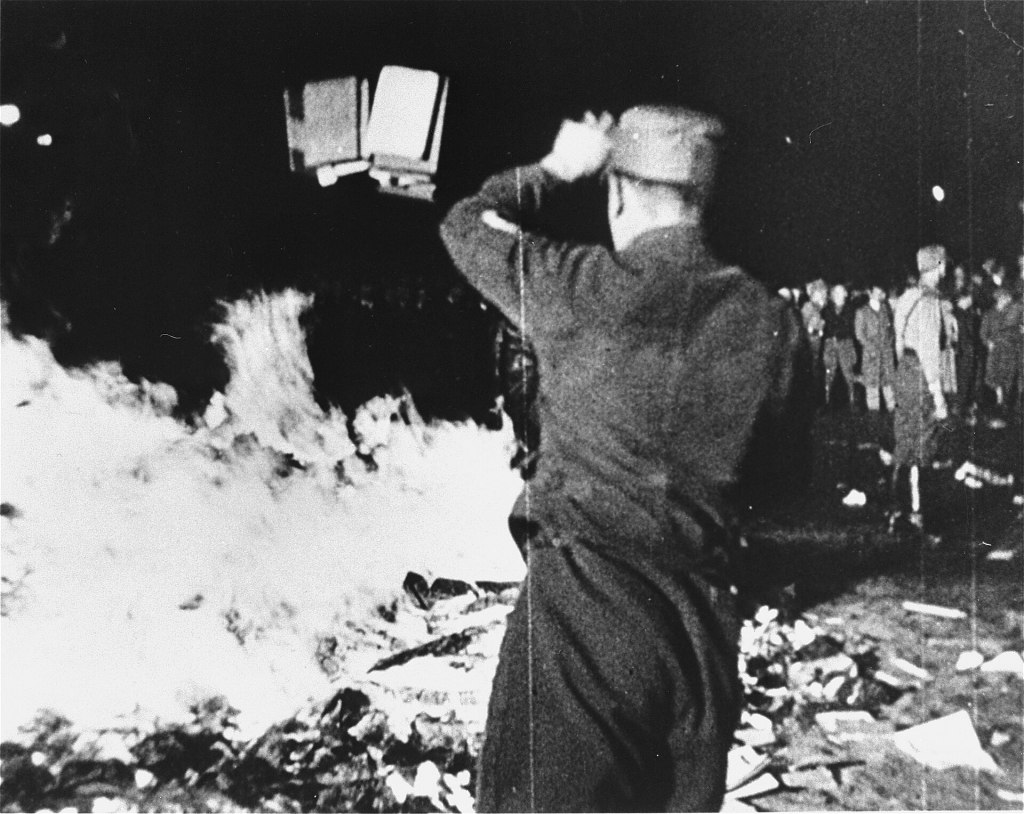
So, what constitutes the antidote? I’d point to the bleak American novel Fahrenheit 451 for a hint of a cure. At the finale, the ex-book-burner Guy Montag encounters a roaming band of people whose lives center on memorizing books. In essence, they become the books themselves.
Memorization and “rote learning” are frequently demonized in contemporary education, and with good reason. Yet imagination depends on memory; it is the storyteller’s toolkit. It’s easy to glance at cultures that still preserve memorization (for instance, Quran memorization) and label them as regressive, limiting freedom and personal expression. The truth is that we err by swinging too far in the opposite direction; without memory, we lack material on which to exercise our imagination. Committing poems and stories to memory is, ultimately, the supreme antidote to the TikTok-induced brain rot. It helps us not only absorb narratives but inhabit them.
You need to become the book.

Pilar Marrero
Political reporting is approached with a strong interest in power, institutions, and the decisions that shape public life. Coverage focuses on U.S. and international politics, with clear, readable analysis of the events that influence the global conversation. Particular attention is given to the links between local developments and worldwide political shifts.